The link is here
A Golden Rule Chief of Police by Frederik C. Howe
Article written by Frederik Howe for Everybody’s Magazine in 1910 about Cleveland Police Chief, Fred Kohler and his “Golden Rule” policy
Remix Cleveland: The Cleveland Music Sector and Its Economic Impact – Full Report (CSU 2011)
Remix Cleveland: The Cleveland Music Sector and Its Economic Impact – Full Report
Abstract
This study was commissioned by the Community Partnership for Arts and Culture (CPAC)as a starting point for gaining a deeper understanding of the different sectors of the Cleveland arts scene in Cuyahoga county. Its objective is to understand the Cleveland Music Sector, delineate its components, learn its dynamics, and assess the economic impact of music events and venues in Cuyahoga county.
Suggested Citation
Iryna Lendel, Sharon Bliss, Candice Clouse, Merissa Piazza, Ziona Austrian, Kathryn W. Hexter, Renee Constantino, and Matthew Hrubey. “Remix Cleveland: The Cleveland Music Sector and Its Economic Impact – Full Report” Urban Publications (2011).
Available at: http://works.bepress.com/sharon_bliss/21
“Carr Talk” – Charles V. Carr article
Cleveland Magazine article about Charles V. Carr. “Charlie Carr, city councilman for 30 years, got his start by promising to protect the numbers racket. The skillful, wily leader also helped make Cleveland the birthplace of the black political rights movement. “
Carr Talk
Charlie Carr, city councilman for 30 years, got his start by promising to protect the numbers racket. The skillful, wily leader also helped make Cleveland the birthplace of the black political rights movement.
One summer afternoon in 1956 or ’57, my father was totaling up the money from the day-shift waitress in the tavern he owned on Scovill Avenue. He saw my eyes grow wide at the stack of bills he was counting. Growing up, I must have seen him do it so many times before — but I was entering puberty and taking an interest in the opposite sex, so I knew I needed to dress better. Thus, my growing interest in money: There was this cool pair of Stetson shoes that I wanted to be the first in my school to own.
“Son,” my father simply said, “those folks down in Washington print way too much of this stuff for a sucker not to have a pile of it.” That was all the economic advice he ever gave me, and it proved to be all I ever needed.
Just then, his friend, attorney and business associate of sorts, Charles V. “Charlie” Carr — who also was the Ward 17 city councilman — walked up to the end of the bar, where we were standing. Overhearing our conversation, Carr reinforced the message.
“Listen to your father, young man — he’s telling you straight,” Carr said, “and don’t you ever forget this: The best thing you can do for poor people is to not be one of them.”
Then, as if to visually punctuate his comment, Carr took a large wad of cash out of his pocket and handed it to my father. “From yesterday,” he said. “Count it.”
“No need to, Charlie,” my father replied, “but what are you doing dropping off?”
“Lem had to take his mother to the doctor, but I had to come past here on my way down to City Hall anyway,” Carr said, not quite answering. “I’ll see you at the ward club meeting tonight, right?” he asked as he went out the door.
Now, I can’t say for certain, but what I’d most likely witnessed was a payout in the “digits” business, an insider’s term for the illegal lottery commonly known as the “numbers racket.” Virtually everyone in black neighborhoods “played the numbers.” Watering holes doubled as booking parlors. Operators like my father received a cut of the winnings whenever someone “hit.” And someone must have hit big. My father fanned 25 or 30 $100 bills before putting them into his safe.
At that point in his career, Carr was arguably the most politically powerful black man in Cleveland. He certainly was the most skillful and clever — if not always the most liked.
Carr had served more than 10 years on Cleveland City Council. He’d won his seat from Republican W.O. Walker, then the publisher of the Call & Post newspaper, on his third attempt in 1945. His winning campaign promise: to introduce legislation that would make it virtually impossible for the police to raid and arrest numbers operators. His argument was simple: If Catholic churches could host bingo games and casino nights, why couldn’t blacks play the numbers without fear of arrest?
There’s a saying that when a smart politician sees a parade forming, he jumps in front and starts leading. That’s exactly what Carr did in 1947. The May Co. did not hire black sales clerks, but returning black soldiers were demanding change. Picket lines formed in front of the store — black folks carrying signs that read, “Don’t Shop Where You Can’t Work.” Carr was one of the organizers, and my mother was carrying a sign.
My father was one of the dozen or so black men — bar owners, numbers runners, professional boxers — standing silently across Euclid Avenue (a few with pistols in their pockets) observing. Some brought their children along: I was 4 years old as I watched history unfold.
The white police officers glowered at the knot of black men, and the black men glowered right back. I recall Carr crossing the street to briefly huddle with the black men and then walking over and speaking with the police officers before going back to talk to the demonstrators. The term “shuttle diplomacy” had yet to be invented, but Carr had already mastered it. In short order, May Co. officials agreed to hire three black sales clerks.
The next month, I was among the first group of black kids to ride the merry-go-round at the previously segregated Euclid Beach Park. In 1946, Carr had introduced an ordinance to make it illegal for amusement park operators to discriminate. By the summer of ’47, after some protests that turned violent, that battle was also won.
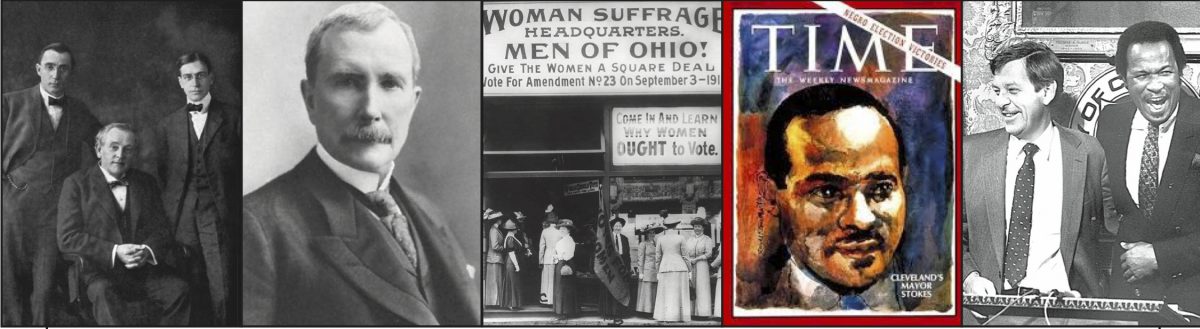
Just as Birmingham, Ala., is known as the birthplace of the black civil rights movement, Cleveland can claim to be the birthplace of the black political rights movement. That is due in large part to Carr. The proof was the 1967 election of Carl B. Stokes as the first black mayor of a major American city. Arnold Pinkney, who was Stokes’ campaign manager, says that victory would not have been possible without Carr.
“After we won, black politicians from all over the country came to Cleveland to learn how we’d pulled it off,” Pinkney says. “We’d take them to talk to Carl, and then to talk to Charlie. They’d sit at his feet, and they’d listen, and they’d learn how to win.”
Carr worked his magic by building on the tactics developed by Clevelander John O. Holly Jr., a pioneering black organizer of the ’30s and ’40s, and mixing them with strategies of Southern civil rights crusaders. He learned how to leverage the strength of the small number of black elected officials by making strategic alliances with white politicians when it suited his purpose. He knew it took money to make the political machinery work, and he was shrewd enough to raise what he needed. The backbone of all political organizations is the precinct committee members — my father was proud to be one — and Carr kept a firm grip on them via money and patronage.
However, Carr had his detractors. Businessman Fred Crosby says Carr was always the smartest man in a room — and if anyone forgot that fact, Carr didn’t mind reminding them. Although he only stood about 5-foot-7 and was slight of build, Carr dominated any gathering.
“If you got into a business deal with Charlie,” Crosby adds, “you just might come out OK — but it was guaranteed that Charlie was going to come out OK. Whatever it took to win, he’d do it. I never recall him losing.”
However, in 1975, Carr (then the longest-serving member of City Council, which made him the “dean”) finally did lose — to the young firebrand Lonnie Burten. Carr was 72, not in the best of health, and took Burten for granted. While Carr was the master of finesse, Burten was riding the crest of the black power movement. The brash loud-talker organized college students to help him trounce Carr.
Even afterward, Carr mentored up-and-coming black politicians. After one of then-council president George Forbes’ legendary displays of temper, Carr called him with some simple advice: “George, quit pissing on every goddamn fireplug you come to.” Forbes says that one comment taught him how to pick his battles.
Upon Carr’s death in 1987, Carl Stokes paid him the ultimate tribute. “Whatever the problem was, he would try to make the opposing parties see there was something in the solution of the problem that each one could find a benefit [from],” the former mayor said. “That is the basic fundamental science of politics: compromise. He was the master, and I learned so much from him.”
Today’s leaders could learn from Carr’s legacy, too. This past spring, when Jerry McFaul was forced out as sheriff, the 1,600 Democratic precinct committee members in Cuyahoga County had the duty to meet and select a replacement. Two eminently qualified men, Bob Reid, the city manager and former police chief of Bedford (who happens to be white), and Clayton Harris, the chief of the Tri-C police department (who happens to be black), squared off for the job. When Reid won, complaints were heard throughout the black community. Yet fewer than 500 party members had voted — and the turnout of black precinct committee members was especially low.
Charlie Carr would have gotten them to show up and vote.
Yet Still We Rise: African American Art in Cleveland 1920-1970
Catalog from exhibit that appeared at Cleveland State during March and and April 1996.
The Correspondence of George A. Myers and James Ford Rhodes, 1910-1923
Article from The Ohio Historical Society
Mayor Tom’s Successor, The World’s Work Magazine, 1914
Article about Newton D. Baker in 1914 in magazine called The Worlds Work. Before Baker was Secretary of War, he was mayor of Cleveland and the favored advisor of Tom L. Johnson. This article also explains Baker’s concept of “civitism”
University Circle From Fresh Water Cleveland
Section on University Circle from Fresh Water Cleveland
A Century of Planning
Online exhibit catalog from CSU reflecting “the evolution of city planning in Cleveland for over a century”
Hough: Building and Tension by Luke Ondish
From CWRU
http://www.case.edu/artsci/sixties/luke.html
Hough: Building and Tension
by Luke Ondish
Hough was annexed by the city of Cleveland in 1872. It is 2 square miles in area bounded by Euclid and Superior on its North and South sides and E 55th and E 105th on its West and East Sides. The summer of 1966 would see Hough in flames. Arson and looting were rampant, a martial law imposed by mobs walking the streets. Those that sought to escape the danger of the riots could count on no protection while policemen would seem to attack at random. The four day race riot would cost the city millions of dollars in damage and several lives. Though in 1950 Hough was still a predominately white middle class neighborhood, by 1960 the story was very different1. It used to be a fashionable neighborhood, known for its large single-family homes, wherein its residents lived comfortably. The streets were busy, but pleasantly so; it was not the overcrowded, deteriorated neighborhood that would eventually exploded into violence.
The neighborhood would become overcrowded. The community would become divided. Eventually, it would not be able to support itself, and it would break. The economic, political, and social, and geographic factors responsible for Hough’s decline, irritated by a lapsing post-war economy give rise to a cyclical dynamic taking the neighborhood on a downward spiral. The combination of deterioration and division in the community would irritate each other until Hough could take no more.
After the stock market crash of 1929, Cleveland was subject to the same destitution as other cities across the nation. Also like other cities, it rebounded in the war time economy of World War II. The city’s factories produced planes, tanks, artillery, bombs, binoculars, and telescopes for the war effort. The city enjoyed a stable industrial base as a producer of machine tools, electrical goods, and metal products. It had a large supply of trained workers, low-cost power and water, and was located within 500 miles of half the population of the United States.
Cleveland’s war time population swelled with ranks of Appalachian whites and southern blacks traveling to the city for work in the factories. Homes that once housed single families were made to accommodate several, beginning the pattern of overuse and overcrowding. The problem would worsen when the factories would close and returning servicemen would be eager to start families. Many families were forced to move where housing was cheapest2.
The once owner-occupied buildings in Hough were bought up by outsiders as the former owners passed away. Living away from the community, the new owners would have less incentive to fix them and make them more livable. The housing grew old and suffered a lack of maintenance. Many tenants could ill afford to move out of dilapidated housing. Often several families had to share converted single-family dwellings. These factors thus enacted a sort of skimming off the top of the economic ladder. Those that could afford to do so moved to better kept areas. With Hough’s population having less money, the tax based was significantly reduced. The area could not afford to shift its course, and by 1960 was in need of reform3.
Geographically, Hough was disadvantaged. Hough Street, the area’s main artery for traffic, was constantly congested. Lake shore traffic would find its way in along Crawford Avenue, which intersected Hough Street. Busy streets in themselves are not inherently bad for neighborhoods, but Hough ran right through the middle of the most concentrated residential districts. It is common that main arteries form boundaries. Cutting the districts in half like this greatly diminished the sense of unity felt by residents of the districts. This made communities much harder to mobilize for their common interests4.
With very little land left undeveloped, overcrowding in Hough’s residential buildings had little hope of relief by expansion. Industry was also impeded from growth because of this. When new space was required, industry had to settle where it could. Many small outcroppings of industry were scattered along and among residential districts. Such settlements would bring more traffic to neighborhoods, as well as noise, fumes, and dust. This contributed to the deterioration of living conditions5.
Hough has a favorable location within the city. It is twenty minutes by bus from the heart of Cleveland’s business and industrial district, ten minutes from what then was Western Reserve and Case Universities as well as surrounding museums, and fifteen minutes from Lake Erie. It was the organization and layout within the neighborhood that was problematic. Without and official local government, matters had to be seen to by local community leaders. With the diminished sense of community due to the splitting of the residential districts, motivation for projects was lacking6. Thus, the first cyclical dynamic is revealed.
Hough was also reflecting a need economically. Unemployment was high and 30% of heads of households were not employed. The rate of unskilled non-white heads of households was 16.7, while the rate for whites was 4.2. One third of the unemployed population was concentrated in the southeast corner7. Along with the fact that 60% of the residents in the northwest and southeast parts of Hough were white while the area from the southwest to northeast is over 60% non-white, there is evidence for further division in the community8. The different racial categories live apart from each other and in different economic conditions, the former reinforcing the alienation that can be felt from the latter.
The percentage of semi-skilled and unskilled workers in two tracts (L-3 and L-4) adjacent to each other out of the ten census tracts comprising Hough was 69.2. Tracts R-6 and R-9 had a rate of 51.8%. L-2 and L-4 have high rates of unemployment. These tracts are the most densely populated. This suggests a wide range of lifestyles within areas of concentrated population and groups of occupation types. This is a factor than can create dissonance in a community and make it harder to come together to realize goals.
The rate of self employed males in 1950 was five percent. By the late 50s, it had dropped to 1.5. This is evidence that the economy could not support as many businesses, and those that would otherwise start their own business were forced to work for a larger operation. This severity of this figure is greater when it is considered that the population during that time also grew by 10 percent. Even though the population grew, the economy was shrinking, stretching the financial resources of Hough very thin.
Not only did different races have large percents with different types of jobs, but large percents of each race’s constituents worked in different areas. Most of the working population of Hough worked on the East side of Cleveland. However, the difference in the amount of white and non-white heads of household that work in East Cleveland was statistically significant. Seventy Seven percet of non-white heads of household held jobs there compared to the 82.7% of white heads of household9. The authority figures of the homes, those that would be most influential in how other members (especially children) view others, have fewer opportunities to interact with each other. This loss limits the ability of persons from different backgrounds to combat the barriers that make relating to each other more difficult to begin with, constituting another fragmenting cycle.
The division between communities was strong was considering social and cultural factors. Two determining factors of differing social classes are occupation and education of populations. The difference in types of occupations held by persons in different areas was significant. In areas of concentrated white populations the rate of employed persons in sales, clerical, professional and managerial positions was 36.6. In areas of concentrated non-white populations the figure was 19.3%.
Irritating the division amongst communities in post-war industrial cities is an alienation felt towards the rest of the county. An attitude of “we helped you in war, now where are you when we need help?” proliferates. This attitude gives populations an insular mindset. They believe that their possible reality consists only of the deterioration surrounding them, and no one is interested in their well being any longer.
The rate of persons over the age of 25 having some college education was 21.3% in white areas, while the average figure for all of the tracts in Hough was just over 10. There is a significant statistical difference between the education level and occupation type of whites and non-whites. This shows that social class was likely to be divided along racial line. Because of this the difference would feel more distinct, and the boundaries more daunting to breach10.
A substantial factor in the drawing of social and cultural boundaries are the rates of involvement and apparent investment in the community. It was found that non-whites have a much higher rate of membership to local organizations. This could mean a group connected to the church, a fraternal organization, or what is predominant, a labor union.11
On average, whites were much more likely to have plans to move. The most extreme example of this is the tract L-4, from which 61.1% of whites as opposed to 16.2% of non-whites had plans to move. It was also recorded that non-whites were twice as likely as whites to buy a house.
Another factor which correlates with investment in a community is relatives that also inhabit the area. The percentage of whites with relatives living in Hough was 38.2. The percentage of non-whites who shared the area with relatives was 60.5. A larger percentage of white persons had relatives outside of Hough than non-whites. Many more whites than non-whites also had no relatives in Cleveland.12
In 1960, half of the population of the Hough was no longer there13. Ninety percent of the non-whites had lived there for five or less years, while roughly 60% of whites had lived there for as long. With a great bulk of the population having spent less than five years in the area, very few families were likely to have any kind of history with Hough14. Less familiarity leaves more room for apathy of citizens for a community, which would decrease investment in the communities. Further evidence of a lack investment in communities is the frequent withdrawal from and enrollment in new schools of high school age students.
At the start of the 1960s, Addison Junior High School faced a major concern in locating and counseling in-migrant students (a term whose definition subsumes any student who moved into the school system 2 or less years ago) to help them adapt to the new environment. With most students possessing an average of a third grade reading level, students needed all of the attention that could possibly be given to them. This was very difficult to accommodate due to the unstable conditions in which the students lived at home in areas of high crime and divorce rates. Addison was fed by the area making up Police Zone 531, recognized as leading the city of Cleveland in terms of crime rate, and murder rate specifically15.
When polled about how they felt toward their neighborhood, 62% of non-whites said they thought Hough was a good place to raise children. Only 27% of whites agreed. Roughly a quarter of these dissenters cited “poor race situation” as their reason, in reference to the disproportionate amount of non-white residents. The boundary implied here is also reflected in the fact that a greater portion of non-whites allow their children to play outside of the home than whites.
Along more cultural lines, there was also a religious boundary. The majority of whites were Catholic, while the majority of non-whites were Baptists. It is likely that this difference was accounted for mostly by the fact that most new non-white families(and most non-white were new) had moved up from the southern parts of the country. These families came to Cleveland hoping to leave behind the South’s caste system-like conventions for a better chance at a better job. However most were quick to realize that northern whites frequently held the same perceptions of caste.16
Leisure time that was not given to local organizations was frequently conducive to solitariness, at least between small areas if not families or even individuals. The three most common leisure time activities were watching television, reading, and fixing up the house. Over three quarters of the population was recorded in a census as watching television every day.17
Politically, Hough also finds itself in a difficult place. Hough itself does not have a local government. The name is used to refer to a collection of neighborhoods rather than any political unit. Therefore it must rely on larger city government if it hopes for political recourse. Many blacks already had this predilection toward larger government because benefits that could be sought if income was low were issued by federal government.
This dynamic situated blacks to swim against a political current. Many government officials tended to see a mass appeal to government for economic support as evocative of federalized health care programs common to socialism and the sort of big statism that would become highly stigmatized as the decade progressed. The Cold War sentiments afloat in the government served as an unfortunate and detrimental context in which to seek political recourse. A further impediment was that in the elections immediately preceding the 1960s, blacks had voted against giving more power to the city government that could help them. Many feared the dilution of power that could be gained by the formation of smaller organizations within the community.
Ralph Besse, owner of the Cleveland Electric Illuminating Company, was a businessman and philanthropy advocate that helped organizations such as the United Freedom Movement and the Citizens United for Adequate Welfare with ideas for the community. In a speech given to the Rotary Club of Cleveland, Besse showed great insight into the city’s political climate. He would say that blacks deserved to be free from discrimination, and most white business would admit to this. It was evident, however, that whites had great difficulty overcoming prejudices because many would wait until a situation became bad enough that self interest and practical rather than moral concerns would motivate them to promote change. Even then, the change pushed for was limited and gradual.
The Greater Cleveland Association Foundation would pay heed to Besse’s words. They attempted to seek recourse through philanthropy but found difficulty communicating with the black community. Cleveland Metropolitan Services was commissioned to perform a study of the black community. The study, however, failed to touch on issues of great concern such as housing. The lack of communication is probably due to the fact that blacks were failed to be invited to the initial meetings of the study. Yet another inefficiency of the GACF was evidenced by sentiments expressed by several members at a meeting. This is best represented by a statement one was quoted giving: “these trustees of Cleveland Foundation funds and these advisors always worry about what some dead man wanted us to do with his money.”18
The political sphere faces difficulty in providing neighborhoods with needed funding. This only adds to the disillusion of these neighborhoods’ residents, cementing their mentalities in modes of division and helplessness. On July 18th of 1966 the tension in Hough became too great and race riots broke out. The incident that sparked the riot was a dispute in which a white worker refused to serve a black patron a glass of water at a café along Hough Street. An argument ensued and before long escalated to the point where police could not prevent conflict. Rock throwing, looting, vandalism and arson spread throughout the Hough area, and repeated the following evening. On the evening of the 20th, the National Guard was called in to quell the violence. By the time the riots were completely subdued on the 25th, 4 people had been killed, approximately 30 had been injured and 300 arrested after over 240 fires had been reported.19
Notes
1 “Hough” Encyclopedia of Cleveland History CWRU. 20 Nov. 2005 <http://ech.cwru.edu/ech-cgi/article.pl?id=H6>.
2 Keating, W. D., Norman Krumholz, and David C. Perry, Cleveland: A Metropolitan Reader Kent, Ohio: Kent State UP, 1995, 32
3 Sussman, Marvin B., and R. C. White, Hough, Cleveland, Ohio: A Study of Social Life and Change Cleveland, Ohio: The Press of Western Reserve University, 1959, 14-17.
4 6″Summary of the Preliminary Plan for the Hough Community” Cleveland, Ohio: City Planing Commission, 1957, 2.
5 “Summary of the Preliminary Plan for the Hough Community” Cleveland, Ohio: City Planing Commission, 1957, 5.
6 Sussman, Marvin B., and R. C. White, Hough, Cleveland, Ohio: A Study of Social Life and Change Cleveland, Ohio: The Press of Western Reserve University, 1959, 42.
7 Sussman, Marvin B., and R. C. White, Hough, Cleveland, Ohio: A Study of Social Life and Change Cleveland, Ohio: The Press of Western Reserve University, 1959, 41.
8 Sussman, Marvin B., and R. C. White, Hough, Cleveland, Ohio: A Study of Social Life and Change Cleveland, Ohio: The Press of Western Reserve University, 1959, 13.
9 Sussman, Marvin B., and R. C. White, Hough, Cleveland, Ohio: A Study of Social Life and Change Cleveland, Ohio: The Press of Western Reserve University, 1959, 42-43.
10 Sussman, Marvin B., and R. C. White, Hough, Cleveland, Ohio: A Study of Social Life and Change Cleveland, Ohio: The Press of Western Reserve University, 1959, 35-36.
11 Sussman, Marvin B., and R. C. White, Hough, Cleveland, Ohio: A Study of Social Life and Change Cleveland, Ohio: The Press of Western Reserve University, 1959, 59.
12 Sussman, Marvin B., and R. C. White, Hough, Cleveland, Ohio: A Study of Social Life and Change Cleveland, Ohio: The Press of Western Reserve University, 1959, 9-10.
13 “Hough” Encyclopedia of Cleveland History CWRU. 20 Nov. 2005 <http://ech.cwru.edu/ech-cgi/article.pl?id=H6>.
14 Sussman, Marvin B., and R. C. White, Hough, Cleveland, Ohio: A Study of Social Life and Change Cleveland, Ohio: The Press of Western Reserve University, 1959, 9-10.
15 “Great Cities – Grey Areas Program” Cleveland, Ohio: Hough Community Project, 1960, 3-4.
16 Sussman, Marvin B., and R. C. White, Hough, Cleveland, Ohio: A Study of Social Life and Change Cleveland, Ohio: The Press of Western Reserve University, 1959, 29.
17 Sussman, Marvin B., and R. C. White, Hough, Cleveland, Ohio: A Study of Social Life and Change Cleveland, Ohio: The Press of Western Reserve University, 1959, 64.
18 Rose, Kenneth W., The Politics of Social Reform in Cleveland, 1945-1967 : Civil Rights, Welfare Rights, and the Response of Civic Leaders Cleveland, Ohio: The Press of Case Western Reserve University, 1988, 226-32.
19 “The Hough Riots” Encyclopedia of Cleveland History CWRU 20 Nov. 2005 <http://ech.cwru.edu/ech-cgi/article.pl?id=HR3>.