Courtesy of the Plain Dealer, a year-by-year timeline of the 20th century
1900 restrospective (pdf)
www.teachingcleveland.org
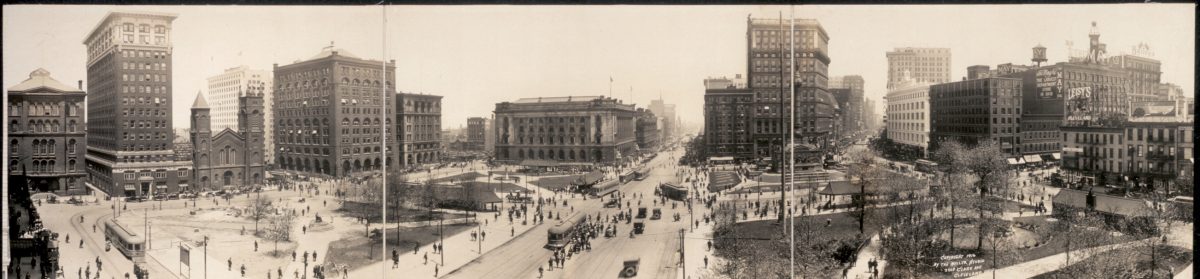
Courtesy of the Plain Dealer, a year-by-year timeline of the 20th century
1900 restrospective (pdf)
Terrific overview of the life of Henry Flagler from the American Enterprise Institutue
| The American
John D. Rockefeller could not have built his empire without one of America’s greatest entrepreneurs, Henry Flagler.
In all of American industrial history, perhaps only Henry Ford is more closely identified with the company he founded than is John D. Rockefeller.
In the 1860s, Rockefeller was just one of many entrepreneurs seeking to exploit the possibilities opened up by the brand-new technology of drilling for oil. No one outside the aborning industry had ever heard of him. But by 1880, Rockefeller’s Standard Oil controlled 80 percent of the by-then vastly larger American oil refining business. In 1902 Ida Tarbell began serializing “The History of the Standard Oil Company” in McClure’s Magazine. She very deliberately made Rockefeller the personification of the company. The book, published in 1904, was a phenomenal best seller and, while highly tendentious, extremely influential.
By the time Standard Oil was ordered broken up by the Supreme Court in 1911, to most people, Standard Oil and John D. Rockefeller were one and the same. And by that time, of course, Rockefeller was the richest man in the world, with a net worth that exceeded the U.S. national debt.
But Standard Oil was never a one-man operation even in its earliest days. Soon after entering the oil business fulltime, Rockefeller had taken on as partner an Englishman named Samuel Andrews. A gifted chemist and mechanic, Andrews made numerous important improvements in refining methods. If the Rockefeller refineries were more efficient than others, Samuel Andrews was the reason.
Later, Standard Oil often acquired other refineries and, if it was interested in bringing the management into the Standard Oil operation, would offer them a very good deal. Such major figures in Standard Oil history as Charles Pratt, Henry H. Rogers, and John D. Archbold joined the company in this way.
But there was a figure far more important to the history of Standard Oil than Andrews, who took no part in the management of the enterprise, or the later major figures who managed it superbly. This was Henry M. Flagler.
Rockefeller and Flagler were so close in the early days that they functioned virtually as a single entity as they designed and executed the strategy that allowed Standard Oil to dominate the oil industry. Astonishingly, Flagler would go on to a second triumph on his own, turning the state of Florida from a subtropical wilderness into a tourist mecca and agricultural powerhouse. Few entrepreneurs in the history of capitalism accomplished as much as Henry Flagler.
How important to the story of Standard Oil is he? Well, consider this. In later years, a reporter asked John D. Rockefeller whose idea it had been to transform the partnership of Rockefeller, Andrews, and Flagler into the corporation called Standard Oil.
“I wish I’d had the brains to think of it,” Rockefeller replied. “It was Henry M. Flagler.”
Like Rockefeller, Flagler was born in upstate New York, just as the new Erie Canal was transforming what had been a semi-frontier into an area of quickly growing prosperity. Nine years older than Rockefeller, Flagler was born in 1830. His father was an itinerant Presbyterian minister who spent his whole life on the edge of poverty. In an age when early death was still common, both of his parents had been married twice before and, indeed, Flagler had been named for his mother’s first husband, Henry Morrison. She had had a son, Daniel Harkness, by her second husband, eight years older than Henry. Flagler’s father had had two daughters by his first wife and one by his second.
After completing the eighth grade, a fairly good education by the standards of the mid-19th century, Flagler decided to leave home and seek his fortune in Ohio, where his half-brother Dan was living with his Harkness relatives. He walked the nine miles to the Erie Canal and caught a freight boat, working with the crew in lieu of paying a fare. He took a boat from Buffalo to Sandusky, Ohio, and walked the 30 miles to the town of Republic, where Dan was living. He arrived with only a carpet bag of clothes, nine cents, and a French five-franc piece that he would keep the rest of his life.
Asked whose idea it had been to transform the partnership into the corporation called Standard Oil, John D. Rockefeller said, ‘I wish I’d had the brains to think of it. It was Henry M. Flagler.’
Flagler quickly got a job in a store owned by Daniel’s uncle, Lamon Harkness, earning five dollars a month plus room and board. He soon showed a gift for salesmanship and for making friends. By the time he was 19, Flagler was working for Chapman and Harkness, which owned the store he had started in, and earning $400 a year in salary. Chapman and Harkness, besides owning a chain of retail stores, was also involved in the wholesale grain and liquor business. Ohio was then the center of the American grain belt, and Flagler quickly mastered the business and was made a partner in the firm.
In 1853 he married Lamon Harkness’s daughter Mary. Together they made an impressive couple. Although in frail health, Mary had a dark-haired, dark-eyed beauty. He was tall, strikingly handsome, and with eyes the rarest of colors, a deep lavender blue.
The early 1850s were a very prosperous time in the United States, thanks in part to the California gold strike, and Flagler flourished. His network of connections in the wholesale grain business expanded rapidly. One of the most important of these was Stephen V. Harkness, Mary’s first cousin (and his half-brother Dan’s older half-brother).
By the beginning of the Civil War, Flagler, still only 31, had two daughters, a large, comfortable house in Bellevue, Ohio, and about $50,000 in capital, a moderate fortune by the standards of the mid-19th century. But he was getting bored with the wholesale grain and liquor trade, which was a mature business, routine and unexciting. Flagler would always be happiest creating a new business, not merely running a successful one.
The war, with its wholly unprecedented demands for materiel and equipment, produced an enormous boom. And the army’s need for salt to preserve food caused demand for that commodity to soar. Salt mines had recently been discovered near Saginaw, Michigan, and the state encouraged their development by making them tax free and offering a bounty of 10 cents a bushel.
Flagler and his brother-in-law, Barney York, invested $50,000 each in a salt property and moved to Saginaw. Competition was intense and they had to learn the salt business from scratch. They made money while the war was on, but with its end, the boom in salt ended too. Flagler’s company went broke and he ended up being $50,000 in the hole, a sum he had to borrow from his father-in-law. He moved back to Bellevue, but instead of living in a large house, he and his family rented rooms in a boarding house.
Flagler soon went to Cleveland and got a job as a grain commission merchant with the firm of Maurice Clark (a former partner of John D. Rockefeller), with which he had dealt before the war. Unlike the salt business, Flagler knew the grain business backwards and forwards and with his gifts as a salesman was soon prospering once again. He paid back his father-in-law and moved his family to Cleveland. Before long he was living on Euclid Avenue, Cleveland’s most fashionable street, near Rockefeller’s house, and the two would often walk to and from work together, discussing the grain and oil businesses.
Edwin Drake had successfully drilled for oil in northwest Pennsylvania in 1859, showing that a substance that had previously been skimmed from ponds and brooks and used for patent medicine could be obtained in huge amounts. This made possible oil’s use as a cheap lubricant and, distilled into kerosene, as fuel for lamps, replacing ever more expensive whale oil. By the end of the Civil War, Rockefeller and Samuel Andrews were running the largest and most profitable oil refining business in Cleveland.
Rockefeller, expanding relentlessly, needed more capital and he approached Stephen Harkness, by this time one of the richest men in Ohio. Harkness was happy to invest $100,000 but wanted someone in the firm he could rely on to watch his interests. So he asked Rockefeller to take on Henry Flagler as a partner. Rockefeller was more than happy to do so, and in fact had already asked Flagler to join the firm, renamed Rockefeller, Andrews, and Flagler.
Rockefeller and Flagler were so close that they functioned virtually as a single entity as they designed and executed the strategy that allowed Standard Oil to dominate the oil industry.
Soon the two were sharing an office, their desks facing each other, as intimate as any two business partners have ever been. Besides discussing everything as they walked to and from their houses on Euclid Avenue, they would routinely pass drafts of documents back and forth between them until each was satisfied.
Rockefeller noted that Flagler had a remarkable ability to express clearly the intent of a document and the obligations of both sides in a contract. “Some lawyers,” Rockefeller wrote, “might sit at his feet and learn things about drawing contracts good for them to know.”
Besides being close partners, they also became intimate friends. “It was,” wrote Rockefeller years later, “a friendship founded on business, which Mr. Flagler used to say was a good deal better than a business founded on friendship.”
The oil business was nothing if not volatile in its first ten years. Northwest Pennsylvania, the only oil field in the world until the 1880s, was a wild and lawless place, much as the California gold fields had been in the 1850s. Worse from the standpoint of Rockefeller and his new partner, the price of oil fluctuated wildly, reaching as low in the 1860s as 10 cents a barrel and reaching as high as $13.25, as annual production rose from 2,000 barrels in 1859 to 4,250,000 in 1869.
Meanwhile, oil refining was a deeply fragmented business. Cleveland alone had more than 30 refineries. Most of these were ramshackle affairs. Many people were unwilling to invest more capital in the oil business than absolutely necessary, afraid that the oil would cease to flow in Pennsylvania and they would be out of luck.
Rockefeller was a superb supervisor of operations, with a keen eye for waste and inefficiency. As his biographer Ron Chernow notes, he anticipated in many ways the famous efficiency studies of Frederick Winslow Taylor. He would keep a red notebook with him at all times, and his managers soon learned to dread when he pulled it out and jotted down ideas that they would have to follow up on.
In one case he was inspecting a plant in New York City that manufactured five-gallon cans of kerosene for export to Europe. He noted that the can lids were applied with 40 drops of solder and asked the manager if he had ever tried using only 38. A small percentage of cans leaked with 38 drops, but none did with 39, which became the new standard. Rockefeller noted that that one drop per can saved the plant $2,500 the first year. Applied throughout the Standard Oil empire over the years, it saved, as Rockefeller noted happily, “many hundreds of thousands of dollars.”
If Rockefeller always paid close attention to the nuts and bolts, Flagler was more of a big-picture man. He made four fundamental contributions to the strategy that turned the Cleveland partnership of Rockefeller, Andrews, and Flagler into the globe-girdling Standard Oil Corporation.
First, as we have seen, it was Flagler who convinced Rockefeller to incorporate and, indeed, he who wrote the act of incorporation despite not even being a lawyer. Being incorporated made it much easier to finance expansion without losing control of the company. The company was, at first, capitalized at $1 million, with 10,000 shares, each with a par value of $100. Rockefeller received 2,667 shares, Flagler and Andrews 1,333 each. The rest were held by Stephen Harkness, William Rockefeller (John’s younger brother), and a new investor named Oliver B. Jennings, who was William Rockefeller’s brother-in-law. The old partnership of Rockefeller, Andrews, and Flagler retained 1,000 shares.
To ensure that the interests of the stockholders would always be paramount, none of the stockholders in the company management received a salary, only the dividends from the stock. This, as it turned out, was not much of a sacrifice. In the first year, Standard Oil paid out $105 per share in dividends.
It would not be an exaggeration to say that no individual ever had as much influence on the history of a single state as Flagler had on Florida.
Second, Flagler, unlike the owners of Standard Oil’s competitors, insisted on building only state-of-the-art refineries. This was a brave financial decision but it made them the low-cost producers with all the advantages of that position.
Third, Flagler convinced Rockefeller, who needed very little convincing, to aggressively buy up their smaller competitors. This would give them increased market influence over the volatile price of oil and control of the Cleveland oil market. He devised a formula to arrive at a fair evaluation of their worth.
Fourth, Flagler realized that there was no controlling the price of crude oil, which then, just as now, fluctuated over a broad range. Demand tended to rise steadily, but supply rose in fits and starts. The reason is simple enough. Drilling for oil and exploring for new fields are always a very expensive gamble, with many dry holes. So drilling and exploration increase only when prices are high (as they are now: every offshore drilling rig in existence is engaged in exploration). But this causes the new wells and new fields to come on line in a rush, knocking the price back down as supply suddenly increases dramatically. This was as true in 1870, when the world’s annual production was less than five million barrels, as it is today, with annual production reaching 30 billion barrels.
But the price of transportation, Flagler knew, could be controlled or at least influenced, and transportation was the largest cost component of a barrel of refined oil, after the crude itself. Here Cleveland refiners had a distinct advantage over their rivals in Pittsburgh, the other center of oil refining. For while Pittsburgh was considerably closer to the oil fields, it was served only by the mighty Pennsylvania Railroad, which had no hesitation whatever to use its transportation monopoly to extract high prices. Cleveland was served not only by the Pennsylvania but also by the Erie and the Lake Shore railroads, the latter controlled by Commodore Vanderbilt’s New York Central after 1869. And Cleveland refineries in the summer months could also ship oil by boat through the Erie Canal to New York.
Flagler and Rockefeller would play the railroads like a fiddle. They not only negotiated secret rebates for their own shipments, but also were able to extract a rebate on the shipments of other refiners. In effect, their competitors, unknowingly, were paying a tax to Standard Oil in order to ship their own products.
(None of this, of course, was illegal in any way at the time. In the post–Civil War era, the United States was rapidly evolving from an economy based on agriculture and small, largely family-held enterprises to a modern industrial state with corporations employing tens of thousands. It had not yet learned what rules were necessary in the new economic conditions to assure a stable, competitive marketplace. Indeed, it can be argued that the capitalists of that era helped mightily to show what rules were needed.)
This gave Rockefeller and Flagler a formidable advantage in seeking to become the dominant company in the oil refining business. Using Flagler’s formula, they would make an offer to a rival they wanted to acquire and the rival had, in effect, three choices. It could accept the offer and take cash, accept it and take Standard Oil stock, or face ruin because of high transportation costs.
Flagler and Rockefeller always paid a fair price—or at least what they thought was a fair price. And as the great historian Allen Nevins pointed out in his book on Rockefeller, the prices that Standard Oil paid to acquire its monopoly in the 1870s and ’80s were often more generous than were the prices the Roosevelt administration paid to assemble the monopoly called the Tennessee Valley Authority in the 1930s. And, of course, those who chose to take Standard Oil stock had no complaints whatever.
As Standard expanded exponentially it found itself facing ever more of a problem with Ohio’s state incorporation law. As in all other states at that time, the law forbade corporations from owning stock in another company or property in another state. Those restrictions had not been much of a problem when the laws had been originally passed in the early and mid-19th century. But as railroads and then the telegraph increasingly unified the United States into a gigantic common market, and companies grew to supply this new, national market, these laws less and less reflected economic reality.
As electricity began to displace kerosene for lighting, Flagler pushed for Standard Oil to begin aggressively marketing gasoline as a fuel for automobiles.
Standard Oil soon had subsidiaries all over the country and, in order to comply with the law, Flagler, as secretary of the corporation, would name himself trustee to hold the stock of the subsidiaries for the benefit of the stockholders of Standard Oil. But by the end of the 1870s, there were many people acting as trustees for subsidiaries and this became increasingly unwieldy.
Again it was Flagler who, in all likelihood, found the solution. Instead of each subsidiary having its own trustee, with these trustees scattered through the ever-expanding Standard Oil empire, in 1879 three men whom today we would call “middle managers” were appointed trustees for all the subsidiaries. In theory, these three controlled all Standard Oil property outside of Ohio. In fact, of course, they did exactly what they were told. This was the beginning of the trust form of organization, a term that has echoed down American economic history ever since.
In 1882, a very talented lawyer named Samuel C. T. Dodd refined the system. He and Flagler drafted a new Standard Oil trust agreement that set up separate corporations in each state with major properties belonging to Standard Oil. Each had its own board of directors, but the stock of the various corporations was all in the hands of the trustees, who issued “certificates of interest” to the stockholders of Standard Oil of Ohio so that they would receive the dividends.
In 1892, the Ohio Supreme Court ruled that the trust was contrary to Ohio law and had to be dissolved. But in 1889, New Jersey had passed the first modern incorporation law, allowing corporations to hold stock in other corporations and property wherever located. So when a reporter asked Dodd about the decision, he replied, “The only effect will be to inconvenience us a little.” Standard Oil (New Jersey) simply took over as the dominant corporation in the Standard Oil empire, and Standard Oil’s grip on the oil industry was in no way disrupted.
As other states began to adopt the New Jersey model for incorporation law, the need for a trust form of organization for multistate companies faded. Indeed it lasted little more than ten years. So-called antitrust laws, however, are very much with us still, although they are much less used today as an instrument of government policy than earlier.
By 1892, both Flagler and Rockefeller were becoming much less involved in the day-to-day operations of the company they had created and guided to greatness, although Flagler would later make one more major contribution to the company. As electricity began to displace kerosene for lighting, Flagler pushed for Standard Oil to aggressively market gasoline as a fuel for the new automobiles that were increasingly seen on American streets and highways. Demand for gasoline soon came to dwarf the demand for kerosene. Rockefeller would increasingly devote much of the rest of his very long life (he lived to be 97) to his vast eleemosynary activities that would associate the Rockefeller name as much with good works as it had been associated with wealth and aggressive business practices.
Flagler took a different approach. He was a private man with no interest in having his name publicly associated with good works. But he was also a very generous man. When many Florida farmers were threatened with disaster after a severe freeze, Flagler wrote to a local minister and told him, “Find any and every case of real need where a chance to start again will be appreciated and see that they have that chance. The only condition I impose is that they do not know the gift comes from Henry M. Flagler.”
Always bored with routine management and now rich beyond counting, with millions more pouring into his coffers every year, Flagler decided to conquer a new world, the state of Florida, then largely uninhabited south of Jacksonville.
Flagler’s wife had been an invalid for most of her marriage, having contracted tuberculosis. In 1879, Flagler had taken her to Jacksonville for the winter but there was little to do in the town of only 7,000 people. And except for Jacksonville and Key West, there were no towns of any size in all of peninsular Florida, which was mostly swamp, scrub, and saw–grass marsh.
Flagler was a private man with no interest in having his name associated with good works. But he was also a very generous man.
Flagler couldn’t take the boredom and returned to New York, where he was by then living, after Standard Oil moved its headquarters there in 1878. He urged Mary to stay, but she refused to be alone. Within a year or two she was too weak to travel and died, aged only 47, in May 1881. Flagler felt terribly guilty, thinking he had sacrificed Mary on the altar of Standard Oil. Undoubtedly she would have died no matter how much personal attention he paid her.
It is possible that the guilt he felt over Mary’s death sparked his interest in Florida. If only the state had had more to offer by way of amusements, he may have thought, she would have been willing to stay there. In the winter of 1882–83 Flagler was hospitalized with a liver ailment and he read a great deal about Florida. He learned that the state was selling land cheaply in order to stimulate the economy. A Philadelphian had recently purchased 4 million acres (an area considerably larger than Connecticut) for only $1 million and was planning to drain it and plant sugarcane, fruits, and vegetables. Railroad mileage was rapidly increasing. A small but elegant hotel had been built in St. Augustine to cater to well-heeled vacationers.
Flagler sensed a waking giant. He decided to build a luxury hotel in St. Augustine with 540 rooms. As always, he built the best, hiring the architectural firm of Carrère and Hastings, which would later build the New York Public Library. The hotel was an immediate success, although it took a while to become profitable.
Flagler had recognized the importance of transportation to the oil business and now recognized its importance to the development of Florida. He purchased a small narrow-gauge railroad that ran between Jacksonville and St. Augustine, converted it to the standard gauge, and built a bridge over the St. Johns River to connect it to railroads further north.
He began extending his railroad southwards and soon reached as far as Daytona. As he entered a new area Flagler would build or rebuild hotels and other tourist facilities. By 1890 it was possible to board a Pullman car in New York and get to Daytona in just 36 hours. Florida, a semitropical jungle ten years earlier, was now the country’s leading winter resort.
The following year, Flagler, now 61, conceived the idea of extending his railroad not only to south Florida but all the way to Key West, then still the state’s largest city. Building a railroad across 150 miles of open ocean would rove one of the great engineering feats of the day and would not be finished until 1912. At that time Dade County, which sprawled across all of Florida south of Lake Okeechobee, was 7,200 square miles in size but had only 726 inhabitants. Flagler transformed it, bringing tourists south and sending winter produce north in the newly developed refrigerated railroad cars.
By the late 1890s he had made Palm Beach in the winter what Newport, Rhode Island, was in the summer: the most fashionable resort for the very rich. There were often a hundred private railroad cars parked on sidings in West Palm Beach at the height of the season. Flagler’s Royal Poinciana Hotel in Palm Beach, with 1,150 rooms, was the largest resort hotel in the world (and the largest wooden building ever erected).
Before the end of his life, Flagler would invest at least $50 million in his Florida enterprises, easily the equivalent of a billion dollars today. It would not be an exaggeration to say that no individual ever had as much influence on the history of a single state as Flagler had on Florida, with the possible exception of Brigham Young and Utah. But Flagler remained, as always, publicly modest. When a new town was incorporated, after the Florida East Coast Railroad reached it, the inhabitants wanted to name it after Flagler. He convinced them to name it instead after the little brook that fl owed into the Atlantic at that point. The brook was called the Miami.
Building a railroad across 150 miles of open ocean would prove one of the great engineering feats of the day and would not be finished until 1912.
But if his new empire was flourishing, his personal life was not. Two years after Mary died, Flagler married the woman he had hired to nurse her, Ida Alice Shrouds. But Ida did not easily make the transition from being a spinster who had to work for a living to being the wife of one of the country’s richest men. By the late 1890s she was hopelessly insane, confined to a hospital from which she would never emerge.
By that point, Flagler was deeply in love with Mary Lily Kenan, more than 30 years his junior. Mary Lily was everything that Ida had not been, well born and well bred, with an easygoing Southern charm. But with Ida alive he could not marry her. The only grounds for divorce in New York State were adultery, and he knew he could do nothing about that law. So Flagler moved his legal residence to Florida, where he thought he could. As he wrote to President McKinley in 1898, “my domain begins in Jacksonville.”
About $125,000 was quietly distributed among Florida state legislators, and Florida’s law was changed to include incurable insanity as grounds for divorce. Flagler married Mary Lily in 1901 and built her a 55-room mansion in Palm Beach called Whitehall. It is now the Henry Morrison Flagler Museum, visited by almost 100,000 people a year.
By the time the Florida East Coast Railway reached Key West, Flagler was 82 years old. The next year, he fell down a short flight of stairs and never recovered from his injuries, dying on May 20, 1913, at the age of 83.
Flagler’s extraordinary achievements in Florida were widely recognized. George Perkins, a partner of J. P. Morgan and Company, is typical. “That any man could have the genius to see of what this wilderness of waterless sand and underbrush was capable,” he wrote, “and then have the nerve to build a railroad here, is more marvelous than similar development anywhere else in the world.”
But because John D. Rockefeller has so dominated the story of Standard Oil, both in his time and later in history, Flager’s achievements and their remarkable partnership have not received the attention that is their due. John D. Rockefeller knew how much Flagler had contributed to the success of Standard Oil. In 1902, he wrote to Flagler, “You and I have been associated in business upwards of thirty-five years, and while there have been times when we have not agreed on questions of policy I do not know that one unkind word has ever passed or unkind thought existed between us. . . . I feel my pecuniary success is due to my association with you, if I have contributed anything to yours I am thankful.”
John Steele Gordon is the author of An Empire of Wealth: The Epic History of American Economic Power (HarperCollins).
Why Chicago and Not Cleveland? The Religious Imperative behind John D. Rockefeller’s Early Philanthopy, 1855-1900
Article by Kenneth W. Rose presented at the Western Reserve Studies Symposium in 1995
COOLEY FARMS WAS NAMED in honor of Harris R. Cooley, the pastor of the Cedar Avenue Christian Church of Cleveland, who served as Director of Charities and Corrections under Tom L. Johnson and Newton D. Baker. Both the idea for the establishment of a farm colony and the responsibility for carrying out the project were his.
In his attitude toward social questions Cooley shared the theories held by Johnson, Samuel M. (Golden Rule) Jones, Brand Whitlock, and Frederic C. Howe. These ideas were not peculiar to the Civic Revival. They were parts of the social gospel which was undermining the individualistic pattern of thought (i.e., the evangelistic psychology) in American religion as well as in American politics in the early years of the twentieth century.
While the ideas he put into practice in Cleveland’s charitable and correctional institutions were thus not always original, Cooley gave them a more vigorous application than they received in any American city outside of Cleveland and Toledo. As Cooley explained to an interviewer, “‘nowhere in the United States had any one such a chance to apply them [the ideas] as Mr. Johnson gave me.” One of the points stressed in the school of psychology to which the Civic Revivalists adhered was the importance of environment in shaping the individual. Cooley Farms was the outgrowth of Cooley’s determination to provide Cleveland with institutions where the city’s charges could be cared for in wholesome surroundings.
Johnson gave Cooley’s proposal for the establishment of a farm colony his vigorous support and the Warrensville site was chosen fairly early in his administration. The project, uncompleted when Johnson left office, was carried on by Newton D. Baker. As indicated above, Cooley Farms was divided into four estates: Colony Farm (the almshouse). Correction Farm (the workhouse). Overlook Farm (the tuberculosis sanatorium), and Highland Park Farm (the municipal cemetery).
For our purposes the significant parts of Cooley Farms are the alms-house and the workhouse. Nearly everybody feels tenderly for the sick and the dead but a kindly attitude toward the indigent and the delinquent is less frequently encountered among public officials.
“They have made the human voyage,” said Cooley of the old men and women who were sent to Colony Farm. That simple fact was enough to stir his sympathy. “Among the unfortunates are some who have been wasteful, intemperate, and vicious. Some are undeserving, some have done wrong, but these things are true of some of the children of luxury.”
Cooley claimed that his generous treatment of the people who were forced to come to the almshouse was not dictated by charitable motives. In providing them with a pleasant home for their last years he thought society was only giving them what was their due. In his opinion, they were the crippled veterans of industry, deserving of at least as much generosity as is showered on the wounded veterans of wars.
“The bent backs, the swollen joints, the wrinkled faces of these underprivileged ones tell the story of trial, hardship and suffering. Most of them have done their fair share of the world’s work.” Cooley placed the red-roofed, stucco buildings of Colony Farm on a hill that commanded a beautiful view of the countryside. In a spirit reminiscent of Jones he had the phrase, “To lose money is better than to lose love.”
Article from Ohio Historical Society Journal written by Dr. John J. Grabowski
An homage to Samuel Jones.
The link is here
from Cleveland: Confused City on a Seesaw
by Philip W. Porter
retired executive editor of the Plain Dealer
1976
courtesy of Cleveland State University, Special Collections
Walter Burr Gongwer was an astute, brilliant, and charming man, totally unlike the image of him the newspapers conjured up, one who did a great deal for the city through the first-rate candidates he supported for public office. Burr was not depicted by the papers as quite the ogre Maschke was, though he was every bit as clever an operator. One reason he got off more lightly was that he was often on the same political side as the Press and Plain Dealer, which tended to be Democratic nationally. Another was that the men he supported or associated with were favorites of the papers — Newton Baker, Bill Hopkins, Carl Friebolin, and Governor James M. Cox. Such a pal of theirs couldn’t be all that bad.
Gongwer was a reporter for the Plain Dealer, and a good one, before he forsook journalism for politics. He covered city hall when Johnson was mayor, and became so fascinated with Johnson’s flair and genius that he quit the paper and became Johnson’s secretary. From then on, for forty years, he was never out of politics. He idolized Johnson and named his only child Dorothy Johnson (Mrs. W. Raymond Barney) after the famous mayor.
Burr, though extremely articulate in private conversation, never made public speeches, as Maschke did in his later years. He was more retiring than Maschke, not a bridge player nor a golfer, but fully as much of an intellectual, a great reader of history and philosophy and somewhat of a loner. One reason Gongwer never made speeches was that Baker was always available to speak for the party, and Baker was one of the finest extemporaneous orators who ever mounted a rostrum.
Burr was election board clerk at one time, and later customs collector. When he left federal office, he went into the general insurance business with his close friend, Pierce D. Metzger. There he was highly successful in writing surety bonds for public officials and contractors who won public contracts, and fire insurance on public buildings. This, like the political practice of law, is lucrative and Gongwer was well off when he died. There is nothing underhanded or illegal about this kind of insurance business. The law requires that such insurance be provided. It could be bought from any insurance company, but actually always goes to old political friends of the officials (and who is an older friend than the county chairman?). This has gone on for years, and still does.
Gongwer was brilliantly profane in his description of people, particularly those he disliked. He knew where all the bodies were buried, and who was trustworthy. He was a handsome man of middle height, with thick curly brown hair, who wore prince-nez and smoked the best Havana cigars. He stocked his cellar with the best liquors, and made certain before prohibition came in that he had plenty to last through the drought. He was not a heavy drinker; he simply was a connoisseur of good brandy, whisky, and imported liqueurs, as he was of good cigars. And of politicians, too.
Like Maschke, Burr could always be relied on to tell the truth to newsmen, and to keep his word when he pledged it. He was greatly admired and respected by all the reporters who dealt with him; the editorial position of their papers, and occasional sharp criticism, did not bother him. He heartily disliked the Press, which was his most constant critic, and he never referred to it by any name except “The Harlot.” (The Press never said anything kind about any political chairman. The word “boss” was always a dirty word.)
Gongwer’s number one problem as chief honcho of the Democrats was the Irish. During his tenure as leader, practically all the Cleveland Irish were Democrats (and still are).
Most of the other ethnic groups were habitual, congenital Democrats, too — the Poles, Czechs, Lithuanians, Slovenians, Italians, Germans, Hungarians, and so forth. They were larger in number but easier to direct than the Irish. Gongwer realized, however, that if his county and legislative ticket was to get anywhere in the white Anglo-Saxon Protestant suburbs, it had to be balanced, not entirely Irish. This was hard to do. Anyone with a familiar Irish name stood a good chance of beating the endorsed slate in the primary, and almost every biennium someone tried it.
Burr’s way of coping with the Irish was to produce a slate, which was well balanced among all the ethnic groups — and with Protestants and Jews, too — and get the executive committee to approve it long before the primary filings. There was no way he could keep the ambitious, fractious Irish from running, but this way he discouraged a few.
One of the Irish he had the most trouble with was Martin L. Sweeney, who got his start from being a high official in the Fraternal Order of Eagles. Sweeney was easily elected municipal judge, and when Congressman Charles A. Mooney died, won the nomination for congress, which automatically meant election, for it was a safe, one-sided district. Mooney was a regular, but Sweeney wasn’t, and he was a constant headache to Gongwer during Roosevelt’s first term. He joined with Father Charles Coughlin, the contentious radio priest from Detroit, in continually denouncing President Roosevelt, and warning against getting into war. He was on the same kick when he ran against Mayor Ray Miller in the 1933 primary; and the bad feeling this fight engendered was a big factor in Miller’s defeat by Harry L. Davis in November. Sweeney continued as a maverick for several years, until Michael A Feighan, then an up-and-coming state legislator, beat Sweeney in a primary, with the help of the Plain Dealer and Press, who were actively pro-Roosevelt and anti-Coughlin. Sweeney was never able to make a comeback.
Burr had none of the problems with blacks that the Democrats today are having. There were no black Democrats in the twenties, and their number did not increase substantially in Ohio until after World War II.
Gongwer’s far-sightedness was best illustrated by the way he encouraged women to get actively into politics after women’s suffrage became the national law. He did this through the brilliant organization of Mrs. Bernice S. Pyke, who had been a suffrage leader. Mrs. Pyke, a dynamic, handsome young woman with prematurely white hair, did so well among the ethnic groups, where women normally took a back seat, that she soon achieved a status in the organization second only to Gongwer.
Mrs. Pyke was one of the few women in politics who thought and acted like a man. She followed the Gongwer-Maschke pattern in leveling with reporters at all times, and her judgment on people was excellent. No Ohio woman before or since has developed such stature. When the movement to unhorse Gongwer developed later, it was directed as much against Mrs. Pyke as against Gongwer. Too many men were jealous of her power.
Gongwer was extremely wise in his choices of assistants for Miller and later Frank T. Cullitan when they were county prosecutors. Among the men who served as assistants in that office were Thomas A. Burke (later mayor), Frank J. Merrick (later safety director, common pleas and probate judge), Frank D. Celebrezze (later safety director and municipal judge), Neil T. McGill (later appellate judge), P. L. A. Leighley (later appellate judge), David Ralph Hertz (later traction commissioner), and Henry S. Brainard (later law director). All were exceptionally able public servants. His choices for other county offices were also excellent, and the performance of his men, with no public blemish, greatly assisted in keeping the Democrats continuously in office — men like County Commissioners John F. Curry, James A. Reynolds, and Joseph F. Gorman, Auditor John A. Zangerle, County Engineer John O. McWilliams, Coroner Samuel T. Gerber.
Gongwer differed from Maschke in one important respect — he was a great hater, all his life. He was not one to forgive and forget. He heartily disliked Witt, with whom he served under Tom Johnson; this was aggravated by Witt’s continual drumfire against Baker, whom Gongwer worshiped. He disliked Martin Sweeney and never forgave him. He disliked Cyrus Locher, whom Governor Donahey appointed senator. He disliked Donahey himself, whom he regarded as an ignoramus and a phony. Eventually he came to dislike Miller, whom he had supported warmly for prosecutor and mayor, and considered him an ingrate for accepting the county chairmanship in the control fight that finally unhorsed Gongwer.
Gongwer was not a gregarious man. He lunched, usually alone, at a private table on an upper floor of Fischer-Rohr’s restaurant every day for many years, and did not return to his office after lunch. In the evenings he enjoyed the solitude of his country place in Lyndhurst (now the site of part of the Acacia Country Club), where he could read and meditate on the cantankerousness of the human race, of which he had abundant evidence.
Cleveland was fortunate in the first third of this century to have had as bosses two such strong, honorable characters as Gongwer and Maschke. But it was fashionable then for newspapers to denounce all bosses on general principles.
The remarkable story of Samuel “Golden Rule” Jones who was mayor of Toledo from 1897 until his death in 1904.
Jones was one of Tom L. Johnson’s mentors along with Henry George and Hazen Pingree.
This article ran in The Arena, a public policy news magazine in 1906.
The link is here
(from Detroit News)
To do battle with Pingree, the traction interests brought to Detroit Tom L. Johnson, who reputedly possessed the most resourceful brain in their industry. Johnson came to admire Pingree so much that when he returned to Cleveland he ran for mayor and campaigned for 3-cent fares in the Pingree style.
“Some day Hazen S. Pingree will be remembered and recognized as one of the foremost leaders in our era of national awakening,” was Johnson’s assessment of his old foe. – Detroit News
Hazan Pingree was one of Tom L. Johnson’s mentors along with Henry George and Samuel Jones. Johnson learned about how to run a 3¢ trolley line under Pingree.
Link is here
From the Ohio Historical Society Journal
PETER WITT, TRIBUNE OF THE PEOPLE 1
by CARL WITTKE
Professor of History and Dean of the Graduate School,
Western Reserve University
Peter Witt’s exciting and colorful career, which closed October
20, 1948, covered a span of nearly eighty years. He was born
when the country was in the turmoil of reconstruction after the
Civil War; he died amidst the perplexing problems precipitated
by two world wars which rocked the very foundations of civili-
zation. His career was in many ways unique; in other respects it
paralleled those of Clarence Darrow, Eugene V. Debs, John P.
Altgeld, “Golden Rule” Jones, and many others who were the
products of a time when honest and generous souls embarked on a
new quest for social justice.
These decades were marked by corrupt alliances between politi-
cal bosses and the corporate interests, the mounting struggle between
the “haves” and the “have nots,” and the attempt to restore a proper
balance between political and economic forces for the benefit of
the people as a whole. Monopoly power was growing; controls in
the public interest seemed ineffective; the same forces were breeding
millionaires and tramps; the Gospel of Wealth was more powerful
than the Social Gospel, and great and swollen fortunes were accu-
mulated and administered with striking disregard for the social
conscience. The income tax was considered socialistic and com-
munistic; the farmers who joined the Populist party to “raise less
corn and more hell,” were regarded as anarchists; and Bryan was
looked upon in 1896 by conservatives as a positive menace to the
Republic of the Fathers. John Hay called him “a blatant ass of
the prairies,” and a leading New York paper likened him to
“Altgeld, the anarchist,” “Debs the revolutionist,” and “other des-
peradoes of that stripe.”
Laissez faire had been twisted into a philosophy to foster not
competition but monopoly power to control both production and
prices. Many rich men had not yet learned their social respon-
sibility as “trustees for the poor,” who made money “according to
the laws of business and spent it according to the laws of God.”
William Dean Howells remarked that “the dollar [was] the measure
of every value, and the stamp of every success,” and William
Howard Taft in 1915 warned of the dangers of a growing plutoc-
racy. In this Gilded Age of “conspicuous consumption” by the
specially privileged, labor struggled desperately for recognition
and for a larger share in the wealth it helped to create. Govern-
ment attempted to control business in the public interest, and the
voters had to decide to what extent “free enterprise” must yield to
a “welfare state.” The Progressive movement, which originated at
the turn of the century, cut across party lines, but it was smothered
in World War I and its aftermath and had to be revived in the
early 1930’s. Radical reformers like Henry George, Edward
Bellamy, and Henry Demarest Lloyd offered specific panaceas, but
their audiences remained relatively small. On the national scene,
Theodore Roosevelt, Woodrow Wilson, and Robert M. LaFollette
carried the banners of the reform movement, and many cities and
states had notable reform mayors and governors.
The main factors in the making of a man are the genes which
he inherits from his ancestors and the forces of environment that
shape his earlier years. Witt’s father was born in Germany in
1822. Apprenticed to a blacksmith, he became a skilled old world
craftsman. Born a Catholic, he broke with all organized religion
and proclaimed himself not only a freethinker but an atheist.
Whether he actually participated in the German Revolution of
1848 has not been established, but certainly he was of the spirit of
that notable group of German “Forty-eighters” and radicals who
came to the United States after the failure of liberalism in their
fatherland.2
Christopher Witt arrived in America in 1849 and found em-
ployment in the Baldwin Locomotive Works of Philadelphia. In
1853 he married Anna Probeck, a German girl who had come to
the United States three years earlier. She bore him many children,
of whom six died in infancy. Like many other German immigrants
of the period, Christopher Witt became an antislavery Republican,
and when Lincoln called for volunteers in 1861, he enlisted for
ninety days and took part in the inglorious Battle of Bull Run.
In 1865 he moved his family to Cleveland. He found employment
in a foundry and bought a house, with a substantial mortgage
which in spite of thrift and hard work remained unpaid at the
time of his death.
The son Peter, born July 24, 1869, was the tenth of eleven
children. He was not raised in the lap of luxury and he attended
school only through the fifth grade. The amazing amount of infor-
mation which he acquired in his later years came from his passion
for reading, but in it there were large gaps, and he probably would
have been the first to admit that he was not a “cultured man” in
the accepted definition of the term. At thirteen Witt went to work
in a basket factory. Then he became a printer’s devil, and in 1886,
a molder and foundryman. He became a member of the molder’s
union and the Knights of Labor. He hated an industrial system
and a “ruling class” which forced him to suffer the results of long
periods of unemployment. He took part in several strikes and
promptly got his name on the employers’ black lists.3 When he
married early in the 1890’s, he was in debt. Significantly, he spent
his last dollars for tickets for himself and his young wife to hear
a lecture by Robert G. Ingersoll.
Witt experienced the pangs of hunger and the insecurity and
hopelessness of the shop-worker. It made him angry and bitter
and sour, and he frequently expressed his feelings in such uncon-
trolled language and in such unreasonable assaults on “special
privilege” that his enemies called him “foul-mouthed Pete.” All
his life he was a sarcastic speaker, and sometimes uncouth. He
hated hypocrisy. He would have no traffic with churches or
preachers. He contended that “the workingmen have not left the
church, but rather the church has left them.”4 His special friends
were the sinners, the downtrodden, and the “have nots,” and he
never forgot them in his later, more prosperous years. His heart
was big and he was full of sentimentality. He was generous with
his time and money and gave gladly to the burns and dead-beats
who accosted him in the streets, but not a dime to the Community
Fund.
Throughout his life Witt remained loyal to the cause of organ-
ized labor. He knew some of its faults, but he was eager to recount
its many achievements. In addition to obvious economic gains, he
credited the unions with helping to destroy racial and religious
prejudice and with teaching men in rags “to learn how to suffer
defeat” without turning to violence. He maintained that the labor
movement built character among the workers, directed their de-
mands and activities into orderly channels, reduced the number and
the severity of strikes, and produced untold social benefits for the
working masses.5
For a man of such a temperament and background, the road
into the Populist party was easy. Witt went as a delegate to the
state Populist convention in Springfield, Ohio, and in 1894 he
fought with the Populists against the Democrats, even though this
meant opposing Tom L. Johnson, his hero of later years, who at
the time was running for congress on the Democratic ticket.
Through the influence of Dr. Louis B. Tuckerman of Ashtabula, a
kindly, socially-minded physician, Witt was introduced to the
single-tax philosophy of Henry George. As late as 1944, Witt still
was denouncing the “infamy” of the state of Ohio in raising money
from horse-racing, gambling, a sales tax, and the whiskey business,
and advocating the single tax instead.6 Since 1886, Witt worked
for the initiative and referendum.7
In 1896, Witt, a single-taxer and “street corner agitator,” took
to the road to campaign for Bryan and free silver. This was his
first real journey outside Ohio. When he met Bryan on the stump
in the Northwest, he was impressed because the Peerless Leader
seemed to be dressed worse than he was. Like Debs, Witt believed
that more was at stake than free silver at a ratio of 16 to 1. Free
men, not free silver, was the real issue. By 1908, however, when
Bryan ran a third time for president, his erstwhile admirer de-
scribed him as but another “trimmer whose hunger for the great
office exposed his real character.”8
Witt was often labeled a socialist. That he had great sym-
pathy for the movement and deep love for some of its leaders
cannot be questioned. He helped conduct memorial services for
Max Hayes in Cleveland and he had an affection for Debs which
deepened with the years. The correspondence between these
champions of the “have nots” dates at least as far back as 1895
when Debs led the American Railway Union in the famous Pullman
Strike. Witt occasionally criticised his friend for the violence of
his attack on the capitalist system, but their friendship was welded
into an unbreakable bond when Debs went to prison during World
War I because he could not support the war and he would not
betray his socialist and humanitarian principles. Witt wrote to
Debs while he was in the federal prison in Atlanta; he sent him
flowers for the holidays when he had returned to his home in Terre
Haute; and he worked hard to get him to accept an invitation to
address the Cleveland City Club in 1923.9 Nevertheless, Witt in-
sisted that he was not a socialist. In 1905 he wrote to a friend, “I
am farther away from that theory than ever before because I am
convinced that the dream of Socialism can be realized with less,
instead of more, government.” There is no evidence that he changed
his mind in later years.10
In men like Peter Witt strong hatreds and sentimental hero
worship are frequently combined. Witt hated many of the success-
ful, old line leaders, including Theodore Roosevelt. He had nothing
but contempt for Joseph B. Foraker and James R. Garfield, whom
he regarded as the representatives of special privilege, and he did
not hesitate to tell them so.11 When Myron T. Herrick was gover-
nor, he wrote him that “the meanest thing that can be said of the
late Senator Hanna is that after he secured your nomination and
election, he went away and died.”12 In 1921, when Herrick was
American ambassador in Paris, Witt referred to him as “the inter-
national ass . . . whose batting average is 1000, in that he has
never said a sensible thing or done a decent thing.”l3
Quite impartial in his condemnation of Ohio governors, Witt
also refused to support Judson Harmon whom he branded as a
pioneer of “government by injunction,” the candidate of “boodle
and booze,” and the enemy of popular referendums. Above all,
he could not forgive him for leading the cheers over Bryan’s defeat
in 1896 at an election night party in the office of Charles P. Taft’s
Times-Star in Cincinnati.14 When Harmon was defeated in the
Democratic convention of 1912 for the nomination for the presi-
dency, Witt suggested that he form a law partnership with Taft
and “employ as a filing clerk our senatorial one-termer, Theodore
Elijah Burton.”15 Witt had written to Brand Whitlock, mayor of
Toledo, on May 7, 1908, to persuade him to run against Harmon
and his Republican rival as an independent. In that letter he wrote,
“With the stamp of Clevelandism on his back, sitting astride a
barrel of whiskey Judson Harmon is the candidate of the system
for Governor of Ohio Yelling like a Comanshe indian [sic] for
‘personal liberty.'” He described him as “an agent of booze, the
product of bosses, the representative of predatory wealth.”16
Among Witt’s heroes were Tom Paine, Abraham Lincoln, John
Peter Altgeld, the courageous governor who pardoned the Hay-
market anarchists when he was convinced of a gross miscarriage of
justice, Robert Burns, the foe of hypocrisy and the bard of the
common people, and in later years Franklin Delano Roosevelt.
But the man who had the greatest influence on his career in
Cleveland, and for whom he reserved a special place in his
pantheon of heroes, was Tom L. Johnson, the monopolist and man
of fortune who was converted by a book, Henry George’s Progress
and Poverty, to become one of America’s greatest reform mayors.
Witt loved him so deeply that he was ready to break with any of
his old associates, including Newton D. Baker, when he thought
they were no longer true to his ideals.
Johnson met Witt in 1894 when he was conducting a tent meet-
ing campaign for congress and Witt was called up by the crowd to
speak. According to Johnson’s account, this “angry, earnest man,
with flashing eyes and black locks hanging down on one side of
his forehead,” arose to ask the candidate a question, and in a char-
acteristically belligerent manner. Johnson invited the heckler to
the platform. In due time Witt became one of that remarkable
coterie of “Johnson men” who left such an indelible imprint upon
the city of Cleveland. The group included, among others, Morris
Black, E. W. Bemis, Frederic C. Howe, the Rev. Harris R. Cooley,
Thomas B. Sidlo, Dr. Martin Friedrich, Fred Kohler, and Newton
D. Baker, who had come to Cleveland from West Virginia in 1899
and had become city solicitor.l7
After serving several terms in congress Johnson became mayor
of Cleveland in 1901. His desire was to make the world “a happier
place to live in and a better place to die in”–a philosophy with
which Witt wholeheartedly agreed. It may be said that Witt fought
with and for his chief both during Johnson’s lifetime and long
after the latter’s death in 1911. He hoped some day to write a
biography of the fallen leader. In 1934 he broadcast a eulogy of
his former chief from the City Club so full of sentiment that it
brought tears to the eyes of many of his hearers.
One of Johnson’s first activities as mayor of Cleveland was to
open a tax school to expose the unequal distribution of the tax
burden among small taxpayers and certain corporations and men
of large wealth. Witt was put in charge, with Baker as his legal
advisor. Though he accepted the assignment reluctantly, Witt soon
plunged eagerly into his new job and had a field day preparing
large maps of Cleveland properties, which showed the specific tax
assessment against each parcel. Thereupon he sent letters to indi-
vidual citizens to inform them that their taxes were either too high
or too low and urged them to seek adjustments from the county
board of review. Needless to say, the activities of the new tax
school were little short of sensational. It could be demonstrated
easily that over half the personal property in the city escaped tax-
ation and that gross inequalities existed in the tax appraisals and
assessments. After twenty months the school was forced to sus-
pend operations because of the large number of lawsuits filed
against it.18
From 1903 to 1909 Witt was Cleveland’s city clerk. As such
he took a lively interest in practically every municipal activity. He
was especially eager to bring about better treatment for juvenile
offenders.19 He refused to use the free passes that were given him
and returned a season pass to a United Labor Carnival with the
comment that he was opposed to the “system of deadheading all
public officials to places of amusement.”20 He accompanied Johnson
on his tours as a candidate for reelection and spoke frequently at
his tent meetings. In 1907 Theodore Burton was virtually drafted
by national leaders of the Republican party to oppose Johnson. He
complied reluctantly, for he disliked his party’s affiliations with
the “traction ring.” When he was defeated, Witt wired President
Theodore Roosevelt, “Cleveland as usual went moral again. The
next time you tell Theodore to run tell him which way.”21 Johnson
himself finally went down to defeat in 1909.
Witt was such an enthusiastic Clevelander that he urged the
city to set aside a “Cleveland Day” each year to celebrate its
superiority to all other American cities. He boasted of a city
without graft in which municipal ownership was making steady
progress and where the citizens owned their electric light plant,
garbage plant, and street cleaning services. He took special pride
in the department of charities and correction under “Johnson’s
preacher,” the Rev. Mr. Cooley, who sponsored a better parole
system and a farm colony in place of a poorhouse and a work-
house, so that men might work on the soil, without guards, and
“kind acts [might] take the place of the club at the Work House.”22
He called attention to the city’s tuberculosis hospital, its play-
grounds and parks and kindergarten, its juvenile court and boys’
farm, its free band concerts, the first municipal bath house, the
new library, and the plans for developing a beautiful mall.23
During Johnson’s incumbency Witt seems to have been completely
happy as he “pounded away” on his ideals for a clean and
beautiful city. He corresponded widely with men of similar objec-
tives in other cities, and he judged people by the extent to which
they accepted Johnson’s ideals and principles. The great reform
mayor’s defeat in the election of 1909 brought tender and affection-
ate letters full of praise for his achievements and disappointment
over his defeat from all over the country. Men like Samuel M.
Jones, Brand Whitlock, and Lincoln Steffens joined with men and
women known only to their local friends in deploring Johnson’s
loss to Cleveland.24
The battle between the reform mayor and the traction com-
panies over franchises and a three-cent fare attracted nation-wide
attention. It cannot be retold here, but Witt was in the midst of it.
He fought alongside his chief to prevent renewals of the old
franchises, and in open council meeting, in the presence of the
highest officials of the street railway company, he accused them of
bribing councilmen, corrupting legislatures, seeking favors from
dishonest judges, and maintaining private detectives at the city
hall. And he called each man by name as he accused them of
specific misdeeds.25
Witt became one of the country’s experts on traction problems.
He vigorously defended municipal operation and control of pri-
vately owned streets railways,26 and he worked indefatigably to
improve the streetcar service. Newton Baker, elected mayor of
Cleveland in 1912, appointed Witt as traction commissioner at a
salary of $7,500 a year, and the latter filled the post with distinc-
tion for three years. He championed the demands of the car
riders, extended the streetcar lines, rerouted the cars, and improved
schedules. When he ordered “Sunday Stops” at all churches, he
was accused of angling for the church vote. He opened aristocratic
Euclid Avenue to streetcar traffic, planned for the day of motor-
buses, and introduced “Donation Day,” when riders could put con-
tributions into the fare boxes, with the understanding that the
amount in excess of the average daily receipts would be given to
the Associated Charities. He sponsored a car rider’s club, and
prominent citizens were glad to wear its badge–“M. U. F.” (Move
Up Forward.) He introduced safety education for school children,
developed new cross-town lines, and added trailers to the regular
cars. He derived substantial royalties from a center-exit streetcar
which he designed and which was widely adopted, but he refused
all royalties for the use of his invention on the streets of Cleveland.
When Witt introduced what was called his “Rag Time Schedule”
of skip-stops to provide speedier transportation, and put “spotters”
on the cars to stop dishonesty, he encountered strong opposition,
especially from employees who protested that the schedules could
not be maintained. The issue was finally submitted to arbitration.
Witt lost and the union won, but the traction commissioner kept
to his improved schedule and simply put more cars on the lines.
Witt’s policies and procedures were studied by many cities, in-
cluding Detroit and Kansas City. After his term of office expired,
he became a consultant for other cities, like Philadelphia and
Boston. Seattle paid him $7,000 for a report. In 1930, Witt
signed a five-year contract as consultant for Metropolitan Utilities,
Incorporated, a Van Sweringen company which controlled the stock
of the Cleveland Railway. There were some ugly charges that the
tribune of the people had “sold out” to the “interests” whose plans
to build a union depot in the Public Square he had fought before
the interstate commerce commission, but it is a significant tribute
to Witt’s reputation for honesty and public service that his career
could survive even this strange relationship with the men of fren-
zied finance, and that the great majority of his followers and friends
found it possible to reconcile his new duties with his earlier career.
In 1915, Witt decided to run for mayor of Cleveland. He had
campaigned for Newton Baker as long as the latter wanted to be
mayor; now it was his turn. His campaign was strenuous and
unique. He delivered “tent talks” all over the city. He refused
to buy political advertising because he had made it a rule never to
advertise in anything,27 and he would not indulge in flattering
appeals for votes to the many nationality groups in Cleveland. He
stood on his record, especially as traction commissioner, and he
made the single tax a feature of his campaign though he knew
perfectly well that the city could do little about the matter.28 He
ran as a Democrat though a large section of organized labor and
of the Democratic organization refused their support. Six candi-
dates were in the field against him. They included Harry L. Davis,
the Republican who turned out to be the winner, and the Socialist,
C. E. Ruthenberg, who advocated municipal ownership of the
street railways. Witt charged him with insincerity, refused to
debate with him, reaffirmed that he was not a socialist, and denied
that municipal ownership was an issue in the campaign.
The campaign was a furious one. Witt accused Davis of in-
triguing with a section of organized labor against him and charged
the opposition with making cheap and unfair appeals to racial and
religious prejudices. Witt fought for an extension to the municipal
light plant through a bond issue, for lower rates, for the consoli-
dation of Cleveland’s two telephone companies, and for a larger
share of the taxes collected by the state. He campaigned as a
“wet” although he voted three times during his lifetime for state
prohibition, not because he wanted to make people “good by law,”
but in order to get the liquor question out of politics. He always
defended the saloon as “the poor man’s club,” but when nation-
wide prohibition finally came, he fought the “noble experiment” as
a piece of hypocritical and unenforceable legislation. He also
dragged the preparedness campaign of President Wilson into the
mayoralty contest of 1915 because he was convinced that it would
not “keep us out of war.” He eulogized Tom Johnson and called
his leading Republican opponent a “boob.”
The opposition reciprocated by calling Witt a demagog, a
scandalmonger, a mud-slinger, and a dangerous anarchist, and by
charging that a real estate company with which he was connected
collected rents from a notorious house of prostitution. In an un-
fortunate address to the Germans of the West Side, Witt reiterated
his hatred of all war and expressed the hope that the United States
might escape involvement and that the war might end in a draw.
In an unguarded moment, and probably moved by sympathy for
his audience, he added that if any side had to win, he hoped it
might be the Germans. The opposition promptly branded Witt as
a pro-German and virtually a traitor to his country. Harry L.
Davis called him a “minion of the Kaiser” and several ministers
attacked him in their pulpits. The Republicans immediately cir-
culated a pamphlet written by a Bohemian challenging Witt’s
patriotism, and Davis exploited his opponent’s alleged pro-German-
ism to draw votes from other nationality groups. Though the inci-
dent undoubtedly lost him votes, Witt continued to draw large
crowds. Congressman Bulkley managed his campaign and Baker
made speeches endorsing his friend as “big enough” to be mayor of
Cleveland.
Obviously the race was a contest of Witt against the field. His
supporters included men from all walks of life, businessmen, jour-
nalists, and bankers, including the president of the Cleveland Trust
Company.29 C. W. Burrows promised to vote for Witt although
the latter had once referred to him in public as the “Pink-Whis-
kered bookseller on Euclid Avenue.”30 A. V. Cannon, a prominent
attorney, supported Witt, and Walter L. Flory, of the law firm of
Thompson, Hine, and Flory, wrote in December 1914, “You are
the only man in Cleveland who deserves the place, can get the
place and can fill the place.”31 Letters poured in from single
taxers, social service organizations, and labor leaders from all over
the nation describing Witt as a worthy successor of Johnson and
Baker. An East Cleveland attorney announced that he would give
him his support because he had “never crooked the knee to power
nor … flown a doubtful flag.”32
Such letters must have pleased the candidate, but probably not
as much as those that came from the humbler folk who wrote to
cheer him on and to enclose their modest contribution toward his
campaign expenses. Letters of this kind came from workingmen
everywhere, and some were from men to whom Peter Witt had made
small loans in their time of need.33 “Dear Sir and Fellow Molder,”
wrote one correspondent, “this is from a Molder who is working his
head off in your Behalf.”34 Another supported him because he
was not “with the Kidd Glove and Silk Stocking Crowd,” but a
“Man with Vim and Vigor,” who would “stand By the Working
Class of People give them Work in the Winter and not Lay the
Poor Fellows off.”35 Still another wrote in an untutored scrawl,
“ill com Down & Shak Hands Win or Loos now Petter Pich in
And give them h–l and they will think Better off you i Wish i
Was a good Writer i Could give you Lots off Pointers i Dont even
know you i saw you a Few times talking taxes and that is what
makes me think you are all right.”36 Tom Johnson’s former Negro
butler offered to come from Buffalo, where he was the secretary
of “the finest Club House of color in America,” to help Witt in the
campaign,37 and a streetcar conductor took a poll of his riders
and reported that they “said you was O.K.”38
Several friends from higher social strata wrote “Friend Pete”
to urge him to tone down his violent speeches. “Beget yourself a
calmness,” wrote one, “speak the words trippingly on the tongue,
do not mouth them or saw the air as some actors do,”39 and shortly
after the election, another advised the defeated candidate that
“dignity and refinement are pleasing alike to both the cultured and
uncultured, and will always win favor wherever exercised.” The
writer hoped that in the future, Witt would avoid the “application
of uncomplimentary and undignified names” to those with whom he
engaged in intellectual combat.40
Witt was extremely optimistic and confident of the outcome
of his mayoralty campaign. As a progressive he had favored the
adoption of a new type of ballot which permitted the voter to
register first, second, and third choices. Harry L. Davis did not
hesitate to ask those who could not give him their first choice to
give him their second. Witt on the other hand told the voters he
wanted the support of no one who did not favor him above all
other candidates. When the votes were counted, Witt had received
44,940 votes in all three choices, and Davis 47,471, though Witt led
Davis in first choices 39,869 to 36,841.
The defeated candidate accepted the outcome philosophically,
although he must have been deeply disappointed. Many of his
supporters in all walks of life wrote in to say “you aren’t licked,”
“they done the same thing to Tom L. Johnson.”41 An insurance
agent wrote from Minneapolis, “Cleveland can be depended upon
to make a monkey of itself every so often.”42
Witt was sure he had fought a good fight and advanced the
cause. He believed he was “the victim of a new fangled idea of
voting,” the preferential ballot which he himself had advocated.
“I was beaten by a progressive idea, the preferential ballot law,”
he wrote to H. C. DeRan. “Being of our own creation, I must not
criticise very much.”43 To a single-taxer in Buffalo he confided his
intention to settle down to making a “wad,” and added, “Then will
be the time to dabble in politics, not the office-holding end of it,
but the agitating part of it.” He hoped to live to see the day when
the philosophy of Henry George would be enacted into law.44
The campaign for mayor of Cleveland in 1915 proved to be
Witt’s major political venture. In 1923 he was elected to the city
council, but he resigned in 1927 because it was too full of “yes
men.” In 1928 he offered himself to the Democrats of Ohio as a
candidate for governor but lost the nomination to Martin L. Davey.
In the course of his campaign he supported Al Smith for president
and lauded his courage in denouncing the hypocrisy of prohibition
although he himself believed “this country would be better off
without the use of alcohol . . . and some day it will be.” He dis-
posed of the Republican party as a “high-toned Ku Klux Klan”
and represented his campaign as a new phase of the old struggle
of the weak against the strong, the Jeffersonians against the Ham-
iltonians. He made short shrift in his speeches of the “oratorical
twaddle” and “political bunk” of the opposition. Among his
specific demands were an automobile license tax of one dollar, a
limit on the gasoline tax, and the exemption of private automobiles
from the personal property tax. Though he lost in the state, he
carried Cuyahoga County by an amazing majority. In 1931 he ran
once more for mayor of Cleveland and lost to Ray T. Miller.
Though out of public office Witt continued at the “agitating
part” of politics for which he had special talents. He worked for the
city manager plan and then fought W. R. Hopkins, the first man-
ager, and the majority of the council because he thought they took
the wrong attitude toward the railroads and the proposed terminal
on the Public Square. He advocated equal rights for women45 and
he attacked the Ku Klux Klan and a Bible reading bill introduced
in the Ohio legislature. In 1924 he was chairman of the LaFollette
campaign for Ohio, and the LaFollette-Wheeler ticket carried
Cleveland.
In 1925 Witt initiated his famous “town meetings” and charged
admission for the privilege of hearing him “skin the skunks” in
public. Thousands reveled in his bitterly personal attacks on the
Van Sweringens, the New York Central, the Union Trust, political
bosses of both parties like Maurice Maschke and W. B. Gongwer,
and others whom he regarded as malefactors and conspirators
against the welfare of the common people and the city he loved.
He was no respecter of persons. The town meeting which he held
in the Public Auditorium in 1935 attracted an audience of 5,000,
and Witt spoke on John 8:32, “And ye shall know the truth, and
the truth shall make you free”; Proverbs 28:1, “The wicked flee
when no man pursueth; but the righteous are bold as a lion”; and
Luke 12:2, “For there is nothing covered, that shall not be revealed;
neither hid, that shall not be known.”
Witt’s address on “Abraham Lincoln, the Man of Sorrow,” was
first delivered at the City Club and over station WHK on February
12, 1932. Thereafter it was repeated annually, and in 1938 it was
published as a pamphlet by the Standard Oil Company of Ohio.
In short sentences choked with sentiment, Witt retold the main
facts in Lincoln’s life. It was a piece of hero worship, not critical
scholarship, but its simplicity made it an appealing human docu-
ment. The author sent copies all over the land and received scores
of commendatory letters–from the Roosevelt family, Josephus
Daniels, Sidney Hillman, Wendell Willkie, Norman Thomas, James
M. Cox, Marshall Field, Governor Earl Warren of California, Helen
Gahagan, and many others–and he kept them all in his letter files.
Needless to add, Franklin D. Roosevelt and the New Deal also
elicited his wholehearted support. On September 13, 1945, in a
radio speech, Witt reviewed the history of the four major panics
which had occurred during his lifetime. As far as the depression
of 1893 was concerned, he insisted that the “saloon keepers fed more
hungry men than all the other agencies combined,” with free
lunches and five-cent beers. Not until Roosevelt’s time, he believed,
had any national leader really grasped the necessity for guarantee-
ing all men a living annual wage and a steady job. Witt was not
disturbed by the New Deal or legislation for a “welfare state,” and
he made a special plea for white-collar workers, the forgotten men
of the New Deal, and urged them to organize for collective bar-
gaining.
Witt’s last great battle was his unsuccessful effort to prevent
the Van Sweringens from building their railroad terminal on the
Public Square. Witt clung tenaciously to Johnson’s plan to have a
union depot on the lake front. The controversy is too long and
involved to detail here. Witt fought the issue single-handed before
the interstate commerce commission, appearing with a “fat brief
case” stuffed with old newspapers, because he noticed that all the
lawyers carried them. When he encountered Newton Baker in
Washington as a witness for the Van Sweringens and later as
counsel for the New York Central, he was through with the “colonel”
forever. Witt was convinced that he lost the battle because he was
unfairly deprived of an opportunity to argue the case a second
time before the commission. He remained opposed to the Terminal
project and lived long enough to see the Van Sweringen empire,
built largely with other people’s money, crash in ruins. He also
opposed building the lake front stadium and was sure it would turn
out to be a white elephant and a burden on the taxpayer.
These are some of the highlights in the career of a tempestuous
Clevelander whose reputation as a crusader spread far beyond the
borders of his native city, and whose activities are part of the great
reform era of recent times.
According to his own testimony, he attributed much of what-
ever success he had to the influence of his parents; to Dr. Tucker-
man, the Ashtabula physician who became “his preceptor in poli-
tics” when Witt was but eighteen years old; to Debs, “the man who
refused to go crazy when the nation went mad”; to Tom L. Johnson;
and to his wife, Sarah James, whom he married in 1892 and to
whom he was deeply devoted.
Witt’s most severe critics recognized that under his sour and
irascible exterior and his biting invective there were qualities of
honesty, fidelity, and generosity that made him the loyal, senti-
mental friend of many people. He had genuine oratorical gifts,
though he sometimes attacked unreasonably and without full in-
formation about the facts, and he had a tongue that he always found
it hard to curb. He never attacked with a rapier. A meat cleaver
was his favorite tool, as he himself readily admitted to his friends.
But he never lacked courage, and he regarded himself as the keeper
of Cleveland’s conscience. As he grew older he earned enough
money to live comfortably and to provide for his children the ed-
ucational opportunities he had been forced to forego. But he never
lost the common touch. His ferocity in battle grew less with ad-
vancing age, but he always loved a brisk encounter and got consid-
erable joy and satisfaction from his crusading activities.46
Debs described his friend as “clean, brave and wholesome.”47
A friend in Bermuda wrote, “Tom [Johnson] gave Cleveland char-
acter and warmth, and in addition to those qualities, you have
given it color.”48 “Peter Witt can only be bought through love and
justice,” was the final judgment of Tom L. Johnson.49 Whatever
the ultimate appraisal of his biographer may be, Peter Witt lived
his own life in his own way wholly unmindful of what others might
think or say, and like Debs he believed that he who loves the com-
mon man must rise with the ranks, not from the ranks.
1 This account is based primarily on two boxes of letters and notes of interviews
with Witt by Louis Post made available to me by the Witt family. Mr. Post at one
time contemplated writing a biography of Peter Witt.
2 See Carl Wittke, “The German Forty-Eighters in America: A Centennial Ap-
praisal,” American Historical Review, LIII (July 1949), 711-725.
3 W. B. Colver to Witt, December 8, 1914. “I remember when you were a
blacklisted union molder.”
4 Witt to Ignatius F. Horstmann, bishop of Cleveland, May 10, 1907. This
letter was written to commend the bishop for an address favorable to labor.
5 Witt to Harry N. Rickey, editor of the Cleveland Press, April 16, 1904.
6 Leaflet by Peter Witt, Think It Over, Cleveland, October 5, 1934, reprinted
with additions, December 21, 1944.
7 Witt to Cleveland Leader, October 4, 1906.
8 Witt to Louis F. Post, July 10, 1908.
9 See Debs to Witt, November 4, 1895, February 1, 1922, January 13, 1923.
10 Witt to “G. H. G.,” December 21, 1905.
11 Witt to Foraker, December 31, 1906.
12 Witt to Herrick, April 27, 1904.
13 Speech at Church Forum, 1921, on “The Union Depot on the Public Square
and Other Grafts.”
14 Witt to Harmon, June 8, 1908, January 11, 1913.
15 Witt to Harmon, January 11, 1913.
16 See also Witt to Simon Hickler, editor of the Cleveland Wachter und Anzeiger,
May 12, 14, 1908.
17 See My Story: By Tom L. Johnson, edited by Elizabeth J. Hauser (New York,
1911) 84; and Carl Lorenz, Tom L. Johnson, Mayor of Cleveland (New York, 1911).
18 My Story: Johnson, 125-126.
19 Witt to William A. Greenlund, chief probation officer of the Cleveland Juve-
nile Court, September 1, 1903.
20 Witt to S. S. Stillwell, June 23, 1903.
21 My Story: Johnson, 267, 275.
22 Witt to William Allen White, August 24, 1908.
23 Witt to G. H. G., December 21, 1905.
24 See also earlier tributes to Johnson in Whitlock to Johnson, October 25, 1908;
Steffens to Johnson, October 23, 1908.
25 My Story: Johnson, 258-259.
26 Witt to Judson Grenell, December 24, 1908, May 6, 1909.
27 Witt to Charles Burger, January 21, 1915.
28 Witt to William A. Spill, May 12, 1915.
29 See F. H. Goff to Witt, November 2, 3, 1915.
30 Burrows to Witt, October 30, 1915.
31 Flory to Witt, December 7, 1914.
32 Sylvester V. McMahon to Witt, October 26, 1915.
33 See, e.g., Denny O’Neill to Witt, Quebec, September 30, 1915.
34 John W. Smith to Witt, October 26, 1915.
35 Julius Bergholz to Witt, December 10, 1914.
36 F. B. Beemer to Witt, February 4, 1915.
37 Daniel Young to Witt, October 24, 1915.
38 H. C. Miller to Witt, October 18, 1915.
39 Z. J. Foyer to Witt, October 12, 1915.
40 Lucien Seymour to Witt, November 3, 1915.
41 Denny O’Neill to Witt, November 6, 1915.
42 S. A. Stockwell to Witt, November 12, 1915.
43 Witt to DeRan, November 9, 1915.
44 Witt to John McF. Howie, November 9, 1915; also Patrick C. Lavey to Witt,
November 5, 1915.
45 See Baker to Witt, January 30, 1917.
46 See Clarence Darrow to Witt, July 17, 1928.
47 Debs to Witt, February 15, 1910.
48 Letter of February 12, 1938.
49 Elizabeth Johnson Mariat to Witt, no date, 1934.