Article from the Western Reserve Symposium
www.teachingcleveland.org
Cleveland Magazine article about Charles V. Carr. “Charlie Carr, city councilman for 30 years, got his start by promising to protect the numbers racket. The skillful, wily leader also helped make Cleveland the birthplace of the black political rights movement. “
One summer afternoon in 1956 or ’57, my father was totaling up the money from the day-shift waitress in the tavern he owned on Scovill Avenue. He saw my eyes grow wide at the stack of bills he was counting. Growing up, I must have seen him do it so many times before — but I was entering puberty and taking an interest in the opposite sex, so I knew I needed to dress better. Thus, my growing interest in money: There was this cool pair of Stetson shoes that I wanted to be the first in my school to own.
“Son,” my father simply said, “those folks down in Washington print way too much of this stuff for a sucker not to have a pile of it.” That was all the economic advice he ever gave me, and it proved to be all I ever needed.
Just then, his friend, attorney and business associate of sorts, Charles V. “Charlie” Carr — who also was the Ward 17 city councilman — walked up to the end of the bar, where we were standing. Overhearing our conversation, Carr reinforced the message.
“Listen to your father, young man — he’s telling you straight,” Carr said, “and don’t you ever forget this: The best thing you can do for poor people is to not be one of them.”
Then, as if to visually punctuate his comment, Carr took a large wad of cash out of his pocket and handed it to my father. “From yesterday,” he said. “Count it.”
“No need to, Charlie,” my father replied, “but what are you doing dropping off?”
“Lem had to take his mother to the doctor, but I had to come past here on my way down to City Hall anyway,” Carr said, not quite answering. “I’ll see you at the ward club meeting tonight, right?” he asked as he went out the door.
Now, I can’t say for certain, but what I’d most likely witnessed was a payout in the “digits” business, an insider’s term for the illegal lottery commonly known as the “numbers racket.” Virtually everyone in black neighborhoods “played the numbers.” Watering holes doubled as booking parlors. Operators like my father received a cut of the winnings whenever someone “hit.” And someone must have hit big. My father fanned 25 or 30 $100 bills before putting them into his safe.
Carr had served more than 10 years on Cleveland City Council. He’d won his seat from Republican W.O. Walker, then the publisher of the Call & Post newspaper, on his third attempt in 1945. His winning campaign promise: to introduce legislation that would make it virtually impossible for the police to raid and arrest numbers operators. His argument was simple: If Catholic churches could host bingo games and casino nights, why couldn’t blacks play the numbers without fear of arrest?
There’s a saying that when a smart politician sees a parade forming, he jumps in front and starts leading. That’s exactly what Carr did in 1947. The May Co. did not hire black sales clerks, but returning black soldiers were demanding change. Picket lines formed in front of the store — black folks carrying signs that read, “Don’t Shop Where You Can’t Work.” Carr was one of the organizers, and my mother was carrying a sign.
My father was one of the dozen or so black men — bar owners, numbers runners, professional boxers — standing silently across Euclid Avenue (a few with pistols in their pockets) observing. Some brought their children along: I was 4 years old as I watched history unfold.
The white police officers glowered at the knot of black men, and the black men glowered right back. I recall Carr crossing the street to briefly huddle with the black men and then walking over and speaking with the police officers before going back to talk to the demonstrators. The term “shuttle diplomacy” had yet to be invented, but Carr had already mastered it. In short order, May Co. officials agreed to hire three black sales clerks.
The next month, I was among the first group of black kids to ride the merry-go-round at the previously segregated Euclid Beach Park. In 1946, Carr had introduced an ordinance to make it illegal for amusement park operators to discriminate. By the summer of ’47, after some protests that turned violent, that battle was also won.
Just as Birmingham, Ala., is known as the birthplace of the black civil rights movement, Cleveland can claim to be the birthplace of the black political rights movement. That is due in large part to Carr. The proof was the 1967 election of Carl B. Stokes as the first black mayor of a major American city. Arnold Pinkney, who was Stokes’ campaign manager, says that victory would not have been possible without Carr.
“After we won, black politicians from all over the country came to Cleveland to learn how we’d pulled it off,” Pinkney says. “We’d take them to talk to Carl, and then to talk to Charlie. They’d sit at his feet, and they’d listen, and they’d learn how to win.”
Carr worked his magic by building on the tactics developed by Clevelander John O. Holly Jr., a pioneering black organizer of the ’30s and ’40s, and mixing them with strategies of Southern civil rights crusaders. He learned how to leverage the strength of the small number of black elected officials by making strategic alliances with white politicians when it suited his purpose. He knew it took money to make the political machinery work, and he was shrewd enough to raise what he needed. The backbone of all political organizations is the precinct committee members — my father was proud to be one — and Carr kept a firm grip on them via money and patronage.
However, Carr had his detractors. Businessman Fred Crosby says Carr was always the smartest man in a room — and if anyone forgot that fact, Carr didn’t mind reminding them. Although he only stood about 5-foot-7 and was slight of build, Carr dominated any gathering.
“If you got into a business deal with Charlie,” Crosby adds, “you just might come out OK — but it was guaranteed that Charlie was going to come out OK. Whatever it took to win, he’d do it. I never recall him losing.”
Even afterward, Carr mentored up-and-coming black politicians. After one of then-council president George Forbes’ legendary displays of temper, Carr called him with some simple advice: “George, quit pissing on every goddamn fireplug you come to.” Forbes says that one comment taught him how to pick his battles.
Upon Carr’s death in 1987, Carl Stokes paid him the ultimate tribute. “Whatever the problem was, he would try to make the opposing parties see there was something in the solution of the problem that each one could find a benefit [from],” the former mayor said. “That is the basic fundamental science of politics: compromise. He was the master, and I learned so much from him.”
Today’s leaders could learn from Carr’s legacy, too. This past spring, when Jerry McFaul was forced out as sheriff, the 1,600 Democratic precinct committee members in Cuyahoga County had the duty to meet and select a replacement. Two eminently qualified men, Bob Reid, the city manager and former police chief of Bedford (who happens to be white), and Clayton Harris, the chief of the Tri-C police department (who happens to be black), squared off for the job. When Reid won, complaints were heard throughout the black community. Yet fewer than 500 party members had voted — and the turnout of black precinct committee members was especially low.
Charlie Carr would have gotten them to show up and vote.
Catalog from exhibit that appeared at Cleveland State during March and and April 1996.
Article from The Ohio Historical Society
Masters of Arts Paper by Karen G. Ketchaver, John Carroll University, 2009
Father Charles E. Coughlin was one of the most prominent, and most controversial, figures in the United States in the 1930s and in the early years of the 1940s. This Canadian-born cleric rose from the life of an ordinary parish priest to becoming one of the leading radio phenomena of his day, masterfully using the new medium to command a vast audience. Coughlin began his radio career addressing religious subjects, but he expanded into the realm of politics by the early 1930s. His views became more and more extreme, and, by the latter part of the decade, he became increasingly anti-Semitic, stridently anti-communist, a fervent isolationist, and an admirer of European fascism. While millions of Americans were enthralled by the man who came to be known as “the Radio Priest,” others viewed him as a dangerous demagogue. The city of Cleveland, Ohio, figured prominently in Coughlin’s career. His radio broadcasts were highly popular throughout the Cleveland listening area, and the priest made a number of high-profile appearances in the city throughout the 1930s. In particular, two of Coughlin’s speeches in Cleveland in 1936 received wide national attention when the priest’s Union Party aspired to influence that year’s presidential election. However, it was not only politicians who struggled with the appeal of the Radio Priest. The increasingly controversial Coughlin became a thorny problem for the leader of the Catholic Diocese of Cleveland, Bishop Joseph Schrembs. This thesis examines the Cleveland connections of Father Charles E. Coughlin. The first part describes Coughlin’s origins, his rise to prominence, and the reaction he garnered. The second part reviews the way three Cleveland newspapers reported on and editorialized about Coughlin. The complex Coughlin-Schrembs relationship as revealed through diocesan correspondence from 1928 to 1940 is explored in the third part. The thesis concludes with an analysis of the part Cleveland played in Coughlin’s career and the impact he had on the city.
“Jewish Cleveland Before the Civil War”
Article by Nancy F. Schwartz and and Stanley Lasky
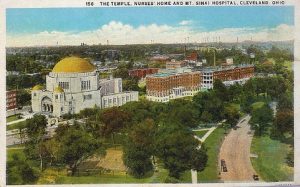 Mt. Sinai Hospital ca.1929
Mt. Sinai Hospital Link from the Encyclopedia of Cleveland History
The “Origins of Mt. Sinai” Video
Mt. Sinai 100th Anniversary Book
The History of Mt. Sinai from Cleveland Historical
Mt. Sinai Memories from The Cleveland Jewish News (part 1 and part 2)
Recollections of Nearly 45 Years at Mt. Sinai from Dr. Stephen N. Weiner. Cleveland Jewish News (1/25/2012)
Henry Goldblatt, Developer of the Goldbatt Kidney
Dr. Alfred Maschke Obit Plain Dealer (3/6/64)
Dr. Samuel Freidlander From the Encyclopedia of Cleveland
Dr. Harry Goldblatt From the Encyclopedia of Cleveland
Herman Sampliner From the Encyclopedia of Cleveland
Nathan Loeser From the Encyclopedia of Cleveland
John Anisfield From the Encyclopedia of Cleveland
John Anisfield as Written by Karen Long
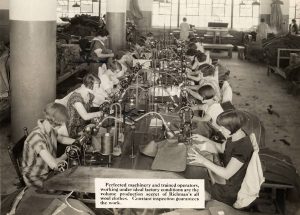 photo: cleveland memory
Links
The Encylopedia of Cleveland on The Cleveland Garment Industry
The Joseph and Feiss Company from Cleveland Historical
Cleveland’s Garment District – A Brief History by Donald C. Shingler
Richard A. Feiss, Mary Barnett Gilson, and Scientific Management at Joseph & Feiss, 1909-1925
From ClevelandJewishHistory.Net
Nicely researched site that catalogs Jewish Members of Cleveland City Council from the 19th and 20th centuries.