The grassroots fight that saved Playhouse Square and jumpstarted its revival

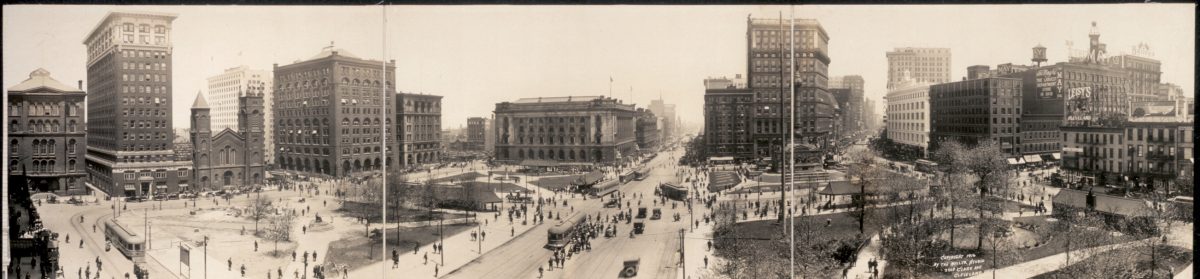
Half a century ago, the streets of what is now one of the most robust corridors in downtown Cleveland were nearly empty — aside from the wrecking ball parked on Euclid Avenue, ready to topple the historic theaters that made up Playhouse Square.
“No one was there. You could play badminton on Euclid,” said Joe Garry, the founder of Cleveland State University’s theater program. “People would proudly say, ‘I haven’t been in the city for 10 years.’”
The performing arts industry had fallen into a death spiral. The high-capacity, ornate theaters were built in the early 1920s when Cleveland was among the most populated U.S. cities to accommodate what Playhouse Square CEO Craig Hassall called a “high cultural appetite.”
But following a post-World War decline of vaudeville touring circuits and a massive exodus to the suburbs, most of Playhouse Square’s five historic theaters — the Palace, the State, the Ohio, the Allen and the Hanna — fell into disuse and disrepair.
“Four of them, except the Hanna, had ceased operating by the 60s, and they were pretty much derelict,” Hassall said. “There were pigeons living in them, the roofs had fallen in, there was a flood, and a fire in the Ohio, which pretty much destroyed the whole theater.”
And with the theater district went the rest of downtown.
“As they started to become less used and more abandoned, the downtown became a bit more sketchy as well,” Hassall said. “So it wasn’t a place you’d want to come down to. It was pretty dirty and dangerous, and there wasn’t much here.”
The theaters were set to be razed and converted into surface parking lots to accommodate the suburbanites coming into the city for work.

But a handful of artists were determined not to go down without a fight.
“There was no pretense other than we couldn’t let it die,” said Garry, now 85 years old, who was among one of the theaters’ saviors. “That was the mantra, I think.”
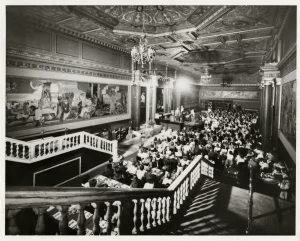
Around that time, Garry was directing a production of “Jacques Brel is Alive and Well and Living in Paris,” a musical revue featuring English translations of songs by the Belgian singer-songwriter Jacques Brel, in a 500-seat lecture hall at CSU.
Raymond Shepardson, whom Garry lovingly called the “madman” credited with saving the theaters, sat in the audience beside Garry’s mother.

“He’d been after me to do something in the [State Theatre] lobby,” Garry recalled, saying he didn’t think it would work. “And my mother told me the next morning we were having company, and she said, ‘I invited that nice man I sat next to,’ and I said, ‘He’s crazy. Are you crazy?’
“And so he came to the house, and he talked us into doing it that morning.”
The pair assembled a team that included Oliver Henkel, a lawyer tasked with tapping into the business community to save the theaters, and Lainie Hadden, the then-president of the Junior League of Cleveland, who used her connections to bring in influential people and audiences, as well as droves of CSU students and volunteers.
“He was a f***ing madman,” Garry said of Shepardson. “You have to understand, he was crazy, and you had to fall in love with his craziness, so he wasn’t the perfect front person for a very conservative business audience.”
Garry said they understood that in order to save the theaters, they needed buy-in from local banks and foundations.
But first, they had to prove there was still an appetite for live theater. They opened the show on April 18, 1973, without certainty or expectations.
“Early on… there was no money, and we literally had to count the house every night to make sure there was enough to pay everyone and to do the show the next day,” Garry said.
“We hoped that it would run three weeks… and you know, it ran two and a half years.”
Garry said the success, which he described as a “fairytale,” was proof of something bigger than their production.
“Everyone had a memory of those spaces. It had a collective history,” Garry said. “People were also hungry to restore the city they loved.”
From there, Garry went on to produce another show in the neighboring lobby of the Palace Theater, while Oliver Henkel used his legal expertise to stop the demolition, negotiate the rights to buy the spaces and build a strong board. He later became the first president and board leader of the Playhouse Square Foundation.
“I worked in a theater environment at Cleveland State where I never had money,” Garry said. “I had to use forces other than money, like sheer will, to make something happen, and that isn’t bad. But when you move into the realm of Playhouse Square, it has to be much bigger than that, and they were able to hire the right people at exactly the right time, and they made very, very smart choices.”

Playhouse Square’s revitalization over the following decades transformed it into a major downtown anchor generating $359 million in local economic impact. Arts advocates point to it as a case study for how investment in the arts can revitalize urban cores and catalyze economic development.
“The arts have always saved cities. It’s not a new idea; it’s an ancient idea,” Garry said. “The Greeks had the great good sense of building their greatest art structures, the amphitheaters, and they became the meccas of religion, art, community, everything.”
That theory has since been validated by urban planners studying downtown revitalization nationally.
“If we give people a reason to linger in a district, they’re more likely to stop and have a bite to eat, have a drink,” said Erika McLitus of the San Francisco Bay Area Planning and Urban Research Association (SPUR). “There’s a lot of pedestrian foot traffic because people have a reason to come and stay, so it also feels safer because there are eyes on the street.”
McLitus co-authored “Culture as Catalyst: How arts and culture districts can revitalize downtowns,” using Cleveland’s Playhouse Square as an example of how cities can use arts investment to rethink and retool downtowns post-pandemic.
“Art and artists and the experiences they create, and the experiences that they add to neighborhoods, the cultural assets that they maintain, do a lot more than just generate revenue. They strengthen our social bonds,” McLitus said. “They create a sense of place in a neighborhood.”
McLitus and co-author Sujata Srivastava also credited Cuyahoga County’s arts funding model, which is believed to be the only place in the country that directs cigarette tax revenue to the arts, as a means to “cultivate cultural assets that serve as economic and social anchors.”
“Cleveland’s journey from minimal public investment in the arts to hosting one of the nation’s largest arts funds is a testament to the power of grassroots advocacy,” they wrote in their 2025 paper.
The state has also backed that bet with policy: since 2009, Ohio has provided a 30% tax credit to TV, film and other media producers on in-state spending. It’s an incentive that has attracted not only major Hollywood productions to film in Cleveland, such as “Captain America: Winter Soldier” and James Gunn’s “Superman,” but also theatrical productions.
In 2023, Playhouse Square successfully lobbied the state to carve out $5 million out of that $50 million pot specifically for theater, setting up the performing arts district to become one of the most powerful launchpads for Broadway tours.
“People often write the arts off because it’s very touchy-feely,” Hassall said. “But actually, there are business principles that are fascinating. … It’s not called show ‘business’ for nothing.”
Hassall said the seemingly enthusiastic support from Clevelanders and local foundations to keep supporting the arts is encouraging at a time when Broadway faces tremendous post-pandemic financial headwinds.
“The cost and the risk of getting a show up on Broadway now is so eye-wateringly huge that it’s a disincentive to investors and therefore producers to create new works for Broadway, and that’s very bad for us,” Hassall said.
So Playhouse Square is expanding its reach. In addition to its 40,000 annual subscribers, it also partners with the University of Akron to put on shows for more than 2,300 season ticket holders at E.J. Thomas Hall.
They’ve also become a major real estate powerhouse, controlling 2.5 million square feet of real estate that generated more than $27 million in revenue for the Playhouse Square Foundation in 2024.
And Hassall is already thinking ahead to Playhouse Square’s next chapter.
“The theaters were saved by Clevelanders, supported and funded by Clevelanders, now attended by Clevelanders,” Hassall said. “We’d love to see it become a real district of entertainment where you might just come down on a Friday night, have a few beers, sit on the lawn, hear some live music, see some jugglers or whatever you know, and just have a nice time in the neighborhood.”