Notable Blacks of Cleveland from Cleveland Memory

Notable Blacks of Cleveland contains approximately 2000 images of 500 individuals selected from the photographs in the Cleveland Press Collection. This collection was donated to the Cleveland State University Library when that newspaper ceased publication in 1982. The photographs in the collection generally date from the 1920’s on, with most of them from 1960 to 1982. The collection is arranged alphabetically by the last name of the individuals. Links have been provided to biographies that are available in the Encyclopedia of Cleveland History.

From Cleveland State University Special Collections

The link is here

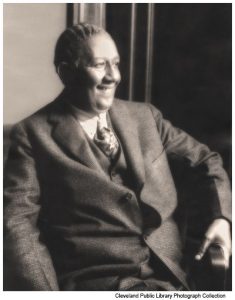
Thomas Fleming: Cleveland’s First Black Councilman

fleming_cpl_0

From the August 2010 issue of Cleveland Magazine by Erick Trickey

Lost to History

Before Carl Stokes, there was Thomas Fleming, Cleveland’s first black city councilman. But since he took office 100 years ago, Fleming, who rose to the heights of political power, has been almost erased from our public consciousness — all over $200 and a clambake.

ON HIS JUDGMENT DAY, Thomas W. Fleming greeted the courtroom with a smile.

Beside him, his wife, Lethia, held a black scarf over her face to foil the cameramen. But Fleming, wearing a three-piece suit and a big-cuffed, knee-length topcoat, flashed the same welcoming, generous grin Cleveland had known for 20 years. His soft, friendly face, round cheeks and lively brown eyes reflected the tenacious optimism that had carried him up from his barbershop to a seat on Cleveland City Council, the first ever held by a black man. His cheerfulness wasn’t just a façade or first impression, but part of his core belief that careful work, well-tended friendships and political compromise would overcome prejudice and win more prosperity and respect for his people than angry protest.

As Fleming walked up the aisle, nodding to his friends from the Central Avenue neighborhood and the reporters he knew from City Hall, would-be spectators in the hallway rushed toward the courtroom, hoping to see the trial’s end.

“Just the reporters!” barked the bailiff, blocking their way.

All that week, Clevelanders had gathered on the courthouse’s fifth floor: women in fur-collared coats, men wearing fedoras or newsboy caps, waiting in line for a seat at the trial. Most were black, and since they’d been kids, or moved to Cleveland from the South, Fleming had been their only black elected official, their neighborhood councilman, the man they’d turned to for jobs or help with a court case.

Now, they’d come to see if the prosecutor had discovered a side of Fleming they hadn’t seen, if it was true that he had taken a bribe from a disabled policeman, if he would remain in power or see his career come to an end.

Fleming walked to the defense table and sat in the chair he’d occupied all week. Three photographers, near the judge’s bench, aimed their tripod cameras at him.

The jurors entered the room and took their seats. Only two of the 12 looked at Fleming.

“Have you agreed upon a verdict?” the clerk asked.

“We have,” the foreman replied.

TODAY, 100 YEARS AFTER Thomas W. Fleming became Cleveland’s first black city councilman, he is all but erased from our history.

We take pride in Carl Stokes’ 1967 election as America’s first black big-city mayor, but not Fleming’s pioneering victory because his life story is no simple tale of racial uplift. In February 1929, his career was marred by a sudden, shocking scandal that sounded notes all too familiar to Clevelanders in 2010: money exchanged at a clambake fundraiser followed by angry accusations that his enemies and the press conspired to bring him down.

Throughout his 15 years on council, even as he became one of City Hall’s most powerful men, questions trailed Fleming about his part in the ruthless Republican political machine, his work as a lawyer defending gamblers and prostitutes, the lawless growth of vice in his ward, his alliance with a swaggering saloonkeeper who controlled a grimy underworld. Fleming’s memoir, My Rise and Persecution, was never published. He was even left out of the 1969 book Memorable Negroes in Cleveland’s Past.

But Fleming was memorable, one of Cleveland’s great characters of the 1910s and 1920s, cheerful and optimistic, clever and folksy. A shrewd ward politician, Fleming delivered more votes for Republican mayors than anyone and brought his neighborhood big gifts made of brick and concrete. After he and his wife helped Ohio’s Warren G. Harding win the presidency, Fleming audaciously asked Harding to name him to the same post his hero, abolitionist Frederick Douglass, had once held: minister to Haiti.

When Cleveland’s black population exploded in the 1910s and 1920s as neighborhoods filled with families who’d left the Jim Crow South to follow freedom’s North Star, Fleming was their lone voice at City Hall, their one-man hiring hall, the most powerful black man in the city. At a time when African-American leaders debated whether to agitate for social equality or focus on self-improvement, whether to join political machines or oppose them, Fleming, a classic politician, chose the machine. He made deals, granted favors and called them in. Until he granted one favor too many.

ON ELECTION NIGHT 1888 in small-town Meadville, Pa., 14-year-old Thomas Fleming stayed out late, leaving his mother worried at home. He stood outside the Commercial Hotel downtown, home to one of Meadville’s few telegraph offices, and listened to the returns until he heard his candidate, Benjamin Harrison, had been elected president.

From an early age, Fleming had seen black men claim a place in his hometown’s civic life. At 6, he was transferred from an all-black school to an integrated one thanks to the protests of prominent black taxpayers. When he was 11, his boss, a black bakery owner, won election to the Meadville council. “His election proved to me, even at my early age, that there was a chance for Colored men to rise in America,” he later wrote.

At 16, Fleming beat the mayor’s son, a college student, in a debate, arguing against restricting the vote to the educated. The debate wasn’t academic to him: Fleming had quit school at 12 to work as a barber to help his mother support him and his two sisters.

In 1893, Fleming rode a westbound train into Cleveland’s Union Depot, figuring he’d stay a few days then head to the world’s fair in Chicago. Instead, he never left, discovering that Cleveland was a good place for a young black tradesman to establish himself. Although the city’s few thousand black residents were often barred from industrial jobs and some restaurants and theaters, they found work as hotel employees, teachers and barbers. Fleming, already a veteran barber, started his own shop on Euclid Avenue within a year. In 1899, he moved into the barbershop in the new Chamber of Commerce building on Public Square. As Fleming trimmed and shaved powerful men in the sixth-floor Chamber Club rooms, some noticed that their barber, snipping and chatting away, possessed a political mind as sharp as his razors.

Like almost all black Americans a generation after the Civil War, Fleming supported the Republicans, the party of Abraham Lincoln, which was usually willing to hire black workers and slate black candidates for the ballot. A strain of racial progressivism had run through Cleveland politics for decades: Before the war, the Western Reserve, settled by New Englanders, had been an outpost of abolitionism. Despite the city’s small black population, its voters elected two black candidates to the state legislature in the 1890s.

Fleming met one of them in 1894 after joining a quartet that sang at rallies for the Republican mayoral candidate. One night, at an East Side meeting hall, he heard an inspiring speech by state Rep. Harry C. Smith, a hero to black Ohioans, who had just helped pass a civil rights law that banned discrimination in public places. Smith’s angry, militant editorials in his newspaper, the Gazette, denounced minstrel shows, racist laws and segregated schools.

“Smith is singular, rugged, forceful, dynamic,” another newspaperman once wrote, “full of the consuming fire that always flames hot to singe every defamer of his race and spurts unceasingly at every vestige of race discrimination.”

Impressed, Fleming became a protégé of Smith’s, stopping by his office nearly every day for political advice.

On Monday nights after work, Fleming would walk to the old City Hall on Superior Avenue, climb to the fifth floor, sit in the gallery and watch the councilmen debate. And one night around 1903, his eyes sweeping across the dozens of desks on the crowded floor, Fleming, not quite 30 years old, had a vision.

“Looking over the Council Chamber, I saw all white men occupying the seats,” Fleming wrote years later. “Every nationality was represented except one of my race group. I said to myself, there ought to be a Colored Councilman occupying one of those seats. I made up my mind that night that I would prepare myself and someday sit in one of those chairs.”

THE FLOWERS WEREN’T all for him, but they still smelled sweet. As Fleming strode into the City Council chamber on Jan. 3, 1910, applause rained down on him from the packed gallery. The mingled fragrances from bouquets blooming on each councilman’s desk filled the room and reached out to him.

He squeezed his stocky frame between the desks until he reached his chair, where his mother, sister and friends awaited. There were gifts from groups he’d co-founded: a horseshoe made of flowers from the Attucks Republican Club, a floral basket from the Cleveland Association of Colored Men. He was now Thomas W. Fleming, councilman-at-large, the town’s first black city councilman.

“It proved to me that Cleveland, Ohio, was The Garden Spot of Earth for anyone who chose to rise,” he wrote, “no matter what his nationality.”

In the seven years since he’d first envisioned this moment, Fleming had studied law at night, become a lawyer, spoken at political meetings, courted powerful friends, forged alliances and started his own newspaper. When a shrewd Republican had warned him he had no political future unless he aligned himself with Mark Hanna, Cleveland’s powerful U.S. senator and friend to presidents, Fleming promptly dumped a candidate supported by his mentor Smith and supported Hanna’s man for the post. Smith never forgave him, but as a political move, Fleming’s switch was shrewd; his standing in the Republican party rose from then on while Smith’s fell.

The council’s business was swift that night. Fleming was one of about 20 new councilmen, part of a Republican landslide that had also knocked legendary mayor Tom L. Johnson out of office. Spectators, crushed together in the balcony, looked on as Herman C. Baehr, the new mayor, mounted the podium and asked the councilmen to help build the Detroit-Superior Bridge and a new City Hall on Lakeside Avenue and annex Lakewood and East Cleveland.

After the meeting and a celebratory supper with family, Fleming headed to the Starlight Café, his friend Albert D. “Starlight” Boyd’s saloon. Tobacco smoke and 200 people filled the banquet hall. Speaker after speaker rose to applaud Fleming: the county treasurer, a deputy sheriff and, most impressive of all, Maurice Maschke, county recorder and undisputed leader of Cleveland’s triumphant Republican machine.

“The addresses of the evening were inspired by the promise of future successes,” Fleming’s newspaper, the Cleveland Journal, declared. “Mr. Fleming’s ability and integrity were highly praised.”

But Fleming’s raucous party appalled Smith. The councilman’s betrayed ex-mentor was uncompromising, exacting in his righteousness. Smith so hated segregation, he even opposed Karamu House’s race-conscious approach to theater. He found politics’ awkward alliances distasteful, refusing to support Baehr because the new mayor, as county recorder, hadn’t hired any black employees. And Smith knew too much about Fleming’s chums.

“Councilman Tom Fleming’s reception and ‘blow-out’ was continued over ‘Starlight’s’ saloon on East Fourteenth Street, after the council meeting Monday night, and was not terminated until the early morning hours,” Smith wrote in his Gazette. “O, shame! Are we degenerating? It certainly looks so.”

ALBERT D. “STARLIGHT” BOYD was a Republican ward leader, saloonkeeper, gambling-house operator and pimp. “He was the Great Mogul of organized vice,” wrote Jane Edna Hunter, a prominent black social worker, “suave, impressive, impervious to shame, and gifted with the art of leadership.”

Sometime around 1900, Maurice Maschke, an ambitious Republican operative, walked into Starlight’s Canal Road saloon. Amid the drinking and the presence of ill-reputed women with names such as Lotta the Small, Maschke saw the raw materials of power. Back then, when big-city political parties served as social clubs and mutual-aid societies, a saloon could double as a party headquarters where a smart ward leader could gather and barter a political machine’s essential fuels: money, loyalty, generosity, jobs, votes.

Starlight Boyd — it’s unclear which came first, his nickname or his star-shaped, diamond-studded watch charm — was as shrewd and calculating as Maschke. So the former hotel bookkeeper and the aspiring politician forged an alliance. Boyd became a Republican poll worker then a ward leader, a man who could get out the black vote and help tip the balance of local power.

As black migrants from the South moved into the crowded neighborhood along Central Avenue, Boyd followed them. He built the Starlight Café on East 14th Street south of downtown, complete with baths, a barber shop and a pool room. He bought apartments and houses and rented them to his allies. He sent food baskets to the needy. And his 11th Ward gave more votes to Republicans than any other part of Cleveland. When one precinct voted 245-5 for his candidate, Boyd was unsatisfied: “Tomorrow I’ll find those five votes,” he declared, “and they will learn something.”

Fleming didn’t need Boyd to succeed — not at first. In fact, his own alliances with Maschke and other white Republicans got him onto the party’s candidate list for City Council in 1907 despite Boyd’s opposition.

Two years later, running as a citywide, at-large candidate, Fleming swung into council on the Republican landslide. He swung back out in 1911 when Newton D. Baker led the Democrats to a rout, but not before his loyalty to Mayor Baehr garnered jobs for more than a dozen black workers: a park policeman, a deputy building inspector, a notice clerk, a storeroom supervisor, two janitors, several garbage collectors. Paltry spoils, but to Fleming, progress.

But after Fleming won the 11th Ward council seat in 1915, he needed Boyd. His memoir shows no qualms about befriending him, only satisfaction in a friendship and a lucrative business venture, their Starlight Realty and Investment Co. For black Clevelanders in the mid-1910s, allying with Boyd was the way to power.

Fleming and Boyd ruled the ward together. The councilman showered Central Avenue with City Hall’s blessings: a newly paved street, new streetlights, a new bathhouse. Boyd kept turning out the votes.

Naturally, Fleming and Cleveland’s Republican mayors were grateful. That’s why Starlight’s Z-Douglass Club on Central Avenue became one of the most infamous gambling clubs in the “Roarin’ Third” police district, yet attracted less than its fair share of police attention.

To Harry C. Smith, Fleming had betrayed black Clevelanders by allowing vice and immorality to flourish in the Central neighborhood. “Speakeasies, disorderly flats and a gambling den are in full operation,” Smith complained to an indifferent City Council in 1917. “The hands of the police seem tied.”

One night in 1921, the righteous Smith stopped by the Z-Douglass Club and told Boyd he might run for Fleming’s council seat.

“Why, you could not get started against Fleming,” Boyd snapped. “I dare you to be a candidate. I wish you would be one so we could defeat you worse than any candidate was ever beaten in Cleveland!”

Boyd and Fleming thought Smith wasn’t man enough to take a dare. But Smith transformed the race into a moral crusade. His angry meetings drew huge crowds as he blamed the Republicans for the Central neighborhood’s poor living conditions and moral degradation. His slogan: “Starlight and Tom must go.”

Smith and Fleming supporters rallied and argued. Smith’s election-eve torchlight parade attracted 1,500 marchers. Election Day on Central Avenue looked like a holiday, as if the whole neighborhood had taken the day off to swarm the polls. Police, stationed at every voting place, broke up several fistfights and arguments.

Fleming won, 2,830 to 2,053.

“My friends were so elated over my election that they hired a band, came to my office and compelled me to get in a parade they were forming in Central Avenue,” Fleming recalled in his memoir. “This street was crowded with people. Led by A.D. (Starlight) Boyd the procession proceeded up the Avenue, stopping at East 36th Street, where a deep hole was dug and they buried Mr. Smith in effigy.”

Soon after, Boyd fell ill with pneumonia. Exhausted by the campaign, he died a month after Election Day, at age 50.

BY 1927, FLEMING HAD achieved more than he’d even imagined as a young man. He owned a beautiful house on East 40th, one of the city’s most prominent streets. That summer, he and his wife, Lethia, sailed on a cruise ship to Europe, toured Windsor Castle and Westminster Abbey in London, ate dinner atop Switzerland’s Mont Blanc, gambled in Monte Carlo, glided through the Venice canals on a gondola and saw Josephine Baker dance at the Folies Bergère and at her private club, Chez Josephine, in Paris.

At home, Fleming had become the most powerful black politician in Cleveland’s history. Maurice Maschke had become chairman of the Cuyahoga County Republicans, and reporters described Fleming as one of his key lieutenants, the “left bower” in the party boss’s euchre hand.

In return for his loyal vote on council and his constituents’ votes on Election Day, Fleming won better pay and increasingly prominent government jobs for black workers: clerks, road foremen, two prosecutors. He’d gotten City Council to ban the Ku Klux Klan from marching in the city — and the Klan had retaliated by dropping angry fliers on Cleveland’s black neighborhoods from a plane. Smith, sniping in theGazette, might not have been satisfied, but Fleming’s alliances had brought results.

“Could anyone have done more? Could I have labored any more faithful?” Fleming wrote plaintively in his memoir. “At least I was true to my trust and loyal to my race.”

In the 11th Ward, Fleming tried to keep the vice raids at bay though police launched a few while he was overseas. For eight years, Fleming had chaired the council’s police and fire committee, setting cops’ salaries and pensions, while defending gamblers, Prohibition-defying liquor dealers and prostitutes as a lawyer in police court.

No one dared call it a conflict of interest though reporters hinted as much. “It is possible,” winked the Plain Dealer’s Roelif Loveland, “that policemen, serving as witnesses in such cases, recalled that the persons against whom they were testifying were the clients of the chairman of the powerful council police and fire committee.”

Fleming saw it differently. “I was their friend,” he wrote of the cops and firemen, “and they came to me with their troubles.”

Detective Walter Oehme was one of those men, a tough, husky cop until he was injured in a fight with a speakeasy’s drug-addicted spittoon-cleaner. Unable to stand on his own or lift his arms above his shoulders, Oehme, living on a pension of $87 a month, asked Fleming to get council to pay his medical bills. Fleming’s ordinance granting Oehme $1,740 passed while he was in Europe.

When Fleming got home, Oehme approached him again. On Sept. 27, 1927, Oehme’s wife drove him to the Colored Elks’ Club on East 55th Street, where Fleming was getting ready for his clambake fundraiser, and Oehme handed the councilman a $200 check.

THE DOORBELL WOKE Tom Fleming after midnight. He was so tired, he ignored it at first, but Lethia said it might be a telegram or special delivery. So he shook off his sleep, put on his blue and red bathrobe and red leather slippers and went to the front door.

Three Plain Dealer reporters crowded in, excited. They asked if he’d quarreled with Walter Oehme after the council meeting that evening, Jan. 21, 1929.

“Why, no,” Fleming replied — their chat had gone just fine.

But the reporters told him Oehme had come to the Plain Dealer office, saying Fleming had insulted him and alleging Fleming had shaken him down for a $200 check.

“Boys, do you think for one moment I would take a check for a bribe?” Fleming laughed.

The reporters assured Fleming they were serious.

“It’s a lie!” he shouted.

“What about the check?”

Fleming later claimed he was so dumbfounded at the accusation, he didn’t recall his exchange with Oehme a year and a half earlier.

“If he thinks he got a check, let him produce it!” Fleming said.

He sat down at a hall table, grabbed a pencil and wrote a note: “I never received one cent from Walter Oehme for anything I did for him. … I felt sorry for him in his crippled condition. … I knew him when he was an able-bodied policeman and tried to help him.”

Pacing the hall carpet, his hands behind his back, Fleming described Oehme as an ungrateful man who showed up at every council meeting, who wouldn’t stop asking for more cash. “For anybody to take money from a crippled man like that would be rotten,” Fleming said. “I don’t need money that bad.”

The reporters looked down the tastefully carpeted hall, where portraits of great Republicans hung on one wall, an old photo of Fleming in a summer suit on another. In the distance they saw Fleming’s living room, with books lining the shelves, and the dining room, filled with gleaming silver and white linen. They told Fleming to look for the Plain Dealer in the morning and left.

When dawn broke, Fleming went to his porch and picked up the paper. “Crippled Policeman Says He Paid Fleming $200 After Council Action,” the headline read.

The same day, Oehme produced a cancelled check with his and Fleming’s signatures on the back. Prosecutor Ray T. Miller called Oehme to testify before a grand jury, which promptly indicted Fleming on charges of soliciting and accepting a bribe.

Fleming’s supporters rallied at meetings across the Central neighborhood, calling the indictment “rushed through” and accusing the Plain Dealer of sensationalism and “trying his case • outside the courts.” Harry C. Smith played it cool, writing that “the great mass of our good people” disapproved of the rallies and would wait to see how the case turned out.

OEHME LEANED on the prosecutor’s arm as he walked shakily to the witness stand. He testified that the $1,740 from the city hadn’t been enough to pay all his medical bills. But when he went to Fleming for more help, the councilman had responded, “Did you save any of it for me?” Oehme said he’d told Fleming he had another $354 in medical debts. “Get me some money and I’ll see what I can do,” he claimed Fleming said. So Oehme borrowed $200 from his step-grandfather, signed the check over to Fleming, and handed it to him at the Colored Elks’ Club. Oehme said no one else had been present.

Oehme’s wife backed up his story, claiming she’d heard Fleming ask for money. Two city councilmen testified Oehme had told them about the bribe a year earlier.

Fleming told a different story on the witness stand than he’d told the reporters, but he denied taking any bribe. He said Oehme had shown up at the Elks’ club and asked him to cash a check. “He thought he owed me some money for legal services and wanted me to keep $50,” Fleming testified. “I took the check, for $200, and gave him $150 in change.”

Two witnesses testified they saw Oehme hand the check to Fleming and take cash back from him. Character witnesses, including several judges, lined up to testify for Fleming.

The trial lasted three days. The jury — eight men, four women, all white — deliberated for 13 hours and delivered their verdict on a Friday morning. The foreman gave it to the clerk, who read it in a deep, booming voice: Not guilty of soliciting a bribe. Guilty of accepting one.

Fleming drummed his fingers on the table, then clenched his fist tight. He scowled. Lethia patted him soothingly on the back.

Then they stood and hurried for the elevator. As they neared the courtroom door, Fleming mumbled, “This is murder.”

FLEMING SERVED 27 months in prison. He returned to Cleveland in January 1933 and greeted visitors at his home on East 40th Street with the same old friendly smile.

“I haven’t any bitterness,” Fleming declared. “I slept every night in the penitentiary because my conscience was clear. … I say now, as I say when I was convicted, that I am innocent of what I was charged with.”

In his memoir, however, Fleming’s sense of persecution shaded into dark paranoia. He blamed the Democratic prosecutor, the Plain Dealerand the Klan for his conviction. “I figured the Ku Klux Klan had been secretly working to frame me ever since that organization scattered those thousands of cards from an airplane among the people of my District,” he wrote. In one of his many appeals, Fleming’s lawyer had claimed several jurors at his trial were Klansmen, but they’d denied it.

Cleveland had moved on. With Fleming gone, the city’s black population, which had grown from 8,400 to more than 70,000 during his years in council, had turned to new leaders. Two more black councilmen had been elected in 1928, and Fleming’s minister had replaced him on council. The press asked Fleming if he’d try to come back, but he demurred.

“If I get into politics,” he said, “I’d be afraid I’d get high again and get knocked out again.”

Two years later, Fleming won permission to practice law again and set up an office in his home. Judges, lawyers and city manager William Hopkins sent him congratulations. But two cerebral hemorrhages sent him to the hospital in 1936 and left him in a wheelchair.

Fleming outlived his rival, Harry C. Smith. He, too, was stricken with a cerebral hemorrhage and died in his newspaper office in 1941. A near-hermit by then, with few friends, he left his estate to a German-American woman described as his friend, tenant and housekeeper.

When Fleming died in 1948, the police chief, countless Elks, Mashcke’s widow and all the councilman from Cleveland’s black wards came to Friendship Baptist Church for the funeral. His coffin lay on the altar, covered with flowers. Years later, his niece would insist that Fleming didn’t die of poor health, but of the heartbreak inflicted by his bribery conviction.
Franciscans leaving Cleveland’s Shrine Church of St. Stanislaus after century of service

Story From the Plain Dealer December 15, 2011

Franciscans leaving Cleveland’s Shrine Church of St. Stanislaus after century of service

Michael O'Malley, The Plain Dealer 
stans.jpg

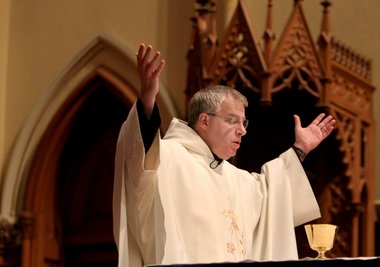
CLEVELAND, Ohio — After 105 years of service, the Franciscan order of priests is leaving the Shrine Church of St. Stanislaus, a historically Polish parish in Cleveland’s Slavic Village neighborhood.

“Our numbers are diminishing and we’re aging,” said the Rev. Michael Surufka, 53, pastor of the parish for the last nine years. “The bottom line is we just don’t have the men.”

The Assumption Province of the Franciscan order, based in Wisconsin, is transferring Surufka to Chicago where he will serve as a director of vocations, recruiting men to the priesthood.

Four friars — three priests and a brother — will continue running St. Stanislaus until July, at which time the Catholic Diocese of Cleveland will take over.

The diocese can either staff the parish, which has 1,100 families, with diocesan priests or invite another order to handle it.

The diocese declined to comment for this story.

But a letter from Bishop Richard Lennon sent earlier this month to parishioners says the bishop and his staff “will make every effort to provide for the continuation of ministry and pastoral care of the people of the parish, in particular to the ministry of the Polish speaking people and people of Polish descent.”

St. Stanislaus, founded in 1873 as a Polish parish, still has one weekly Mass celebrated in Polish.

“I just don’t know where this bishop will find a priest that can conduct Mass in Polish and English,” said Mike Jankowski, 86, a parishioner since 1946. “There’s a shortage of priests all over.”

Jankowski, of Garfield Heights, sings in the parish’s Polish choir, which, less than a decade ago, had 25 members, but is now down to a dozen. “A few passed away,” he said. “And some of them can’t get up to the choir loft. The stairs are too steep.”

Jankowski said he’ll miss the brown-robed Franciscans, but added, “Somehow or other we’ll survive.”

The Assumption Province, which encompasses the Great Lakes region, Pennsylvania and New York, has only 119 friars, 81 of whom are priests. The median age is 70.

“That’s the story of religious life today,” the Rev. John Puodziunas, Assumption’s provincial minister, said in a telephone interview Wednesday.

The first parishioners of St. Stanislaus worshipped at an abandoned church in the Flats. In the 1870s, church leaders bought 13 lots on the city’s South Side for $3,000, including a potato patch, which would became the site of the existing church.

The cornerstone for the grand shrine was laid in 1886. The building was completed in 1891.

A year later, the priest who headed the building of the church, the Rev. Anton Kolaszewski, was exiled from the diocese by Bishop Ignatius Horstmann for concealing from the diocese the exorbitant cost of the building — $250,000 — and the unpaid bills.

In 1894, Kolaszewski, who had gone to Syracuse, N.Y., came back to Cleveland and built a schismatic church, Immaculate Heart of Mary Parish on Lansing Avenue, about a half mile from St. Stanislaus.

Kolaszewski was excommunicated, but in 1908, the year Horstmann died, he reconciled with the church and Immaculate Heart joined the diocese.

The late 19th century and early 20th century saw waves of Polish immigrants coming to Cleveland to work the steel mills.

“Of course, the vast majority was Catholic,” said John Grabowski, professor of history at Case Western Reserve University and a historian at the Western Reserve Historical Society. “The Franciscans were there when this immigration was mushrooming.”

The Franciscans took over St. Stanislaus in 1906. A year later, they built an elementary school building on the grounds.

By the late 1920s, the Franciscans had built a priests’ rectory, a convent and a high school on the property. The elementary school and high school are still in operation today.

“I certainly will miss the Franciscans,” said Yolanda Kane, 81, who still lives in the neighborhood and had taught at the elementary school for 30 years. “I love their brown robes.

“They’re very dignified, holy and kind. And they have really been a part of the neighborhood.”

Rob Jageleweski, 58, who still lives in his boyhood home in the same block of the church, said this is not the first time the parish lost a group of Franciscans.

The original group of friars, from the order’s Sacred Heart Province in St. Louis, left St. Stanislaus in 1989, turning it over to the order’s Assumption Province.

But now, because of the priest shortage, said Jageleweski, it appears the Franciscan-era at St. Stanislaus is gone forever.

“A lot of people are sad, some were crying,” said Jageleweski. “We grew up with the Franciscans. This is like a death. But what are you going to do?”

Warszawa: The Development of a Polish-American Industrial Community 1882-1919

From Cleveland State

The link is here

WARSZAWA:
THE DEVELOPMENT OF A POLISH-AMERICAN INDUSTRIAL COMMUNITY, 1882-1919
Chuck Kaczynski

On the morning of 3 June 1882 the Cleveland Leader ran a copy of a notice that had been posted by the president of the Cleveland Rolling Mill regarding the condition of the plant in light of the on going strike.

Cleveland Rolling Mill Company
Cleveland, O., June 2, 1882.

On Monday next, the wire mill, rail mill, new
melting furnace, and blooming mill will start
with non-union men, single turn. As soon as
practicable other departments will start, due
notice of which will be given.
(Signed) William Chisholm, President.

A large number of the men referred to by Chisholm were recent Polish immigrants who would come to settle in the area northwest of the rolling mill. Thirty seven years later, in the Fall of 1919, the Cleveland Rolling Mill was again hit by a major strike. By this time, however, Polish-American workings composed approximately fifty percent of the strikers who walked out in support of the twelve point demands of the Amalgamated Iron, Steel, and Tin Workers Association. What caused this shift?

This paper examines the causes of this change in attitude and the growing sense of permanency among the employees of the Cleveland Rolling Mill and their families. In order to understand this transition, one must examine the development of the Polish-American community of Warszawa, located on the southeast side of Cleveland, which experienced a fantastic rate of growth between the years 1882 and 1919. By examining this growth one can identify a shift in attitude among the Polish immigrants from viewing themselves as a temporary “colony” of migrants to a permanent “community” of Polish-American workers. It is this attitudinal evolution which accounts for this transition from strike breakers to strikers.

A number of factors are examined in this paper which illustrate this transition. Primary among these is the development of Saint Stanislaus parish which acted as a center of the community. A statistical analysis of baptisms, marriages, societies and confraternities, and school size illustrates the rate of growth of the Warszawa community. Along with this, the paper examines the development of mutual aid societies, savings and loans and banks, which supported the growing permanency among the residents of Warszawa.


The history of Poles in Cleveland can be traced back to 1848. Through the 1870’s the Polish population of Cleveland was composed primarily of skilled artisans who were either self-employed or employed for wages in small manufacturing plants. At this time, Cleveland’s Poles lived among the Czech community centered around Croton Avenue, three miles north of the Cleveland Rolling Mill. But, with the increasing number of Poles coming to Cleveland, a new settlement was sought. In the late 1870’s between seventy and eighty families left the Croton Avenue community and settled in farmland near the intersection of Fleet Avenue and Tod Street. It would be from this nucleus that the Warszawa community would grow. Along with their personal belongings, the Poles who moved to Warszawa brought with them a Roman Catholic parish, Saint Stanislaus, which had been created by the Cleveland Diocese in 1873. Lacking a permanent location, this community held its services at Saint Mary’s Church in Cleveland’s “Flats” district.

During the late 1870’s and early 1880’s, the Poles of Warszawa came to rely on the Cleveland Rolling Mill for a majority of their jobs. The Cleveland Rolling Mill was part of an industry which had existed in Cleveland since 1856. With the increased demand for iron resulting from the American Civil War, the Cleveland Rolling Mill hired a number of Czechs and Poles to bolster the output of the existing Welsh/Irish work force. Through the 1880’s, the Poles and Czechs came to fill a number of unskilled and semiskilled positions at the mill.

In May of 1882 the Cleveland Rolling Mill received new ownership which immediately enacted a series of wage reduction measures. On the morning of 10 May 1882 five thousand employees of the mill went on strike protesting the reduction in wages, working conditions, and the closing of the mill to labor unions. In that morning’s edition of the Cleveland Plain Dealer, President Chisholm explained his thoughts on the cause of the walkout. “Until within a few months ago the employes (sic) of our company have not been connected with the labor organization known as the Iron and Steel Workers’ Association. Latterly however, they have been gathered into this organization and the result has been discontent and trouble to the company. The question was not a matter of wages so much as whether the Amalgamated Association should control our affairs and dictate to us our method of doing business.

The strike continued until early June when strike breakers, including between 500 and 1,500 Poles, were brought into the mills. Chisholm continued his stand against the Amalgamated and its membership, stating that no union member would be given a postion in the mill. The lack of experience of the strike breakers soon became evident. One report indicated that approximately one third of the output of the rail-mill was “useless.” Due to the increasing number of strike breakers, and the disorganization of the Amalgamated, though, the strike was quickly broken.

The ineffectiveness of the Polish laborers who were brought in to break the strike can be explained by examining the source population of these workers. Known as the Stara Emigracja, “Old Emigration,” three fourths of the pre-1920 Polish immigrants were farm laborers, unskilled workers, or servants. Only three percent of this population possessed fifty dollars when they entered this country. One quarter of the “old emigrants” had their travel expenses covered by someone else. Many of these laborers were “birds of passage,” who left their wives and family back in Europe in order to find “good” jobs which would allow them to earn enough money to return to Europe and purchase land. Between 1820 and 1870 these laborers left at the rate of ten to twenty per one hundred new immigrants. This number increased to thirty three to forty per one hundred by the period between 1900 to 1914. Those that remained in Cleveland developed a hybrid system of allegiance, mixing Polish culture with American methods to create the permanent community of Warszawa.


In the years following the end of the 1882 Strike, Cleveland experienced a continuous growth of its Polish population. Even with the difficulties of tabulating Polish immigration into Cleveland, with the Polish immigrants regularly being identified as “German,” “Russian,” or “Austrian.” The number of Poles entering Cleveland was quite substantial. By the year 1890, 2,848 Poles were living in the city of Cleveland, making up 1.09 percent of the total population. It was this population which maintained the notion of the Okolica, the neighborhood, with its emphasis on material possessions (land, house and permanent material objects), personal abilities (individual skill and organizational honors), and family status, which came to characterize the Warszawa community.

Over a short period of time the Warszawa community exhibited qualities which indicated a shift away from the “birds of passage,” to a community of Polish immigrants who had been attracted to Cleveland by correspondence with family and friends already living there. This reflects a common immigration pattern among Poles during the late nineteenth century. This sense of purpose and permanency was displayed only three years after the 1882 Cleveland Rolling Mill Strike when a second, and more violent strike broke out. In July of 1885, in the face of a recession, Chisholm cut employee wages. Poles and Czechs, who had been recruited as strike breakers a mere three years earlier, led a “more massive and violent strike” which began on 6 July 1885. This strike was an attempt by the workers to preserve the gains that they had made since moving to Warszawa.


A prime indicator of this permanency in the Warszawa community was the development of the Saint Stanislaus parish. After the shift of the Poles to Warszawa, distance prohibited the use of Saint Mary’s in the Flats as a place of worship. It was in 1881 that the first permanent church building was erected at the intersection of Tod Street and Forman Avenue. Two years later the pastor of Saint Stanislaus, Father Francis Kolaszewski, unveiled plans for a church which would be the largest in the Cleveland Diocese. In 1887, a mere six years after building the first church at Tod and Forman, Kolaszewski’s plans became reality with the dedication of a two hundred foot long, on hundred and forty five feet high brick structure.

Kolaszewski’s grand plans ran into financial difficulties starting in the mid-1890’s. By the seventh of April 1906 the Bishop of Cleveland, Ignatius F. Horstmann, requested that the Franciscan Order take over the parish in order to solve the Saint Stanislaus’ financial problems. This task was made even more difficult when on 21 April 1909 a “cyclone” damaged the church and school buildings. The tall twin steeples of the south facade of the church collapsed during the storm, and were never rebuilt. The final total of the cyclone damage to the Saint Stanislaus property was $27,000. The financial strength and stability of the Warszawa community, however, was clearly exhibited, when only seven years later, the pastor of the church reported to the bishop that Saint Stanislaus was free of debt.

A better representation of the growth of the Warszawa community can be seen by examining the records of marriage and baptism ceremonies as they are recorded in the annual reports to the bishop. (See Graph A and Graph B) In 1882, Saint Stanislaus conducted twenty six marriage ceremonies and one hundred and fifty baptisms. Excluding a slight decrease in baptisms between 1884 and 1885, and marriages between 1883 and 1885, Saint Stanislaus showed a constant rate of growth through 1891/1892. The number of marriage ceremonies peaked in 1891 with 115 weddings, while baptisms reached its highest level one year later, totaling five hundred and thirty one.

Both baptisms and marriages fell drastically after 1891. Two factors played a role in the decreasing number of marriages and baptisms between 1893 and 1894. The United States at this time was suffering through an economic depression, which effected the earnings of the workers at the Cleveland Rolling Mill. But more significant to the Saint Stanislaus parish was the return of Father Kolaszewski from Syracuse, New York. One 8 June 1892, the bishop had replaced Kolaszewski, indicating that he had financially hampered the parish. Some members of the Saint Stanislaus community loyal to Kolaszewski clashed with those who called for his ouster, causing a split in the parish, which resulted in the bishop sending Kilaszewski to Syracuse, New York.

The annual report to the bishop for 1894 notes that Kilaszewski had returned to Cleveland, “…uncalled by the church authority to organize what he calls an independent church on 3rd day of May…” This schism resulted in the creation of a runaway parish, the Immaculate Heart of Mary, which acquired property on Fremont Avenue, only six blocks south of Saint Stanislaus. It was the creation of this second Polish Church, in close proximity to Saint Stanislaus, which was the primary cause for the decrease in marriages and baptisms.

During the period from 1894 to 1905, there was little growth in marriages or baptisms. From 1905 to 1907, however, the number of marriages in the parish increased dramatically. The annual report to the bishop for 1905 indicated that seventy marriages were performed at Saint Stanislaus. By 1907, a mere two years later, this number had more than doubled, to one hundred and forty six. Exhibiting a delay factor of one year, the number of baptisms performed also grew dramatically during this period. The year 1905 saw four hundred and one baptisms performed at Saint Stanislaus. Three years later, six hundred and forty five baptisms were performed. The number of marriages and baptisms continued to rise through 1916. It was in this year that Saint Stanislaus reached its prewar peak in marriages with two hundred and thirty ceremonies.

A third indicator of the growth of Warszawa was the growing school population of Saint Stanislaus. (See Graph C) Great emphasis must be placed on this development, for the school was seen as a “new, concrete institutional bond between immigrants.” The parochial school was also seen as one of the first institutions to express a growing sense of community and self-development, which facilitated the shift from a Polish “colony” to a Polish-American community. The statistical data of Saint Stanislaus’ school clearly indicated that the bonds between “immigrants” who had settled in Warszawa developed into bonds between “neighbors.”

Diocesan records indicated that in 1882 two hundred and five students attended Saint Stanislaus school. Four years later, a new school building was opened at the cost of $1,500. By 1893, the school was attended by seven hundred and fifty students, with a staff of ten teachers. In response to a question regarding the number of students that did not attend the parish school, the pastor of Saint Stanislaus wrote: “Some (students) after their first communion attend public school to learn more English.” At this time all instruction was done in Polish. Ten years later, the annual report indicated that two hundred students did not attend Saint Stanislaus school because of the “lack of rooms in our school.” In 1906, the school population of the parish was one thousand two hundred and ninety seven students.

A new school building was completed in 1907, which contained eighteen classrooms, two basement offices and an auditorium. The building was erected at a cost of $9,300. Even with this massive construction project, the population of Warszawa outstripped any progress in the number of classrooms. As late as 1912 the annual report indicated that five hundred students were not attending the school because of the lack of space. At this time, Saint Stanislaus school had twenty four teachers instructing one thousand four hundred and eighty five students in eight grades. This upward trend continued through 1919, with Saint Stanislaus peaking at two thousand one hundred and thirty seven students, with an additional six hundred having to attend public school because of lack of space.

This dramatic growth in school population, along with the increases in marriages and baptisms indicated that by the middle of the 1890’s Saint Stanislaus had entered a third phase of development, one of self-generated growth. This reaching maturity is noted by William I. Thomas and Florian Znaniecki: “Later when the community is definitely settled marriages and births–at first relatively insignificant–gradually acquire the predominant importance.”

A significant role in the development of Saint Stanislaus, and its school, was that played by the various confraternities and societies which developed between 1882 and 1919. These organizations performed two functions in the parish community, providing devotional support for the priest and economic and cultural support for the community. Taking the economic conditions which effected the parish into consideration, one can observe continuous improvement in the Warszawa community. Returning, once again to the 1882 annual report, one finds that Saint Stanislaus had only two societies. The number of confraternities and societies rose quickly, so that by 1887 Saint Stanislaus boasted five male societies, three female societies, and one children’s society. By 1894, the number of these organizations increased to fifteen.

An interesting situation developed in these societies with the outbreak of the First World War. The 1917 report to the bishop announced that seven military companies had been formed among the parishioners of Saint Stanislaus. Of the five hundred men who entered military service, two hundred and fifty had been drafted by the United States Army, one hundred and twenty five had volunteered for the “American” Army, while one hundred and twenty five volunteered for the Polish Army. This split allegiance was made reference to again in the 1918 annual report. On 24 March 18, Saint Stanislaus held a ceremony in which the pastor blessed the parish’s “service flag.” The flag was decorated with five hundred and fifty five stars, one for each man in the service of the United States, along with eighty eight stars for men serving in the Polish Army. This divided allegiance, as late as 1917-1918, reflects the merging of a “Polish” identity with the reality of making one’s home in the United States.

The years between 1882 and 1919 also saw the development of a number of social and economic institutions, which reinforced the permanency of the Warszawa community while maintaining the cultural traditions brought from Poland. This hybrid of Polish traditions and values with American institutions and methods was well illustrated in the evolution of the mutual aid societies into extraterritorial insurance federations. Initially, Polish immigrants tended to rely on the “wider social group” for assistance during periods of financial difficulty. “The immigrant has been accustomed to see the wider social group hold every narrower social group within its limits responsible for the behavior of every member; the village praises or blames the family as a whole for the activities of an individual, the parish does the same with reference to the village group, the wider community with reference to the parish or village.” It was this attitude which the Polish immigrants brought with them to the Cleveland Rolling mill and the Warszawa community. But over time, with the growth of the community, and the expansion of immigration patterns beyond “chain migration,” mutual aid tended to develop a more impersonal “Americanized” flavor.

Personal assistance among Polish-American communities tended to evolve from a system which functioned on a case by case basis to one of mutual insurance where the membership of an organization collectively insure themselves against accident. Over time, this idea dissolved into a system of self-insurance where individual policyholders protect themselves. “In the older and larger colonies the individual’s desire to be insured plays, therefore, perhaps even a greater part in the development of mutual insurance associations than this desire to insure others.” This personal focus which developed was further evidence of the “Americanization” of the community and its growing sense of permanence.

In Warszawa, the first fraternal insurance clubs were associated with Saint Stanislaus parish. For a low weekly premium, usually around twenty five cents, the individual was able to protect themselves against layoffs and accidents, provide funds for family burials, and have a source for low-interest loans.” The first of Cleveland’s mutual aid societies was founded in 1873 by Anton Dzieweczynski and Andrew Skonieczny, the Society of Saint Vincent de Paul. Seven years later, a Polish Roman Catholic Union lodge (P.R.C.U.) was formed at Saint Stanislaus.

During the 1880’s and early 1890’s, the Warszawa community organized a host of mutual aid societies and fraternal insurance organizations. One of the more unique organizations was the Polish National Alliance, which founded its first Cleveland chapter in 1886. “However, it (Polish National Alliance) did not have strong church ties (though membership was initially limited to Catholic Poles) and worked strongly for the reconstitution of the Polish state.” Considered by many in the Warszawa to be composed of “freethinkers,” and “socialist: the Polish National Alliance, after its 1895 national conference in Cleveland, was abandoned by many Warszawa Poles when the P.N.A. Constitution was amended to allow non-Catholic Poles to join the organization. This led to the splintering off of Group 143 which reconstituted itself first as the Alliance of Poles of Ohio, and after 1917 as the Alliance of Poles in America.

The popularity of these mutual aid societies and fraternal insurance organizations was exhibited by the number of policies opened each year. A survey of new applications was conducted for the P.R.C.U. Lodge of Saint Stanislaus for the years 1909 to 1919. (See Graph D) For the seven months of 1909 that it was recorded, the number of new P.R.C.U. policies increased by one hundred and twenty five. To find the first full year of new memberships, one must turn to the data from 1912, in which three hundred and twelve new memberships were opened. New applications increased again in 1913 with four hundred and twenty three policies being issued.

As a result of the economic depression of 1913, P.R.C.U. applications fell in 1914. For the ten months in which it was recorded, only three hundred and nineteen new policies were opened. The following year, however, new policies skyrocketed to five hundred and seventy five. By the time of the First World War, the organizations which started as societies which provided assistance to its members joined the ranks of national insurance organizations. This was part of a trend among Polish mutual aid societies which only late in their development “added insurance to provide themselves with a broader base and more working capital…” Once again, one observes the evolution of a tradition among Poles, community assistance during times of emergency, into an “Americanized” institution of federated insurance organizations which insured thousands of unrelated individuals.

Beyond the development of a parish community and the growth of mutual aid societies, the creation of a permanent community was best gauged by the geographic growth of the community and the degree of home ownership. For those individuals and families which claimed Warszawa as “home,” home ownership became a primary goal. Along with providing a sense of status, home ownership provided the Polish-American community with a greater control over their environment, an “enforced” form of savings resulting from the buildup of equity in their homes, and a second source of income. It was quite common for home owners to erect a second house on their property to use as a source of rental income.

In 1912, Warszawa was composed of one and a half, two, and two and a half story wooden frame houses with additional sheds or stables. Wooden frame storefronts were common along Tod Street and Fleet Avenue, which continued to be the major intersection of Warszawa. The southern geographic limit of Warszawa at this time was found at Worley Avenue, just south of Fremont Avenue. This area was known as the “Reid Estate Subdivision,” but no construction was indicated in the 1912 Plat Books. Ten years later this area was filled with two-family homes, and the church and school complex of the Immaculate Heart of Mary. By 1920, Poles in Cleveland controlled over twenty million dollars of property, a clear indication of the permanent nature of the community.

By the second decade of the twentieth century, Warszawa had expanded to the south to Harvard Avenue, where its expansion was limited by the northward growth of the Krakowa community, a second Polish-American community, on the west where it reached East 55th Street, on the east at Broadway Avenue by the growing Cleveland Rolling Mill complex, and on the north by the Morgana ravine. With improvements in public transportation, Polish-Americans soon moved out of Warszawa starting satellite communities. In addition to Krakowa, which had developed during the 1870’s, Polish-Americans created the Jackowa community around the Saint Hyacinth parish. By 1910, Polish-American families were moving south along Turney Road, “settling along the side streets lining Turney from just above Warner Road to immediately above Garfield Heights Boulevard.”

Related to this growth in home ownership was the development of community financial institutions. During Warszawa’s early history, its residents did not establish institutions for savings. This responsibility was undertaken by the individual family or through mutual aid societies and fraternal organizations. A second institution which played a financial role in the community was Warszawa’s foreign exchange and travel broker, Michael Kniola. Members of the Warszawa community would “deposit” money with Kniola. His success in this area led him to help found the Warsaw Savings and Loan Association of Cleveland. In the Fall of 1915, Kniola, along with B. Filipiak, C. Orlikowski, Michael Bauza, and S. Ciemnoczolowski organized the Savings and Loan in order to facilitate home buying among the members of the Warszawa community. The organization began operations of 16 September 1916, incorporating six days later. Initially working out of a room in the Sokol Polski Hall on Broadway Avenue, the Warsaw Savings and Loan sold stock subscriptions valued at one hundred dollars each. By the end of 1916, subscriptions were high enough to allow the savings and loan to make its first loan of $1,800.

The Warsaw Savings and Loan, however, was not the only Polish financial institution in Warszawa. Three years earlier, a former employee of Kniola’s, Stanley Klonowski, opened the Bank of Cleveland on the corner of Marcelline and Broadway. By the year 1920, Warszawa had two additional financial institutions, the Broadway Savings and Trust Company on the corner of Broadway and East 55th Street, and the Columbia Savings and Loan Company directly across the street from the Broadway Savings and Trust Company.

By the year 1919, the Warszawa community had developed from an intersection of two roads in the middle of farmland to a bustling, thriving, permanent Polish-American community. Workers from Warszawa played a major role in the 1919 Steel Strike which shut down “all 16 plants of the American Steel and Wire Co. and the plant of the McKinney Steel Co. and the Lake Erie Iron Co. and other independents…” One can easily see the shift of Polish-American workers’ attitude toward the Cleveland Rolling Mill and the Amalgamated Iron, Steel, and Tin Workers Association by examining a list of the members of the strike committee, and their nationality. John Bieski, Lakeside Lodge, Amalgamated Association, A. Bilowski, Fullerton Lodge, Amalgamated, Frank J. Owezarak, Warsaw Lodge, Amalgamated, and John M. Widlanski, Warsaw Lodge, Amalgamated were identified as members of the Cleveland Strike Committee.

In conclusion, when one examines the history of the Warszawa community in Cleveland, Ohio, one is struck by the steady growth of the community, and its fusing of traditions and values brought from Europe with “Americanized” institutions and methods. This growth, along with this mixture of “old” and “new” world created a sense of permanency and belonging. From its beginning as a “homeless” community the parish of Saint Stanislaus developed into one of the largest communities in the Diocese of Cleveland. The development of a parish school, the growth in the number of marriages, and baptisms, and the increasing numbers of confraternities and societies all point to the development of permanency among the Warszawa community. Besides the growth of the parish community, Warszawa, between 1882 and 1919, saw a growth and change in its mutual aid societies. All of these factors, along with the rise in the degree of home ownership and financial institutions indicates that over this period of time a change took place in the thinking of the residents of Warszawa, a change from perceiving themselves as a temporary “colony” of Polish workers to a “community” of Polish-Americans.


Teaching Cleveland Digital