Roldo Bartimole, Cleveland’s original alt-journalist, by Erick Trickey, July 2018


George Forbes removes Roldo Bartimole from City Council meeting. Photo courtesy of the Michael Schwartz Library at Cleveland State University.

Roldo Bartimole, Cleveland’s original alt-journalist
JULY 26, 2018
The link is here

The day Roldo Bartimole turned 35—April 5, 1968—a crisis of conscience struck him. Martin Luther King had been assassinated the night before, and riots had broken out in major US cities. Bartimole, a Cleveland journalist who’d gone to the 1963 March on Washington, attended a meeting between George Wiley, a civil-rights activist, and several Ohio college professors. He was appalled when the white professors asked Wiley when riots, not injustice, would end.

“It felt to me like things were as bad as they could be,” Bartimole recalls.

By day, Bartimole worked in The Wall Street Journal’s Cleveland bureau. He moonlighted as an anonymous writer for a Cleveland Council of Churches newsletter. At the nation’s moment of despair, he felt the need to do more.

So Bartimole actually made the move that countless reporters have fantasized about. He quit his newsroom job and started his own publication, a newsletter he named Point of View.

“I tried to tell the story that I saw as a reporter,” recalls Bartimole, “but knew would never be published in a traditional newspaper. So I had to invent something.” Typed after hours on a church’s IBM Selectric, printed on heavy-stock 11-by-14-inch paper, Point of View became the underground samizdat of Cleveland’s political, business, and journalistic circles.

A clip for the first issue. Read the full PDF here.

Bartimole became Cleveland’s first alternative journalist—a role he continued for 50 years, until he called it quits this February, just before he turned 85. For 32 years, Bartimole’s Point of View, funded via subscriptions, combined media criticism with inside information and radical critiques of the local power elite. His solo reporting career inspired comparisons to I.F. Stone’s national weekly of the 1950s and 1960s. After retiring the newsletter in 2000, Bartimole continued as a columnist for the alt-weekly Cleveland Free Times and various local websites—always living on a very low income, the self-imposed price of independence.

“He was a real factor in the town,” says Michael D. Roberts, a longtime Cleveland writer and editor and Bartimole’s contemporary. “His criticisms were embarrassing, to-the-point, and he didn’t spare anyone.”

Like in many cities, Cleveland’s press is much more comfortable critiquing elected power than unelected power. Reading Roldo was the great exception. (Clevelanders always referred to him by his distinctive first name, shared with his father, whom his grandmother named after the hero of a cheap Italian novel.) Bartimole’s work instructed generations of local journalists in how business figures wield power out of sight, leveraging philanthropic dollars, campaign donations, and private meetings with top politicians to control the civic agenda. Though his relationship with mainstream media outlets was unfailingly acerbic, he encouraged young reporters to see the power behind City Hall.

“Don’t compromise,” Bartimole advised his younger readers at the end of his last column. “It’s not worth it and it’s not as much fun or as rewarding at the end. Challenge. Bend as little as possible. Make the bosses bend. They’re not that tough.”

I had a completely different view. My view was that racism and poverty were the cause of what was happening.

BARTIMOLE’S MUCKRACKING BEGAN in his hometownof Bridgeport, Connecticut. His damning reports from the city’s impoverished neighborhoods, which angered the city’s mayor, identified dangerous tenements where children later died in fires. Hired in 1965 by Cleveland’s morning newspaper, The Plain Dealer, Bartimole contributed to a series, “The Changing City,” that was one of the paper’s first frank examinations of urban renewal and what was then known as the black ghetto. His work stood out compared to the paper’s usual attitudes.

“There was a real current of racism,” says Roberts, 79, who was a Plain Dealer reporter in the ’60s. “The black community didn’t exist. You’d call in a story, and the editor would ask, ‘Is it a good address?’” Bad addresses were black neighborhoods, says Roberts, of little news value to the era’s editors.

Point of View debuted in the racial crucible of summer 1968. Many early issues burned with Bartimole’s fury at the city power structure’s treatment of black Clevelanders. After Cleveland’s Glenville shootout between police and black nationalists and the riots that followed—50 years ago this week—Bartimole excoriated police conduct and questioned official accounts of the shootout. “Who polices the police?” he wrote, prefiguring today’s debates about police accountability and use of lethal force. Point of View’s Glenville commentary contrasted with the coverage in Cleveland’s daily press, which generally accepted the police’s version of events.

“I had a completely different view,” recalls Bartimole. “My view was that racism and poverty were the cause of what was happening.”

Point of View’s second issue broke the news that Cleveland businessmen had paid black activists $40,000 to “keep the peace” in summer 1967. “Politics as social control,” Bartimole called it, noting that unrest could’ve scuttled Carl Stokes’s election in November 1967 as the first black mayor of a major US city.

Roberts says Bartimole’s reporting on local power players broke new ground. “He saw the business community sort of as the deep state,” Roberts recalls. Point of View delivered critical coverage of the Cleveland Foundation, the city’s largest philanthropic organization. It scrutinized the political and civic activities of business leaders such as Jack Reavis, managing partner of Jones Day, Cleveland’s largest law firm, and founder of the local Businessmen’s Interracial Committee on Community Affairs. “If you were at The Plain Dealer,” says Roberts, “you didn’t dare go into those waters.”

Bartimole believed business leaders got involved in civic affairs for selfish reasons, not benevolence. “Certain interests were making major decisions, and making them as self-interest,” Bartimole recalls. “Cleveland was a very institutional town, and still is.” Much of Cleveland’s wealth from its boom years in the 1920s is still left in the hands of foundations, Bartimole observes—“structures that keep an agenda going that favors those who have. Not much has changed.”

Point of View was also a journalism review, says Bartimole. His press coverage was inspired by the Chicago Journalism Review, founded by Chicago reporters in response to their editors’ apologias for police violence at the 1968 Democratic convention. Bartimole covered tensions between reporters and management at Cleveland’s dailies, the Plain Dealer and thePress. He printed killed stories and deleted grafs smuggled out of the Plain Dealer newsroom, including an exposé of local nonprofits’ interlocking directorships, deep-sixed by the publisher.

Roberts, the Plain Dealer’s city editor in the early ’70s, says he often thought Bartimole’s criticism of the paper was unfair. Disgruntled Plain Dealer reporters would use him, Roberts says, to get back at management.

But Roberts admired Bartimole’s dogged coverage of Cleveland politics. “He helped spark the way the two papers covered City Hall,” he recalls. “They couldn’t do a slipshod job, because he’d come out with what really took place. The town was lucky to have him.”

In the ’70s and ’80s, Bartimole frequented Cleveland City Hall and the Cuyahoga County Recorder’s office, where he’d find stories in newly-filed partnership records. In January 1982, Point of View reported that the Cleveland Press’s owner had transferred the paper’s land to a new partnership he controlled—a harbinger of the afternoon paper’s shutdown six months later.

Other Point of View stories came from tips on the street. “I walked around downtown a lot,” Bartimole says. “People, if they saw me, would stop and tell me something. They would never call me up to tell me that. But if they met me, they seemed almost obligated to want to tell me something.”

City Hall coverage included epic critiques of Cleveland politicians such as future congressman Dennis Kucinich, mayor from 1977 to 1979, and George Voinovich, mayor in the ’80s and later Ohio governor and a US Senator. Bartimole once confronted Voinovich at a City Hall food drive, grilling him about why he hadn’t opposed President Ronald Reagan’s food-stamp cuts more strenuously.

Bartimole’s most famed confrontation with a politician came in 1981, when George Forbes, Cleveland’s City Council president, forcibly removed him from a meeting. Bartimole felt Forbes was breaking Ohio’s sunshine law, and his refusal to leave more than made his point. “He just got really upset and grabbed me,” Bartimole recalls. “His misfortune was, he had all the media right outside the door, which was open.” Newspaper and TV cameras captured the scuffle. A photo of Forbes grabbing Bartimole by his suit has become one of the legendary images of Cleveland journalism.

George Forbes removes Roldo Bartimole from City Council meeting. Photo courtesy of the Michael Schwartz Library at Cleveland State University.

Though Point of View was widely read in government offices, newsrooms, and corporate boardrooms, widespread photocopying expanded its audience beyond its small circulation: about 500 at the start, peaking near 1,700 in the late ’70s, around 1,400 afterward. Annual subscriptions were $3 in 1968, $25 to $50 in 2000.

Independence meant extreme frugality for Bartimole. “He had virtually no money,” Roberts recalls. “He’d park his car in the cheapest place in town and walk a mile or two miles to get where he was going. I’d always call him a communist when I’d see him. He’d give me the finger.”

Bartimole says his annual income in the 1970s through the 2000s ranged from about $4,000 to $10,000 a year. “It was 32 years with not a lot of money,” Bartimole says. “How could you make any money on that?” For most of the ’70s, he drove a 1965 Volvo, even after it needed a push or a blow from a hammer to start it. At one point, Bartimole raised his three kids, alone, on his writing. He shrugs it off: They had a car, a fridge. “It wasn’t easy. My kids understood it. I think they are proud of it in some ways.” His children would help him stick mailing labels on the newsletters and bundle them for the mail.

Bartimole never considered rejoining a newsroom. “I felt what I was doing was important,” he says. “I could never feel comfortable in a regular job.” He feared compromising his independence. In the 1960s, he’d written a short-lived column for the city’s longtime black newspaper, the Call and Post, in exchange for the paper printing Point of View for free. But when the publisher refused to run a Bartimole piece critical of the local United Way, he walked.

At one point a Cleveland Press editor asked Bartimole to write a column. “I refused, because I knew what was going to happen,” he says. “I’d write one they didn’t want to run, and then I’d be out.”

I knew I couldn’t play a different role, clean things up, and go back on what I was writing.

IN THE 1980S AND 1990S, Bartimole started making more money by becoming a columnist for local alt-weeklies, first the Cleveland Edition and later the Cleveland Free Times. He continued Point of View, splitting his writing energies. It’s the only time he made a living wage, he says. “I was hurting myself, cutting into subscriptions,” he says. “But I got paid, and it was way more exposure.”

Bartimole became a sort of frugal populist, Cleveland’s fiercest critic of tax abatements for downtown development projects and public funding for stadiums. He opposed the 1990 ballot campaign to levy alcohol and cigarette taxes to fund the Indians’ baseball stadium, now Progressive Field, and the Cavaliers’ basketball arena, now Quicken Loans Arena. He printed lapel pins and bumper stickers calling out then–Indians owner Dick Jacobs: “Let Jacobs Pay,” they read.

At age 67, Bartimole began a long, slow retirement. He shuttered Point of View in 2000, but continued writing his column for the Free Times until it closed for seven months in October 2002. By the time the paper was revived as part of an antitrust settlement in May 2003, Bartimole had already moved his column to a black newspaper, the City News and Tab, where he wrote into the mid-2000s.

Even semi-retired, writing without pay for local websites such as Cool Cleveland, RealNEO, and Have Coffee Will Write, Bartimole decried the more than $1 billion in local tax money that’s gone to build and renovate Cleveland’s sports palaces. Sometimes it seemed like he was the only journalist in town who could explain how the complex funding worked.

A 2009 account of Bartimole’s walk through downtown Cleveland, unusually narrative for a writer who focused on facts and figures, catalogued the deals that had subsidized each new building. His tally ran to $660 million—with, he felt, not enough people on the streets to justify it. “Activity will come when people—the market—demand it,” he wrote. “You can’t force it even with almost free money.” That was heresy in Cleveland, which prides itself on its downtown’s subsidized comeback.

“There was no down-the-middle in how people viewed him,” recalls Roberts. “You either liked him for what he was doing, or thought he was a crackpot.”

Despite Bartimole’s career of castigating the city’s daily paper, Roberts lobbied his fellow Press Club of Cleveland members to induct Bartimole into their Hall of Fame in 2004. They agreed, reluctantly. Among other journalists, “he was not well-liked, generally speaking,” Roberts recalls. “He had a group of guys who were his friends, but the editors detested him. They asked, ‘Why take this guy in who’s been spending his career criticizing us?’”

Bartimole’s acceptance speech made Roberts cringe.

“I knew I couldn’t play a different role, clean things up, and go back on what I was writing,” Bartimole recalls, “so I slashed out at The Plain Dealer.” The outsider journalist dismissed local TV news as “essentially hopeless and headed south,” radio as “mostly irrelevant,” and The Plain Dealer as “too often put[ting] its readers and reporters to sleep” and spending more effort on food and sports coverage than “its coverage of who is doing what to whom.”

To Roberts and others in the audience, Bartimole’s speech was memorably mean-spirited. “He enjoyed that,” Roberts says. “He’s got an ego. That was one of the things that drove him.”

WHAT LEGACY IS BARTIMOLE LEAVING, in Cleveland or beyond? His own answer is modest. “One person doesn’t make that much of a difference,” he says. “It takes movements.”

But Sam Allard, a staff writer for the alt-weekly Cleveland Scene, disagrees. Allard, 30, wrote about Bartimole’s influence on Cleveland journalism for Scene this winter. “He took a real interest in mentoring and fostering younger journalists in Cleveland, myself included,” says Allard. “He was actively calling, emailing and setting up coffee dates.” Allard says Bartimole advised him on his 2017 coverage of an issue dear to the elder journalist: an activist group’s aborted battle against new public funding for Quicken Loans Arena. “One of the things he saw his role as was helping shape media discourse in town. He thinks it’s important to reach out to people who are crafting the narrative.”

In local journalism, calling out unelected power can make reporters uncomfortable and power brokers hostile. “One of the things that’s inspired me the most about Roldo,” says Allard, “is that he spent his entire career writing and reporting critically about people he interacted with regularly. It’s a lot more courageous to report critically about people in your town or community.”

Bartimole’s advice for young journalists trying to cover power in their city is simple. “Look at records, and look at who benefits and who pays,” he says. “Pick out, what are the institutions making decisions? How do certain things get before the public officials to ratify? Look at the organizations that are considered quote-unquote ‘good.’ What are they doing with their money? How are they collecting it?”

Unelected power brokers “come out when there’s certain crises and things have to be quote-unquote ‘handled,’” Bartimole says. “If you watch, you can see that happen. Who pulls certain strings at certain times?”

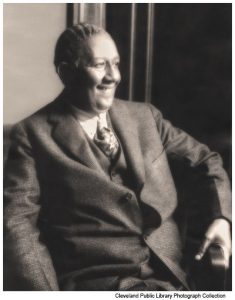
Thomas Fleming: Cleveland’s First Black Councilman

fleming_cpl_0

From the August 2010 issue of Cleveland Magazine by Erick Trickey

Lost to History

Before Carl Stokes, there was Thomas Fleming, Cleveland’s first black city councilman. But since he took office 100 years ago, Fleming, who rose to the heights of political power, has been almost erased from our public consciousness — all over $200 and a clambake.

ON HIS JUDGMENT DAY, Thomas W. Fleming greeted the courtroom with a smile.

Beside him, his wife, Lethia, held a black scarf over her face to foil the cameramen. But Fleming, wearing a three-piece suit and a big-cuffed, knee-length topcoat, flashed the same welcoming, generous grin Cleveland had known for 20 years. His soft, friendly face, round cheeks and lively brown eyes reflected the tenacious optimism that had carried him up from his barbershop to a seat on Cleveland City Council, the first ever held by a black man. His cheerfulness wasn’t just a façade or first impression, but part of his core belief that careful work, well-tended friendships and political compromise would overcome prejudice and win more prosperity and respect for his people than angry protest.

As Fleming walked up the aisle, nodding to his friends from the Central Avenue neighborhood and the reporters he knew from City Hall, would-be spectators in the hallway rushed toward the courtroom, hoping to see the trial’s end.

“Just the reporters!” barked the bailiff, blocking their way.

All that week, Clevelanders had gathered on the courthouse’s fifth floor: women in fur-collared coats, men wearing fedoras or newsboy caps, waiting in line for a seat at the trial. Most were black, and since they’d been kids, or moved to Cleveland from the South, Fleming had been their only black elected official, their neighborhood councilman, the man they’d turned to for jobs or help with a court case.

Now, they’d come to see if the prosecutor had discovered a side of Fleming they hadn’t seen, if it was true that he had taken a bribe from a disabled policeman, if he would remain in power or see his career come to an end.

Fleming walked to the defense table and sat in the chair he’d occupied all week. Three photographers, near the judge’s bench, aimed their tripod cameras at him.

The jurors entered the room and took their seats. Only two of the 12 looked at Fleming.

“Have you agreed upon a verdict?” the clerk asked.

“We have,” the foreman replied.

TODAY, 100 YEARS AFTER Thomas W. Fleming became Cleveland’s first black city councilman, he is all but erased from our history.

We take pride in Carl Stokes’ 1967 election as America’s first black big-city mayor, but not Fleming’s pioneering victory because his life story is no simple tale of racial uplift. In February 1929, his career was marred by a sudden, shocking scandal that sounded notes all too familiar to Clevelanders in 2010: money exchanged at a clambake fundraiser followed by angry accusations that his enemies and the press conspired to bring him down.

Throughout his 15 years on council, even as he became one of City Hall’s most powerful men, questions trailed Fleming about his part in the ruthless Republican political machine, his work as a lawyer defending gamblers and prostitutes, the lawless growth of vice in his ward, his alliance with a swaggering saloonkeeper who controlled a grimy underworld. Fleming’s memoir, My Rise and Persecution, was never published. He was even left out of the 1969 book Memorable Negroes in Cleveland’s Past.

But Fleming was memorable, one of Cleveland’s great characters of the 1910s and 1920s, cheerful and optimistic, clever and folksy. A shrewd ward politician, Fleming delivered more votes for Republican mayors than anyone and brought his neighborhood big gifts made of brick and concrete. After he and his wife helped Ohio’s Warren G. Harding win the presidency, Fleming audaciously asked Harding to name him to the same post his hero, abolitionist Frederick Douglass, had once held: minister to Haiti.

When Cleveland’s black population exploded in the 1910s and 1920s as neighborhoods filled with families who’d left the Jim Crow South to follow freedom’s North Star, Fleming was their lone voice at City Hall, their one-man hiring hall, the most powerful black man in the city. At a time when African-American leaders debated whether to agitate for social equality or focus on self-improvement, whether to join political machines or oppose them, Fleming, a classic politician, chose the machine. He made deals, granted favors and called them in. Until he granted one favor too many.

ON ELECTION NIGHT 1888 in small-town Meadville, Pa., 14-year-old Thomas Fleming stayed out late, leaving his mother worried at home. He stood outside the Commercial Hotel downtown, home to one of Meadville’s few telegraph offices, and listened to the returns until he heard his candidate, Benjamin Harrison, had been elected president.

From an early age, Fleming had seen black men claim a place in his hometown’s civic life. At 6, he was transferred from an all-black school to an integrated one thanks to the protests of prominent black taxpayers. When he was 11, his boss, a black bakery owner, won election to the Meadville council. “His election proved to me, even at my early age, that there was a chance for Colored men to rise in America,” he later wrote.

At 16, Fleming beat the mayor’s son, a college student, in a debate, arguing against restricting the vote to the educated. The debate wasn’t academic to him: Fleming had quit school at 12 to work as a barber to help his mother support him and his two sisters.

In 1893, Fleming rode a westbound train into Cleveland’s Union Depot, figuring he’d stay a few days then head to the world’s fair in Chicago. Instead, he never left, discovering that Cleveland was a good place for a young black tradesman to establish himself. Although the city’s few thousand black residents were often barred from industrial jobs and some restaurants and theaters, they found work as hotel employees, teachers and barbers. Fleming, already a veteran barber, started his own shop on Euclid Avenue within a year. In 1899, he moved into the barbershop in the new Chamber of Commerce building on Public Square. As Fleming trimmed and shaved powerful men in the sixth-floor Chamber Club rooms, some noticed that their barber, snipping and chatting away, possessed a political mind as sharp as his razors.

Like almost all black Americans a generation after the Civil War, Fleming supported the Republicans, the party of Abraham Lincoln, which was usually willing to hire black workers and slate black candidates for the ballot. A strain of racial progressivism had run through Cleveland politics for decades: Before the war, the Western Reserve, settled by New Englanders, had been an outpost of abolitionism. Despite the city’s small black population, its voters elected two black candidates to the state legislature in the 1890s.

Fleming met one of them in 1894 after joining a quartet that sang at rallies for the Republican mayoral candidate. One night, at an East Side meeting hall, he heard an inspiring speech by state Rep. Harry C. Smith, a hero to black Ohioans, who had just helped pass a civil rights law that banned discrimination in public places. Smith’s angry, militant editorials in his newspaper, the Gazette, denounced minstrel shows, racist laws and segregated schools.

“Smith is singular, rugged, forceful, dynamic,” another newspaperman once wrote, “full of the consuming fire that always flames hot to singe every defamer of his race and spurts unceasingly at every vestige of race discrimination.”

Impressed, Fleming became a protégé of Smith’s, stopping by his office nearly every day for political advice.

On Monday nights after work, Fleming would walk to the old City Hall on Superior Avenue, climb to the fifth floor, sit in the gallery and watch the councilmen debate. And one night around 1903, his eyes sweeping across the dozens of desks on the crowded floor, Fleming, not quite 30 years old, had a vision.

“Looking over the Council Chamber, I saw all white men occupying the seats,” Fleming wrote years later. “Every nationality was represented except one of my race group. I said to myself, there ought to be a Colored Councilman occupying one of those seats. I made up my mind that night that I would prepare myself and someday sit in one of those chairs.”

THE FLOWERS WEREN’T all for him, but they still smelled sweet. As Fleming strode into the City Council chamber on Jan. 3, 1910, applause rained down on him from the packed gallery. The mingled fragrances from bouquets blooming on each councilman’s desk filled the room and reached out to him.

He squeezed his stocky frame between the desks until he reached his chair, where his mother, sister and friends awaited. There were gifts from groups he’d co-founded: a horseshoe made of flowers from the Attucks Republican Club, a floral basket from the Cleveland Association of Colored Men. He was now Thomas W. Fleming, councilman-at-large, the town’s first black city councilman.

“It proved to me that Cleveland, Ohio, was The Garden Spot of Earth for anyone who chose to rise,” he wrote, “no matter what his nationality.”

In the seven years since he’d first envisioned this moment, Fleming had studied law at night, become a lawyer, spoken at political meetings, courted powerful friends, forged alliances and started his own newspaper. When a shrewd Republican had warned him he had no political future unless he aligned himself with Mark Hanna, Cleveland’s powerful U.S. senator and friend to presidents, Fleming promptly dumped a candidate supported by his mentor Smith and supported Hanna’s man for the post. Smith never forgave him, but as a political move, Fleming’s switch was shrewd; his standing in the Republican party rose from then on while Smith’s fell.

The council’s business was swift that night. Fleming was one of about 20 new councilmen, part of a Republican landslide that had also knocked legendary mayor Tom L. Johnson out of office. Spectators, crushed together in the balcony, looked on as Herman C. Baehr, the new mayor, mounted the podium and asked the councilmen to help build the Detroit-Superior Bridge and a new City Hall on Lakeside Avenue and annex Lakewood and East Cleveland.

After the meeting and a celebratory supper with family, Fleming headed to the Starlight Café, his friend Albert D. “Starlight” Boyd’s saloon. Tobacco smoke and 200 people filled the banquet hall. Speaker after speaker rose to applaud Fleming: the county treasurer, a deputy sheriff and, most impressive of all, Maurice Maschke, county recorder and undisputed leader of Cleveland’s triumphant Republican machine.

“The addresses of the evening were inspired by the promise of future successes,” Fleming’s newspaper, the Cleveland Journal, declared. “Mr. Fleming’s ability and integrity were highly praised.”

But Fleming’s raucous party appalled Smith. The councilman’s betrayed ex-mentor was uncompromising, exacting in his righteousness. Smith so hated segregation, he even opposed Karamu House’s race-conscious approach to theater. He found politics’ awkward alliances distasteful, refusing to support Baehr because the new mayor, as county recorder, hadn’t hired any black employees. And Smith knew too much about Fleming’s chums.

“Councilman Tom Fleming’s reception and ‘blow-out’ was continued over ‘Starlight’s’ saloon on East Fourteenth Street, after the council meeting Monday night, and was not terminated until the early morning hours,” Smith wrote in his Gazette. “O, shame! Are we degenerating? It certainly looks so.”

ALBERT D. “STARLIGHT” BOYD was a Republican ward leader, saloonkeeper, gambling-house operator and pimp. “He was the Great Mogul of organized vice,” wrote Jane Edna Hunter, a prominent black social worker, “suave, impressive, impervious to shame, and gifted with the art of leadership.”

Sometime around 1900, Maurice Maschke, an ambitious Republican operative, walked into Starlight’s Canal Road saloon. Amid the drinking and the presence of ill-reputed women with names such as Lotta the Small, Maschke saw the raw materials of power. Back then, when big-city political parties served as social clubs and mutual-aid societies, a saloon could double as a party headquarters where a smart ward leader could gather and barter a political machine’s essential fuels: money, loyalty, generosity, jobs, votes.

Starlight Boyd — it’s unclear which came first, his nickname or his star-shaped, diamond-studded watch charm — was as shrewd and calculating as Maschke. So the former hotel bookkeeper and the aspiring politician forged an alliance. Boyd became a Republican poll worker then a ward leader, a man who could get out the black vote and help tip the balance of local power.

As black migrants from the South moved into the crowded neighborhood along Central Avenue, Boyd followed them. He built the Starlight Café on East 14th Street south of downtown, complete with baths, a barber shop and a pool room. He bought apartments and houses and rented them to his allies. He sent food baskets to the needy. And his 11th Ward gave more votes to Republicans than any other part of Cleveland. When one precinct voted 245-5 for his candidate, Boyd was unsatisfied: “Tomorrow I’ll find those five votes,” he declared, “and they will learn something.”

Fleming didn’t need Boyd to succeed — not at first. In fact, his own alliances with Maschke and other white Republicans got him onto the party’s candidate list for City Council in 1907 despite Boyd’s opposition.

Two years later, running as a citywide, at-large candidate, Fleming swung into council on the Republican landslide. He swung back out in 1911 when Newton D. Baker led the Democrats to a rout, but not before his loyalty to Mayor Baehr garnered jobs for more than a dozen black workers: a park policeman, a deputy building inspector, a notice clerk, a storeroom supervisor, two janitors, several garbage collectors. Paltry spoils, but to Fleming, progress.

But after Fleming won the 11th Ward council seat in 1915, he needed Boyd. His memoir shows no qualms about befriending him, only satisfaction in a friendship and a lucrative business venture, their Starlight Realty and Investment Co. For black Clevelanders in the mid-1910s, allying with Boyd was the way to power.

Fleming and Boyd ruled the ward together. The councilman showered Central Avenue with City Hall’s blessings: a newly paved street, new streetlights, a new bathhouse. Boyd kept turning out the votes.

Naturally, Fleming and Cleveland’s Republican mayors were grateful. That’s why Starlight’s Z-Douglass Club on Central Avenue became one of the most infamous gambling clubs in the “Roarin’ Third” police district, yet attracted less than its fair share of police attention.

To Harry C. Smith, Fleming had betrayed black Clevelanders by allowing vice and immorality to flourish in the Central neighborhood. “Speakeasies, disorderly flats and a gambling den are in full operation,” Smith complained to an indifferent City Council in 1917. “The hands of the police seem tied.”

One night in 1921, the righteous Smith stopped by the Z-Douglass Club and told Boyd he might run for Fleming’s council seat.

“Why, you could not get started against Fleming,” Boyd snapped. “I dare you to be a candidate. I wish you would be one so we could defeat you worse than any candidate was ever beaten in Cleveland!”

Boyd and Fleming thought Smith wasn’t man enough to take a dare. But Smith transformed the race into a moral crusade. His angry meetings drew huge crowds as he blamed the Republicans for the Central neighborhood’s poor living conditions and moral degradation. His slogan: “Starlight and Tom must go.”

Smith and Fleming supporters rallied and argued. Smith’s election-eve torchlight parade attracted 1,500 marchers. Election Day on Central Avenue looked like a holiday, as if the whole neighborhood had taken the day off to swarm the polls. Police, stationed at every voting place, broke up several fistfights and arguments.

Fleming won, 2,830 to 2,053.

“My friends were so elated over my election that they hired a band, came to my office and compelled me to get in a parade they were forming in Central Avenue,” Fleming recalled in his memoir. “This street was crowded with people. Led by A.D. (Starlight) Boyd the procession proceeded up the Avenue, stopping at East 36th Street, where a deep hole was dug and they buried Mr. Smith in effigy.”

Soon after, Boyd fell ill with pneumonia. Exhausted by the campaign, he died a month after Election Day, at age 50.

BY 1927, FLEMING HAD achieved more than he’d even imagined as a young man. He owned a beautiful house on East 40th, one of the city’s most prominent streets. That summer, he and his wife, Lethia, sailed on a cruise ship to Europe, toured Windsor Castle and Westminster Abbey in London, ate dinner atop Switzerland’s Mont Blanc, gambled in Monte Carlo, glided through the Venice canals on a gondola and saw Josephine Baker dance at the Folies Bergère and at her private club, Chez Josephine, in Paris.

At home, Fleming had become the most powerful black politician in Cleveland’s history. Maurice Maschke had become chairman of the Cuyahoga County Republicans, and reporters described Fleming as one of his key lieutenants, the “left bower” in the party boss’s euchre hand.

In return for his loyal vote on council and his constituents’ votes on Election Day, Fleming won better pay and increasingly prominent government jobs for black workers: clerks, road foremen, two prosecutors. He’d gotten City Council to ban the Ku Klux Klan from marching in the city — and the Klan had retaliated by dropping angry fliers on Cleveland’s black neighborhoods from a plane. Smith, sniping in theGazette, might not have been satisfied, but Fleming’s alliances had brought results.

“Could anyone have done more? Could I have labored any more faithful?” Fleming wrote plaintively in his memoir. “At least I was true to my trust and loyal to my race.”

In the 11th Ward, Fleming tried to keep the vice raids at bay though police launched a few while he was overseas. For eight years, Fleming had chaired the council’s police and fire committee, setting cops’ salaries and pensions, while defending gamblers, Prohibition-defying liquor dealers and prostitutes as a lawyer in police court.

No one dared call it a conflict of interest though reporters hinted as much. “It is possible,” winked the Plain Dealer’s Roelif Loveland, “that policemen, serving as witnesses in such cases, recalled that the persons against whom they were testifying were the clients of the chairman of the powerful council police and fire committee.”

Fleming saw it differently. “I was their friend,” he wrote of the cops and firemen, “and they came to me with their troubles.”

Detective Walter Oehme was one of those men, a tough, husky cop until he was injured in a fight with a speakeasy’s drug-addicted spittoon-cleaner. Unable to stand on his own or lift his arms above his shoulders, Oehme, living on a pension of $87 a month, asked Fleming to get council to pay his medical bills. Fleming’s ordinance granting Oehme $1,740 passed while he was in Europe.

When Fleming got home, Oehme approached him again. On Sept. 27, 1927, Oehme’s wife drove him to the Colored Elks’ Club on East 55th Street, where Fleming was getting ready for his clambake fundraiser, and Oehme handed the councilman a $200 check.

THE DOORBELL WOKE Tom Fleming after midnight. He was so tired, he ignored it at first, but Lethia said it might be a telegram or special delivery. So he shook off his sleep, put on his blue and red bathrobe and red leather slippers and went to the front door.

Three Plain Dealer reporters crowded in, excited. They asked if he’d quarreled with Walter Oehme after the council meeting that evening, Jan. 21, 1929.

“Why, no,” Fleming replied — their chat had gone just fine.

But the reporters told him Oehme had come to the Plain Dealer office, saying Fleming had insulted him and alleging Fleming had shaken him down for a $200 check.

“Boys, do you think for one moment I would take a check for a bribe?” Fleming laughed.

The reporters assured Fleming they were serious.

“It’s a lie!” he shouted.

“What about the check?”

Fleming later claimed he was so dumbfounded at the accusation, he didn’t recall his exchange with Oehme a year and a half earlier.

“If he thinks he got a check, let him produce it!” Fleming said.

He sat down at a hall table, grabbed a pencil and wrote a note: “I never received one cent from Walter Oehme for anything I did for him. … I felt sorry for him in his crippled condition. … I knew him when he was an able-bodied policeman and tried to help him.”

Pacing the hall carpet, his hands behind his back, Fleming described Oehme as an ungrateful man who showed up at every council meeting, who wouldn’t stop asking for more cash. “For anybody to take money from a crippled man like that would be rotten,” Fleming said. “I don’t need money that bad.”

The reporters looked down the tastefully carpeted hall, where portraits of great Republicans hung on one wall, an old photo of Fleming in a summer suit on another. In the distance they saw Fleming’s living room, with books lining the shelves, and the dining room, filled with gleaming silver and white linen. They told Fleming to look for the Plain Dealer in the morning and left.

When dawn broke, Fleming went to his porch and picked up the paper. “Crippled Policeman Says He Paid Fleming $200 After Council Action,” the headline read.

The same day, Oehme produced a cancelled check with his and Fleming’s signatures on the back. Prosecutor Ray T. Miller called Oehme to testify before a grand jury, which promptly indicted Fleming on charges of soliciting and accepting a bribe.

Fleming’s supporters rallied at meetings across the Central neighborhood, calling the indictment “rushed through” and accusing the Plain Dealer of sensationalism and “trying his case • outside the courts.” Harry C. Smith played it cool, writing that “the great mass of our good people” disapproved of the rallies and would wait to see how the case turned out.

OEHME LEANED on the prosecutor’s arm as he walked shakily to the witness stand. He testified that the $1,740 from the city hadn’t been enough to pay all his medical bills. But when he went to Fleming for more help, the councilman had responded, “Did you save any of it for me?” Oehme said he’d told Fleming he had another $354 in medical debts. “Get me some money and I’ll see what I can do,” he claimed Fleming said. So Oehme borrowed $200 from his step-grandfather, signed the check over to Fleming, and handed it to him at the Colored Elks’ Club. Oehme said no one else had been present.

Oehme’s wife backed up his story, claiming she’d heard Fleming ask for money. Two city councilmen testified Oehme had told them about the bribe a year earlier.

Fleming told a different story on the witness stand than he’d told the reporters, but he denied taking any bribe. He said Oehme had shown up at the Elks’ club and asked him to cash a check. “He thought he owed me some money for legal services and wanted me to keep $50,” Fleming testified. “I took the check, for $200, and gave him $150 in change.”

Two witnesses testified they saw Oehme hand the check to Fleming and take cash back from him. Character witnesses, including several judges, lined up to testify for Fleming.

The trial lasted three days. The jury — eight men, four women, all white — deliberated for 13 hours and delivered their verdict on a Friday morning. The foreman gave it to the clerk, who read it in a deep, booming voice: Not guilty of soliciting a bribe. Guilty of accepting one.

Fleming drummed his fingers on the table, then clenched his fist tight. He scowled. Lethia patted him soothingly on the back.

Then they stood and hurried for the elevator. As they neared the courtroom door, Fleming mumbled, “This is murder.”

FLEMING SERVED 27 months in prison. He returned to Cleveland in January 1933 and greeted visitors at his home on East 40th Street with the same old friendly smile.

“I haven’t any bitterness,” Fleming declared. “I slept every night in the penitentiary because my conscience was clear. … I say now, as I say when I was convicted, that I am innocent of what I was charged with.”

In his memoir, however, Fleming’s sense of persecution shaded into dark paranoia. He blamed the Democratic prosecutor, the Plain Dealerand the Klan for his conviction. “I figured the Ku Klux Klan had been secretly working to frame me ever since that organization scattered those thousands of cards from an airplane among the people of my District,” he wrote. In one of his many appeals, Fleming’s lawyer had claimed several jurors at his trial were Klansmen, but they’d denied it.

Cleveland had moved on. With Fleming gone, the city’s black population, which had grown from 8,400 to more than 70,000 during his years in council, had turned to new leaders. Two more black councilmen had been elected in 1928, and Fleming’s minister had replaced him on council. The press asked Fleming if he’d try to come back, but he demurred.

“If I get into politics,” he said, “I’d be afraid I’d get high again and get knocked out again.”

Two years later, Fleming won permission to practice law again and set up an office in his home. Judges, lawyers and city manager William Hopkins sent him congratulations. But two cerebral hemorrhages sent him to the hospital in 1936 and left him in a wheelchair.

Fleming outlived his rival, Harry C. Smith. He, too, was stricken with a cerebral hemorrhage and died in his newspaper office in 1941. A near-hermit by then, with few friends, he left his estate to a German-American woman described as his friend, tenant and housekeeper.

When Fleming died in 1948, the police chief, countless Elks, Mashcke’s widow and all the councilman from Cleveland’s black wards came to Friendship Baptist Church for the funeral. His coffin lay on the altar, covered with flowers. Years later, his niece would insist that Fleming didn’t die of poor health, but of the heartbreak inflicted by his bribery conviction.
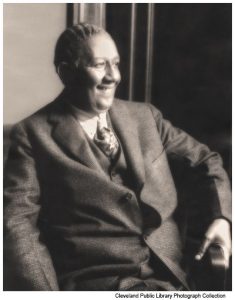
Thomas Fleming: Cleveland’s First Black Councilman

fleming_cpl_0

From the August 2010 issue of Cleveland Magazine by Erick Trickey

Lost to History

Before Carl Stokes, there was Thomas Fleming, Cleveland’s first black city councilman. But since he took office 100 years ago, Fleming, who rose to the heights of political power, has been almost erased from our public consciousness — all over $200 and a clambake.

ON HIS JUDGMENT DAY, Thomas W. Fleming greeted the courtroom with a smile.

Beside him, his wife, Lethia, held a black scarf over her face to foil the cameramen. But Fleming, wearing a three-piece suit and a big-cuffed, knee-length topcoat, flashed the same welcoming, generous grin Cleveland had known for 20 years. His soft, friendly face, round cheeks and lively brown eyes reflected the tenacious optimism that had carried him up from his barbershop to a seat on Cleveland City Council, the first ever held by a black man. His cheerfulness wasn’t just a façade or first impression, but part of his core belief that careful work, well-tended friendships and political compromise would overcome prejudice and win more prosperity and respect for his people than angry protest.

As Fleming walked up the aisle, nodding to his friends from the Central Avenue neighborhood and the reporters he knew from City Hall, would-be spectators in the hallway rushed toward the courtroom, hoping to see the trial’s end.

“Just the reporters!” barked the bailiff, blocking their way.

All that week, Clevelanders had gathered on the courthouse’s fifth floor: women in fur-collared coats, men wearing fedoras or newsboy caps, waiting in line for a seat at the trial. Most were black, and since they’d been kids, or moved to Cleveland from the South, Fleming had been their only black elected official, their neighborhood councilman, the man they’d turned to for jobs or help with a court case.

Now, they’d come to see if the prosecutor had discovered a side of Fleming they hadn’t seen, if it was true that he had taken a bribe from a disabled policeman, if he would remain in power or see his career come to an end.

Fleming walked to the defense table and sat in the chair he’d occupied all week. Three photographers, near the judge’s bench, aimed their tripod cameras at him.

The jurors entered the room and took their seats. Only two of the 12 looked at Fleming.

“Have you agreed upon a verdict?” the clerk asked.

“We have,” the foreman replied.

TODAY, 100 YEARS AFTER Thomas W. Fleming became Cleveland’s first black city councilman, he is all but erased from our history.

We take pride in Carl Stokes’ 1967 election as America’s first black big-city mayor, but not Fleming’s pioneering victory because his life story is no simple tale of racial uplift. In February 1929, his career was marred by a sudden, shocking scandal that sounded notes all too familiar to Clevelanders in 2010: money exchanged at a clambake fundraiser followed by angry accusations that his enemies and the press conspired to bring him down.

Throughout his 15 years on council, even as he became one of City Hall’s most powerful men, questions trailed Fleming about his part in the ruthless Republican political machine, his work as a lawyer defending gamblers and prostitutes, the lawless growth of vice in his ward, his alliance with a swaggering saloonkeeper who controlled a grimy underworld. Fleming’s memoir, My Rise and Persecution, was never published. He was even left out of the 1969 book Memorable Negroes in Cleveland’s Past.

But Fleming was memorable, one of Cleveland’s great characters of the 1910s and 1920s, cheerful and optimistic, clever and folksy. A shrewd ward politician, Fleming delivered more votes for Republican mayors than anyone and brought his neighborhood big gifts made of brick and concrete. After he and his wife helped Ohio’s Warren G. Harding win the presidency, Fleming audaciously asked Harding to name him to the same post his hero, abolitionist Frederick Douglass, had once held: minister to Haiti.

When Cleveland’s black population exploded in the 1910s and 1920s as neighborhoods filled with families who’d left the Jim Crow South to follow freedom’s North Star, Fleming was their lone voice at City Hall, their one-man hiring hall, the most powerful black man in the city. At a time when African-American leaders debated whether to agitate for social equality or focus on self-improvement, whether to join political machines or oppose them, Fleming, a classic politician, chose the machine. He made deals, granted favors and called them in. Until he granted one favor too many.

ON ELECTION NIGHT 1888 in small-town Meadville, Pa., 14-year-old Thomas Fleming stayed out late, leaving his mother worried at home. He stood outside the Commercial Hotel downtown, home to one of Meadville’s few telegraph offices, and listened to the returns until he heard his candidate, Benjamin Harrison, had been elected president.

From an early age, Fleming had seen black men claim a place in his hometown’s civic life. At 6, he was transferred from an all-black school to an integrated one thanks to the protests of prominent black taxpayers. When he was 11, his boss, a black bakery owner, won election to the Meadville council. “His election proved to me, even at my early age, that there was a chance for Colored men to rise in America,” he later wrote.

At 16, Fleming beat the mayor’s son, a college student, in a debate, arguing against restricting the vote to the educated. The debate wasn’t academic to him: Fleming had quit school at 12 to work as a barber to help his mother support him and his two sisters.

In 1893, Fleming rode a westbound train into Cleveland’s Union Depot, figuring he’d stay a few days then head to the world’s fair in Chicago. Instead, he never left, discovering that Cleveland was a good place for a young black tradesman to establish himself. Although the city’s few thousand black residents were often barred from industrial jobs and some restaurants and theaters, they found work as hotel employees, teachers and barbers. Fleming, already a veteran barber, started his own shop on Euclid Avenue within a year. In 1899, he moved into the barbershop in the new Chamber of Commerce building on Public Square. As Fleming trimmed and shaved powerful men in the sixth-floor Chamber Club rooms, some noticed that their barber, snipping and chatting away, possessed a political mind as sharp as his razors.

Like almost all black Americans a generation after the Civil War, Fleming supported the Republicans, the party of Abraham Lincoln, which was usually willing to hire black workers and slate black candidates for the ballot. A strain of racial progressivism had run through Cleveland politics for decades: Before the war, the Western Reserve, settled by New Englanders, had been an outpost of abolitionism. Despite the city’s small black population, its voters elected two black candidates to the state legislature in the 1890s.

Fleming met one of them in 1894 after joining a quartet that sang at rallies for the Republican mayoral candidate. One night, at an East Side meeting hall, he heard an inspiring speech by state Rep. Harry C. Smith, a hero to black Ohioans, who had just helped pass a civil rights law that banned discrimination in public places. Smith’s angry, militant editorials in his newspaper, the Gazette, denounced minstrel shows, racist laws and segregated schools.

“Smith is singular, rugged, forceful, dynamic,” another newspaperman once wrote, “full of the consuming fire that always flames hot to singe every defamer of his race and spurts unceasingly at every vestige of race discrimination.”

Impressed, Fleming became a protégé of Smith’s, stopping by his office nearly every day for political advice.

On Monday nights after work, Fleming would walk to the old City Hall on Superior Avenue, climb to the fifth floor, sit in the gallery and watch the councilmen debate. And one night around 1903, his eyes sweeping across the dozens of desks on the crowded floor, Fleming, not quite 30 years old, had a vision.

“Looking over the Council Chamber, I saw all white men occupying the seats,” Fleming wrote years later. “Every nationality was represented except one of my race group. I said to myself, there ought to be a Colored Councilman occupying one of those seats. I made up my mind that night that I would prepare myself and someday sit in one of those chairs.”

THE FLOWERS WEREN’T all for him, but they still smelled sweet. As Fleming strode into the City Council chamber on Jan. 3, 1910, applause rained down on him from the packed gallery. The mingled fragrances from bouquets blooming on each councilman’s desk filled the room and reached out to him.

He squeezed his stocky frame between the desks until he reached his chair, where his mother, sister and friends awaited. There were gifts from groups he’d co-founded: a horseshoe made of flowers from the Attucks Republican Club, a floral basket from the Cleveland Association of Colored Men. He was now Thomas W. Fleming, councilman-at-large, the town’s first black city councilman.

“It proved to me that Cleveland, Ohio, was The Garden Spot of Earth for anyone who chose to rise,” he wrote, “no matter what his nationality.”

In the seven years since he’d first envisioned this moment, Fleming had studied law at night, become a lawyer, spoken at political meetings, courted powerful friends, forged alliances and started his own newspaper. When a shrewd Republican had warned him he had no political future unless he aligned himself with Mark Hanna, Cleveland’s powerful U.S. senator and friend to presidents, Fleming promptly dumped a candidate supported by his mentor Smith and supported Hanna’s man for the post. Smith never forgave him, but as a political move, Fleming’s switch was shrewd; his standing in the Republican party rose from then on while Smith’s fell.

The council’s business was swift that night. Fleming was one of about 20 new councilmen, part of a Republican landslide that had also knocked legendary mayor Tom L. Johnson out of office. Spectators, crushed together in the balcony, looked on as Herman C. Baehr, the new mayor, mounted the podium and asked the councilmen to help build the Detroit-Superior Bridge and a new City Hall on Lakeside Avenue and annex Lakewood and East Cleveland.

After the meeting and a celebratory supper with family, Fleming headed to the Starlight Café, his friend Albert D. “Starlight” Boyd’s saloon. Tobacco smoke and 200 people filled the banquet hall. Speaker after speaker rose to applaud Fleming: the county treasurer, a deputy sheriff and, most impressive of all, Maurice Maschke, county recorder and undisputed leader of Cleveland’s triumphant Republican machine.

“The addresses of the evening were inspired by the promise of future successes,” Fleming’s newspaper, the Cleveland Journal, declared. “Mr. Fleming’s ability and integrity were highly praised.”

But Fleming’s raucous party appalled Smith. The councilman’s betrayed ex-mentor was uncompromising, exacting in his righteousness. Smith so hated segregation, he even opposed Karamu House’s race-conscious approach to theater. He found politics’ awkward alliances distasteful, refusing to support Baehr because the new mayor, as county recorder, hadn’t hired any black employees. And Smith knew too much about Fleming’s chums.

“Councilman Tom Fleming’s reception and ‘blow-out’ was continued over ‘Starlight’s’ saloon on East Fourteenth Street, after the council meeting Monday night, and was not terminated until the early morning hours,” Smith wrote in his Gazette. “O, shame! Are we degenerating? It certainly looks so.”

ALBERT D. “STARLIGHT” BOYD was a Republican ward leader, saloonkeeper, gambling-house operator and pimp. “He was the Great Mogul of organized vice,” wrote Jane Edna Hunter, a prominent black social worker, “suave, impressive, impervious to shame, and gifted with the art of leadership.”

Sometime around 1900, Maurice Maschke, an ambitious Republican operative, walked into Starlight’s Canal Road saloon. Amid the drinking and the presence of ill-reputed women with names such as Lotta the Small, Maschke saw the raw materials of power. Back then, when big-city political parties served as social clubs and mutual-aid societies, a saloon could double as a party headquarters where a smart ward leader could gather and barter a political machine’s essential fuels: money, loyalty, generosity, jobs, votes.

Starlight Boyd — it’s unclear which came first, his nickname or his star-shaped, diamond-studded watch charm — was as shrewd and calculating as Maschke. So the former hotel bookkeeper and the aspiring politician forged an alliance. Boyd became a Republican poll worker then a ward leader, a man who could get out the black vote and help tip the balance of local power.

As black migrants from the South moved into the crowded neighborhood along Central Avenue, Boyd followed them. He built the Starlight Café on East 14th Street south of downtown, complete with baths, a barber shop and a pool room. He bought apartments and houses and rented them to his allies. He sent food baskets to the needy. And his 11th Ward gave more votes to Republicans than any other part of Cleveland. When one precinct voted 245-5 for his candidate, Boyd was unsatisfied: “Tomorrow I’ll find those five votes,” he declared, “and they will learn something.”

Fleming didn’t need Boyd to succeed — not at first. In fact, his own alliances with Maschke and other white Republicans got him onto the party’s candidate list for City Council in 1907 despite Boyd’s opposition.

Two years later, running as a citywide, at-large candidate, Fleming swung into council on the Republican landslide. He swung back out in 1911 when Newton D. Baker led the Democrats to a rout, but not before his loyalty to Mayor Baehr garnered jobs for more than a dozen black workers: a park policeman, a deputy building inspector, a notice clerk, a storeroom supervisor, two janitors, several garbage collectors. Paltry spoils, but to Fleming, progress.

But after Fleming won the 11th Ward council seat in 1915, he needed Boyd. His memoir shows no qualms about befriending him, only satisfaction in a friendship and a lucrative business venture, their Starlight Realty and Investment Co. For black Clevelanders in the mid-1910s, allying with Boyd was the way to power.

Fleming and Boyd ruled the ward together. The councilman showered Central Avenue with City Hall’s blessings: a newly paved street, new streetlights, a new bathhouse. Boyd kept turning out the votes.

Naturally, Fleming and Cleveland’s Republican mayors were grateful. That’s why Starlight’s Z-Douglass Club on Central Avenue became one of the most infamous gambling clubs in the “Roarin’ Third” police district, yet attracted less than its fair share of police attention.

To Harry C. Smith, Fleming had betrayed black Clevelanders by allowing vice and immorality to flourish in the Central neighborhood. “Speakeasies, disorderly flats and a gambling den are in full operation,” Smith complained to an indifferent City Council in 1917. “The hands of the police seem tied.”

One night in 1921, the righteous Smith stopped by the Z-Douglass Club and told Boyd he might run for Fleming’s council seat.

“Why, you could not get started against Fleming,” Boyd snapped. “I dare you to be a candidate. I wish you would be one so we could defeat you worse than any candidate was ever beaten in Cleveland!”

Boyd and Fleming thought Smith wasn’t man enough to take a dare. But Smith transformed the race into a moral crusade. His angry meetings drew huge crowds as he blamed the Republicans for the Central neighborhood’s poor living conditions and moral degradation. His slogan: “Starlight and Tom must go.”

Smith and Fleming supporters rallied and argued. Smith’s election-eve torchlight parade attracted 1,500 marchers. Election Day on Central Avenue looked like a holiday, as if the whole neighborhood had taken the day off to swarm the polls. Police, stationed at every voting place, broke up several fistfights and arguments.

Fleming won, 2,830 to 2,053.

“My friends were so elated over my election that they hired a band, came to my office and compelled me to get in a parade they were forming in Central Avenue,” Fleming recalled in his memoir. “This street was crowded with people. Led by A.D. (Starlight) Boyd the procession proceeded up the Avenue, stopping at East 36th Street, where a deep hole was dug and they buried Mr. Smith in effigy.”

Soon after, Boyd fell ill with pneumonia. Exhausted by the campaign, he died a month after Election Day, at age 50.

BY 1927, FLEMING HAD achieved more than he’d even imagined as a young man. He owned a beautiful house on East 40th, one of the city’s most prominent streets. That summer, he and his wife, Lethia, sailed on a cruise ship to Europe, toured Windsor Castle and Westminster Abbey in London, ate dinner atop Switzerland’s Mont Blanc, gambled in Monte Carlo, glided through the Venice canals on a gondola and saw Josephine Baker dance at the Folies Bergère and at her private club, Chez Josephine, in Paris.

At home, Fleming had become the most powerful black politician in Cleveland’s history. Maurice Maschke had become chairman of the Cuyahoga County Republicans, and reporters described Fleming as one of his key lieutenants, the “left bower” in the party boss’s euchre hand.

In return for his loyal vote on council and his constituents’ votes on Election Day, Fleming won better pay and increasingly prominent government jobs for black workers: clerks, road foremen, two prosecutors. He’d gotten City Council to ban the Ku Klux Klan from marching in the city — and the Klan had retaliated by dropping angry fliers on Cleveland’s black neighborhoods from a plane. Smith, sniping in theGazette, might not have been satisfied, but Fleming’s alliances had brought results.

“Could anyone have done more? Could I have labored any more faithful?” Fleming wrote plaintively in his memoir. “At least I was true to my trust and loyal to my race.”

In the 11th Ward, Fleming tried to keep the vice raids at bay though police launched a few while he was overseas. For eight years, Fleming had chaired the council’s police and fire committee, setting cops’ salaries and pensions, while defending gamblers, Prohibition-defying liquor dealers and prostitutes as a lawyer in police court.

No one dared call it a conflict of interest though reporters hinted as much. “It is possible,” winked the Plain Dealer’s Roelif Loveland, “that policemen, serving as witnesses in such cases, recalled that the persons against whom they were testifying were the clients of the chairman of the powerful council police and fire committee.”

Fleming saw it differently. “I was their friend,” he wrote of the cops and firemen, “and they came to me with their troubles.”

Detective Walter Oehme was one of those men, a tough, husky cop until he was injured in a fight with a speakeasy’s drug-addicted spittoon-cleaner. Unable to stand on his own or lift his arms above his shoulders, Oehme, living on a pension of $87 a month, asked Fleming to get council to pay his medical bills. Fleming’s ordinance granting Oehme $1,740 passed while he was in Europe.

When Fleming got home, Oehme approached him again. On Sept. 27, 1927, Oehme’s wife drove him to the Colored Elks’ Club on East 55th Street, where Fleming was getting ready for his clambake fundraiser, and Oehme handed the councilman a $200 check.

THE DOORBELL WOKE Tom Fleming after midnight. He was so tired, he ignored it at first, but Lethia said it might be a telegram or special delivery. So he shook off his sleep, put on his blue and red bathrobe and red leather slippers and went to the front door.

Three Plain Dealer reporters crowded in, excited. They asked if he’d quarreled with Walter Oehme after the council meeting that evening, Jan. 21, 1929.

“Why, no,” Fleming replied — their chat had gone just fine.

But the reporters told him Oehme had come to the Plain Dealer office, saying Fleming had insulted him and alleging Fleming had shaken him down for a $200 check.

“Boys, do you think for one moment I would take a check for a bribe?” Fleming laughed.

The reporters assured Fleming they were serious.

“It’s a lie!” he shouted.

“What about the check?”

Fleming later claimed he was so dumbfounded at the accusation, he didn’t recall his exchange with Oehme a year and a half earlier.

“If he thinks he got a check, let him produce it!” Fleming said.

He sat down at a hall table, grabbed a pencil and wrote a note: “I never received one cent from Walter Oehme for anything I did for him. … I felt sorry for him in his crippled condition. … I knew him when he was an able-bodied policeman and tried to help him.”

Pacing the hall carpet, his hands behind his back, Fleming described Oehme as an ungrateful man who showed up at every council meeting, who wouldn’t stop asking for more cash. “For anybody to take money from a crippled man like that would be rotten,” Fleming said. “I don’t need money that bad.”

The reporters looked down the tastefully carpeted hall, where portraits of great Republicans hung on one wall, an old photo of Fleming in a summer suit on another. In the distance they saw Fleming’s living room, with books lining the shelves, and the dining room, filled with gleaming silver and white linen. They told Fleming to look for the Plain Dealer in the morning and left.

When dawn broke, Fleming went to his porch and picked up the paper. “Crippled Policeman Says He Paid Fleming $200 After Council Action,” the headline read.

The same day, Oehme produced a cancelled check with his and Fleming’s signatures on the back. Prosecutor Ray T. Miller called Oehme to testify before a grand jury, which promptly indicted Fleming on charges of soliciting and accepting a bribe.

Fleming’s supporters rallied at meetings across the Central neighborhood, calling the indictment “rushed through” and accusing the Plain Dealer of sensationalism and “trying his case • outside the courts.” Harry C. Smith played it cool, writing that “the great mass of our good people” disapproved of the rallies and would wait to see how the case turned out.

OEHME LEANED on the prosecutor’s arm as he walked shakily to the witness stand. He testified that the $1,740 from the city hadn’t been enough to pay all his medical bills. But when he went to Fleming for more help, the councilman had responded, “Did you save any of it for me?” Oehme said he’d told Fleming he had another $354 in medical debts. “Get me some money and I’ll see what I can do,” he claimed Fleming said. So Oehme borrowed $200 from his step-grandfather, signed the check over to Fleming, and handed it to him at the Colored Elks’ Club. Oehme said no one else had been present.

Oehme’s wife backed up his story, claiming she’d heard Fleming ask for money. Two city councilmen testified Oehme had told them about the bribe a year earlier.

Fleming told a different story on the witness stand than he’d told the reporters, but he denied taking any bribe. He said Oehme had shown up at the Elks’ club and asked him to cash a check. “He thought he owed me some money for legal services and wanted me to keep $50,” Fleming testified. “I took the check, for $200, and gave him $150 in change.”

Two witnesses testified they saw Oehme hand the check to Fleming and take cash back from him. Character witnesses, including several judges, lined up to testify for Fleming.

The trial lasted three days. The jury — eight men, four women, all white — deliberated for 13 hours and delivered their verdict on a Friday morning. The foreman gave it to the clerk, who read it in a deep, booming voice: Not guilty of soliciting a bribe. Guilty of accepting one.

Fleming drummed his fingers on the table, then clenched his fist tight. He scowled. Lethia patted him soothingly on the back.

Then they stood and hurried for the elevator. As they neared the courtroom door, Fleming mumbled, “This is murder.”

FLEMING SERVED 27 months in prison. He returned to Cleveland in January 1933 and greeted visitors at his home on East 40th Street with the same old friendly smile.

“I haven’t any bitterness,” Fleming declared. “I slept every night in the penitentiary because my conscience was clear. … I say now, as I say when I was convicted, that I am innocent of what I was charged with.”

In his memoir, however, Fleming’s sense of persecution shaded into dark paranoia. He blamed the Democratic prosecutor, the Plain Dealerand the Klan for his conviction. “I figured the Ku Klux Klan had been secretly working to frame me ever since that organization scattered those thousands of cards from an airplane among the people of my District,” he wrote. In one of his many appeals, Fleming’s lawyer had claimed several jurors at his trial were Klansmen, but they’d denied it.

Cleveland had moved on. With Fleming gone, the city’s black population, which had grown from 8,400 to more than 70,000 during his years in council, had turned to new leaders. Two more black councilmen had been elected in 1928, and Fleming’s minister had replaced him on council. The press asked Fleming if he’d try to come back, but he demurred.

“If I get into politics,” he said, “I’d be afraid I’d get high again and get knocked out again.”

Two years later, Fleming won permission to practice law again and set up an office in his home. Judges, lawyers and city manager William Hopkins sent him congratulations. But two cerebral hemorrhages sent him to the hospital in 1936 and left him in a wheelchair.

Fleming outlived his rival, Harry C. Smith. He, too, was stricken with a cerebral hemorrhage and died in his newspaper office in 1941. A near-hermit by then, with few friends, he left his estate to a German-American woman described as his friend, tenant and housekeeper.

When Fleming died in 1948, the police chief, countless Elks, Mashcke’s widow and all the councilman from Cleveland’s black wards came to Friendship Baptist Church for the funeral. His coffin lay on the altar, covered with flowers. Years later, his niece would insist that Fleming didn’t die of poor health, but of the heartbreak inflicted by his bribery conviction.

Teaching Cleveland Digital