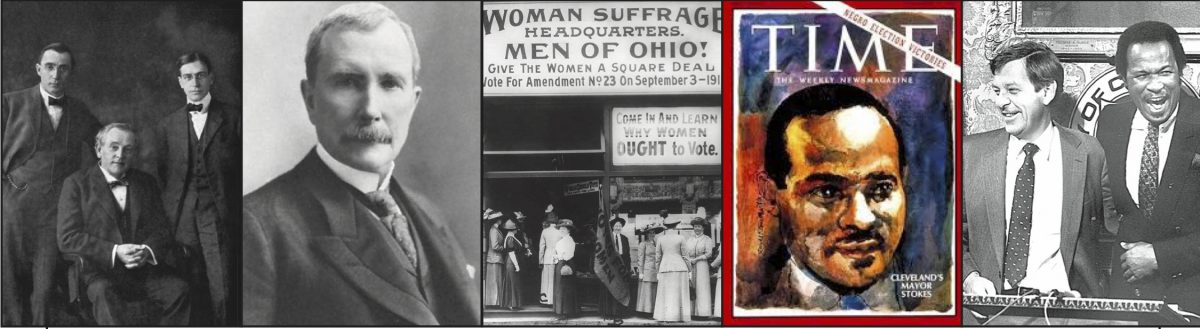
Roldo Bartimole tells his version of Cleveland civic history during the 1960s, 1970s and 1980s in a piece called “”25 Years of Cleveland Mayors” written in 1992
Tag: Roldo Bartimole
Squire Sanders and the Sabotage of Cleveland by Roldo Bartimole Written June, 2009
SQUIRE-SANDERS AND THE SABOTAGE OF CLEVELAND
written June 2009
By Roldo Bartimole
This is a story of civic sabotage.
The desire for the private sector to damage, destroy and take over the Cleveland’s public electric power system reveals an important lesson in how power works in this or any community.
It also is instructive in the sense that you can apply these past lessons to today’s events and Squire-Sanders’s role in the medical mart.
This piece continues my attempt to review aspects of power that have been used in the community and to suggest how it is used today.
Squire, Sanders & Dempsey, Cleveland’s second largest law firm at the time, was a key player in this assault on public government.
Oddly, Squire-Sanders represented the city at the same it represented CEI, the private electric company. Guess whether the city or CEI got the best representation. The city claimed in court papers that the flow of crucial financial information went one way – to CEI, never to the city.
A lot of information about this situation became publicly available because the city eventually sued CEI. Court cases open private matters to public scrutiny.
Here’s the issue. Back in 1972 the city needed financing to help improve its electricity system. It wanted to borrow $9.8 million by letting bonds. Squire-Sanders served as its bond counsel.
The original legislation provided for sale through the City’s Sinking fund. If this didn’t work the city wanted to borrow via its own treasury account. This would allow the city to borrow from itself and at cheaper rates than on the private market.
However, an amendment to the city’s legislation, written by a Squire-Sanders attorney, stated that the bond issue could only be made on the open market. The amendment was attached to the legislation by then Council utilities chairman Frank Gaul, a close friend to CEI. Gaul in a court deposition admitted that he took gifts from CEI general counsel Lee Howley, a former city law director, and cooperated with the company in other ways.
Another Squire-Sanders lawyer wrote the original city legislation. It wanted the borrowing to avoid the private market.
“At that meeting the SS&D lawyer who wrote the ordinance was asked by the (city) law director to defend it, but, says the city, he “declined to defend his own work product and CEI’s crippling amendment was adopted and the amendment was approved…” I wrote from city documents at the time.
The move delayed the required borrowing for improvements until 1975. Just CEI’s desire. Ironically, the delayed bond issue was made through the city’s treasury account, as originally planned.
On another occasion during this period, the city attempted to buy backup power to avoid bad service. A CEI memo revealed that its executives, along with a Squire-Sanders partner, decided “The the company should refuse” to allow the city’s system to join a group that would give Muny Light cheaper power it vitally needed.
The city claimed that Squire-Sanders lawyers’ “representation of the city has endured so long, involved so many of its lawyers, and been so all pervasive it is very difficult to put any limits on their knowledge of the city’s affairs… Their inside knowledge… very likely exceeds that of the city itself.” All too true. Sabotage.
One of the milder charges against the law firm at the time was, “It would appear that Squire-Sanders used the management and financial information gleaned from its representation of the city for the benefit of CEI,” according to a brief that asked that Squire-Sanders be disqualified from representing CEI before the U. S. Nuclear Regulatory Commission on an issue involving the city. Sabotage.
Here were some of the charges the city made against the law firm:
– It allowed amendments to legislation that it wrote to insure the city wouldn’t get needed financing.
– Advised CEI of a plan by which it could thwart the city’s attempt to get interconnections to needed electric power, although the law firm knew that the plan was likely illegal.
– Participated in CEI decisions that denied Muny Light cheaper power source.
Squire-Sanders, as today, injects itself into public matters. Indeed, it is used by many politicians as consultants. This puts the law firm in a central position on many public decisions, as Nance has been with the Browns situation and now the Medical Mart/Convention Center project.
One of the strategies businesses uses is to offer itself as helpmates to the city.
This was the case in 1967 when Ralph Besse, chairman of CEI, and a former Squire-Sanders law partner (upon retirement he went back to the law firm as a partner), formed the Inner City Action Committee to supposedly “help” Mayor Ralph Locher. The city was in serious trouble at the time with its urban renewal program.
Instead of helping, Besse administered a severe blow to Locher in a re-election year. First, he tried to foist one of his people on Locher to head the city’s urban renewal program. His odd choice was a former major general of the U. S. Army.
Locher balked. Besse turned on Locher. He went to the always accommodated Plain Dealer. The Pee Dee, as I have always liked to call the paper, did more than simply accommodate. It ran a top of Page One headline: “Besse’s Inner-City Group Quits Locher.” It was a powerful blow to a beleaguered Locher. Sabotage.
Locher did hit back. “I have not yet seen on real constructive action taken by the committee. So far we have heard some cries from them and they have made some demands on us. Where’s their action?” Locher’s point had validity.
Besse, of course, had an ulterior motive in embarrassing the mayor. His company wanted control of the city’s municipal light plant. But that never came into the public discussion. The media rarely, if ever, call corporate people on their self-interest in civic matters.
These efforts poisoned the relations between government and the private sector as dominated by corporate/legal interests in Cleveland.
This is an important point. These efforts damaged decision-making and leadership in this town. They built mistrust into all civic dealings.
Besse greatly admired favored Hitler general Field Marshall Erwin Rommel. He admired Rommel so much that he ordered his top executives to read him and adopt his methods.
War, not business.
One of his lines to his executives read, “The dead are lucky, it’s all over for them.” He had just finished reading ‘The Rommel Papers,” edited by B. H. Liddel Hart.
“There are so many places (in the book) where the parallel with business command is apparent that I have copied a few of the most interesting quotations… and have attached them,” wrote Besse to his executives.
One employee challenged him and he was dumped. He charged Besse wanted the company to operate as a war machine even though the company was actually a public utility with a “guaranteed profit.” I think this truth about it being a public utility whose profit was assured goes to the core of why CEI and the business community so wanted Muny out of the way. (See the full story in Point of View, Vol. 10, No. 22, May 22, 1978.)
The truth was both the city’s plant and CEI were not businesses in the true sense.
Here is one of the passages he cited for his executives:
“If there is anyone in a key position who appears to be expending less than the energy that could be properly be demanded of him, or who has no natural sense for practical problems of organization, then that man must be RUTHLESSLY REMOVED.” (My emphasis).
The fight by the city to maintain its electric system is a classic case of public vs. private interests. It should be studied in business economics classes. It goes to the core of many ideological problems being examined now on the national stage.
We will see how CEI and Squire-Sanders tried to destroy the city’s electric system over a number of years and how it was caught breaking the law by the U. S. Nuclear Regulatory Commission and how a federal lawsuit, in two trials, failed because of a Cleveland judge’s bias permeated the courtroom.
CARL STOKES —PROMISES NOW SADLY FADED by Roldo Bartimole July 10, 2017
CARL STOKES —PROMISES NOW SADLY FADED
July 10th, 2017
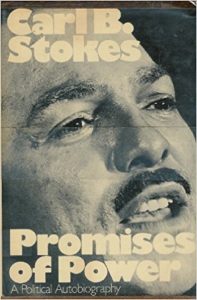
We are getting close to the 50th anniversary of the election of Carl Stokes as the first black mayor of a major American city. It’s hard to imagine that so much time has passed.
We need the thrust of those days of dissent against the imbalance of today’s Cleveland. The difference we endure between prosperity and despair.
The first time I met Carl Stokes must have been in 1965, my first year at the Plain Dealer. I was a general assignment reporter and had to cover an event where Stokes was appearing. It was, I remember a Sunday and likely the reason I got the assignment. I talked with him before or after his meeting. I don’t remember any content, but 50 years does that to you.
I do remember the impression he left. The first impression of Carl Stokes remains clear 50 years on. Here was a man who didn’t like reporters. Likely didn’t trust them. His manner sent the message.
I can’t tell you what he said. I only remember the cool manner. I talked to him only a few minutes. It was all very perfunctory. The man was going to run for mayor and he should be covered. I guess that was the reason anyone was assigned to him that day.
I’m sure he had his reasons for disliking reporters.
He made it clear many times.
He once said at a press conference, “There is hardly a place in this community where two or more persons join that their disgust in the two newspapers is not expressed. Rich people, poor people, black and white people. There is a serious erosion of confidence in the truthfulness, the integrity and the sincerity of the newspapers. And yet, what recourse do the people have as a source of news? None, really.”
A lot of people agreed with that. I do with experience from inside. That is why I’ve used that quote more than once or twice.
Carl Stokes was the best politician I ever covered. He had charm. He had great political instincts. He carried himself with confidence and distinction. And good looks never left him. Never hurt him either.
He decided not to run for a third term, in my opinion, because he had become sick of the Cleveland plutocracy. His press secretary Dick Murway told me that bluntly. Stokes, he said, was tired of being their “house nigger.”
He had had it with the racism and in particular with the corporate community. Business interests after his election ran a full-page ad in the Wall Street Journal. It was putting a brave face on its nervousness in having the first black mayor of a major U. S. city at a time of civil unrest. The ad bragged of an old blue chip city having bright new leadership.
In 1989 Fortune magazine described how Cleveland’s corporate leaders engineered a coup by dumping Mayor Dennis Kucinich. It was only the start of a takeover of city government. It has become the model for control and dominance. Limited to specific prized areas of the city.
Mayor Frank Jackson, now seeking a fourth term, comfortably represents the present Cleveland establishment. He totally lacks the political instincts of a Stokes. But this is an amazingly different time in Cleveland. Instead of civil rights and uprisings with hope, we have sporadic convulsions fed by a depressing succession of social disease caused by poverty and the lack of concern that spurred actions in the 1960s. We have a community illness lacking a spark of hope. Hopelessness breeds social disintegration. This may be Jackson’s legacy. His and corporate fear is that resistance has taken hold.
That’s why Jackson has begun to act as if he cares. And corporate interests are starting to strike back. Out of fear. It may be too late for them. Many citizens see the duplicity.
A first sign has been the formation of a church grouping to draw attention to a number of social issues that have gone unattended here. This is a crucial event. The latest attack against the groups indicates this realization. It was noticed. Not with pleasure.
The media play of the four of 43 religious organizations that left the Greater Cleveland Congregations organization because of its opposition to a multi-million gift to Dan Gilbert has the smell of Cleveland corporate politics at work. No one could convince me this isn’t Jackson/corporates string pulling. No doubt the PD won’t examine the elites and connections of the four dissenting church groups. The media will let it ride.
But it is the most relevant action in years.
In 1968, a kind of payoff program run by some business leaders—paying black militants to keep peace during Stokes’ primary run—provided resources that led to the purchase of guns used in the 1968 Glenville shootout with police.
That ended any real cooperation with Stokes from the business people.
Stokes wrote about the establishment in his Promises of Power, a perfect title for his political career.
He related his experience with the established corporates in his memoir of the times:
In the Spring and Summer of 1967, when the same power structure was grooming me as the man to back in the mayor’s race, I was invited to the most exclusive clubs in Cleveland to talk to them about myself and what I hoped to do for Cleveland. It became clear after a couple of these lunches that these men had two things on their minds—the fear of another riot and the possibility of an alliance between Stokes and Cyrus Eaton.
Eaton was an unconventional corporate leader and a worry to Cleveland’s top business leadership. When I started Point Of Viəw in 1968 there was a silly rumor that he was financing me. Never met him. I never heard from him.
Stokes said one thing he learned from Eaton a Cleveland unwritten code. It was unstated “but hard as a rigid fist—against getting involved publicly on issues. That is the rule for the power structure, the business community, those very private men at the top of our businesses and industries. They couldn’t afford to fight Eaton in the public area because they do too many things the public must not know; their deceptions, their intrigues, their dealings with each other must remain private.”
Quite a telling truism. Backed by experience.
Of course, you could never forget the problems Stokes had with the Cleveland police. They refused to accept a black mayor. He blamed the media, particularly the Plain Dealer, for allowing the police to spew hatred. The Western Reserve University Civil Violence Center labeled the PD effort as “effectively keeping the vendetta going between the races.”
Calling the police department “blatantly anti-Stokes” in his book, he charged the PD with permitting them “to spew out their hostilities toward me on the front page.” (I remember writing that what the PD did was “print the ugly rumor from fact,” while promising to separate “ugly rumor from fact.” Chief among the PD reporters was Doris O’Donnell, a favorite of the cops.)
However, the police remained a significant problem for Stokes.
There is a police-corporate connection via Bluecoats. Wealthy Bluecoat donors provide help to officer’s families if killed on duty. At one Bluecoat meeting Fred Crawford, boss of TRW, Inc. made a racial joke about Stokes. The PD reporter cited it in his coverage but it was removed before publication. Someone sent the original copy to me and it appeared in POV.
Stokes may have thought he had a surprising solution. He believed he had found an answer in Gen. Benjamin Davis. Davis was retiring as an Air Force three star general. (He got a 4th star from President Bill Clinton). Stokes had had trouble with naming a Safety Director. So Stokes met with him secretly and asked him to come to Cleveland as Safety Director. The police would have to respect him, thought Stokes. He writes that he allowed himself “to be carried into the greatest personal debacle of my career.”
However, I believe the result revealed Stokes’s incredible political talent when his choice became a critical mistake. Davis was loved by the police and by the Cleveland business and media establishments. They thought of him as Stokes’s replacement.
I put the Davis situation in clear, simple language, noting that he was supposed to “bridge the gap between the police and the Stokes Administration.”
But I noted instead, “He joined the cops.”
Stokes put it another way in his book, “Jim Stanton (Stokes bitter rival and Council President) love him, the newspapers loved him, the white community loved him. And … the police fell madly in love with him.”
It didn’t work that way.
Davis, apparently taken by all the adulation he was receiving, struck at Stokes in a devastating way.
He wrote a letter of resignation, claiming Stokes was supporting “enemies of law enforcement.”
The hit was where Stokes was most vulnerable—on community safety.
“I find it necessary and desirable to resign as director of public safety,” Davis wrote in a letter to Stokes.
“The reasons are simple: I am not receiving from you and your administration the support my programs require. And the enemies of law enforcement continue to receive support and comfort from you and your administration. I request your acceptance of my resignation at your earliest convenience.”
It was a news bombshell. It became a news media frenzy.
I wrote at the time that Tom Guthrie, an assistant to PD publisher Tom Vail and someone reporters felt was intolerant of blacks, rarely wrote anything. But here he couldn’t resist, blessing Davis with “absolute integrity.” He apparently learned this reporting that Davis’s golf shots were “right down the middle,” revealing himself as a golf partner of the General.
Not only did Davis say enemies of law were ascended but Stokes was supporting them.
“This damn hero,” said Stokes, “was accusing me of harboring criminals; suddenly all the racist rumor about me were confirmed,” Stokes wrote.
The charge, however, lacked political shrewdness on Davis’s part. He was a straight-laced commander, not a politician.
He excited the news media. However, he wouldn’t name any “enemies of law enforcement.” He remained silent.
Stokes, shocked by the press favorable response to the Davis charges, called upon Davis to name the names of these “enemies of the law.”
Davis stood his ground. After all, he was the General. His word was The Word.
Stokes, at a packed press conference, put out the names himself. He had gotten them privately from the General.
It blew a giant hole in the General’s and media’s damning story.
As I’ve written before the “enemies” list included the Council of Churches, the Call & Post, a black community newspaper, and a settlement house.
None were on anyone’s “wanted” list. It was a blunder by Davis, He didn’t understand Cleveland.
Stokes had set the political trap for Gen. Davis. His reluctance to name names did him in. Further, Stokes had more ammo.
At the time there had been attacks on blacks in the Tremont area. Police did little or nothing to suppress the violence. Davis ignored it. I had written about the issue two weeks before. Neither its councilman, Dennis Kucinich at the time, nor Davis moved to quell the violence.
Davis apparently thought he was headed for greater things in Cleveland.
I wrote in July 1970: “Davis began getting tacit support from parts of the media and the Democratic and Republican parties looking for a candidate in 1969.
Stokes, of course, not only survived the crisis but went on to win the election in 1969.
I had a young man in Stokes’s office that provided me with information. I was able to print that Davis tried to order 30,000 Remington 38 special, 125 grain hollow point bullets. At the City Club about this time, Davis charged that black nationalists were “out to get police and out to get us.” I then noted that it appeared he got it backwards.
After Martin Luther King, Jr. was assassinated in July of 1968, Stokes walked the streets of Cleveland. Cleveland had no rioting that night as other cities exploded.
So the corporate community joined with Stokes in a program supposedly to attend to some of the urban problems. It was called Cleveland Now but was not heavily funded. The media played it up as a serious attack on poverty. It was a phony program.
In 1993 I was given a celebratory night marking 25 years of publishing the newsletter. I walked in and could see Carl Stokes standing in front of the stage. He was reading it. The headline on Vol. 1 No. 1 was:
Cleveland Now:
another gimmick
It started:
Just ask yourself: Is the answer to the massive physical and social problems of American cities to be found in 55 cent contributions of widows, 10 cent donations of welfare children, or one hour’s wages of laborers.
Cleveland Now creates the illusion that it is. Therefore, it’s a pornographic answer to the city’s ills. It is a diversion.
I quickly walked up and said, “You don’t want to read that Carl.” He said, I believe amused, “It’s the only thing up there.”
When he left office, Stokes went off to New York City, where if you can make it there you can make it anywhere. He became an anchor at the local NBC TV station.
But he returned in the late 1970s. First to bolster Dennis Kucinich’s run against George Voinovich, the corporate darling who claimed to like “Fat Cats” and did. “I want as many in Cleveland as I can get,” he told the New York Times.
But his return had to be part of a deal. The United Auto Workers were big backers of Kucinich. The steel union became a Stokes law client. A major client he lost with a change in national union leadership.
I remember at the time meeting him on the street downtown. He invited me up to see his new offices. The office was being reconstructed.
I remember him telling me, “You didn’t think I came back to be a Councilman, did you?” Hadn’t even thought of that.
But I figured he came back to resume his place as the town’s major powerbroker, particularly in the black community. But it was too late. George Forbes had consolidated power and wasn’t about to share. Forbes had made his deal with the white Democrats and the white business community. And they with him.
He was their guy.
My personal remembrances of Stokes were mostly good.
When he was mayor WKYC-TV had televised press conferences with city hall reporters questioning Mayor Stokes. I pushed my way in. At one point Channel 3 management tried to bar me. Stokes essentially said I was in or he was out. They couldn’t so easily dismiss me, thanks to Stokes. The show went on for a time. It’s shameful that today there is no real live coverage of the mayor or the county executive. A weekly press conference would produce news.
One experience wasn’t good. That’s when he sent me a threatening letter. He threatened to sue me. I believe I know the reason. It had to do with that power thing. I ran the headline on his threat: STOKES: POV LIES [Page 3, JH].
He was right. I had inadvertently made a mistake. Indeed, I had called him about an organization I was to write about. He told me he didn’t really know much and that he wasn’t a member. His brother Lou Stokes was, he said.
When I ran the list of members I erroneously typed in both Lou and Carl Stokes. This was early 1982.
I apologized after running his entire letter of complaint. I never heard anything else about it.
I believe he was sending a shot across the bow. He worried about any criticism of him at that time, especially that someone would write negatively about him. I would have been a minor possible hazard but he knew Point Of Viəw did have limited but readership among politicians, media and corporate types.
Stokes did invite me to speak to a class he was teaching at Case-Western Reserve University. Most mayors seem to get teaching positions at local universities after serving.
Following the class with Stokes he asked me to dinner at the now gone Boarding House on Euclid near Mayfield Road. We had dinner upstairs.
When we finished and were coming down the stairs, a young black man playing pool looked up. He said, “Hey aren’t you….” and anyone could finish that sentence: “Carl Stokes, right?” But instead he continued, “Roldo?” I was recognized because The Edition, a classy alternative, used a caricature of me with a column I wrote. More people recognize me from that drawing than from any photo of me.
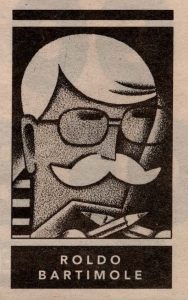
I couldn’t believe that Carl Stokes would go unrecognized. It didn’t upset him but it reveals how easily we forget our history.
As we left the restaurant, Stokes said something to the effect that “wouldn’t Dick Feagler make a story of that.”
Feagler was a favorite of Stokes. He could write the touchy-feely columns that just aren’t done here anymore.
I always regret that the last time I saw Stokes he was picking up something from my home. We didn’t talk long. I regret that I didn’t ask him to sit and share some time with him.
He died not long after.
By Roldo Bartimole…
The story originally ran on July 10, 2017 and the link is here
One Man Can Make A Difference by Roldo Bartimole
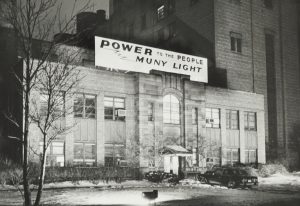 photo: Cleveland State University
One Man Can Make a Difference
By Roldo Bartimole
It took a single person’s act in 1979 to save Cleveland’s public electric light system.
And no, that man wasn’t Mayor Dennis Kucinich.
It was a Plain Dealer reporter. His name was Bob Holden.
Mayor Kucinich had been forced by political pressure to put the Cleveland Municipal Light System, commonly known as Muny Light at that time, on the ballot. The measure asked voters to decide whether to sell or keep the troubled electric system. Muny produced no electric power itself. The city’s system owed its origin to the progressive politics of Mayor Tom L. Johnson in the early 1900s.
Kucinich and his administration worked exhaustively to save Muny. But without Holden’s act and the ensuing revolt at the Plain Dealer, it would not have been sufficient.
A Jan. 23 poll showed the ballot measure would go down by a 70 to 30 vote. Cleveland voters were tired of the constant disputes of the Kucinich administration. The poll revealed the voter frustration. On Feb. 27, 1979 the voters, however, made their choice.
Historically, the era of the 1960s was ending or over. In Cleveland, however, Kucinich kept it alive. He espoused an urban theory that urged progressives to concentrate on economic issues, not social issues. Progressives flocked to his administration from around the nation. He even drew Ralph Nader into the drama.
The two electric power companies had been involved in explosive disputes – legal and financial – for years. The city was suing the Cleveland Electric Illuminating Co. (CEI) for anti-trust violations and dirty tricks. A federal case was pending. Cleveland also disputed unusual high charges for power provided to Muny by CEI. Meanwhile, CEI tried numerous underhanded methods to weaken and destroy the city’s system. The aim was clearly to put the city out of the electricity business. CEI now is an operating company of First Energy Company of Akron.
So how did Bob Holden do it? He did it by being kicked off the story of how CEI had purposely damaged Muny Light.
But Holden didn’t go quietly.
Here’s what happened.
As the reporter assigned to cover CEI, Holden was delegated to report about the dispute between the two entities. In early 1979 series of articles was planned.
Before he got started, however, CEI complained about him to the Plain Dealer. They didn’t want Holden doing the reporting. They figured him as too tough. They also knew that the proof of the company’s bad behavior was readily available. Holden would not shy from collecting the data and writing it.
The editors folded under CEI’s pressure. Holden was pulled from the story. The reason editors gave was that Holden “would be unfair.” Not something reporters wanted to hear.
Since he hadn’t written a word how they determined bias was a mystery. How could they say that? The Plain Dealer editorial hierarchy was going out on a limb with that excuse. Reporters weren’t buying it.
At the time the Newspaper Guild, representing reporters, was strong and militant. Unlike today when reporters fear losing their jobs in a diminished newspaper business, reporters then were willing to fight management. The Guild voted to withhold bylines on articles and to picket the PD. This would reveal their displeasure about the censorship to the public. It would embarrass the editors. The Guild contract allowed reporters to withhold bylines.
Management buckled, though not totally.
These were tough times for media managers. In November 1978 WJW Channel 8 retracted a piece done by Bob Franken. Franken reported that a National City Bank Chairman Claude Blair wanted to deny refinancing city debt and force Cleveland into default to insure Mayor Dennis Kucinich’s defeat in the next mayoral election.
The station, under pressure from the bank, retracted the report. Ch. 8 news director Virgil Dominic read the rare retraction that said “We now find that all of the statements we made were inaccurate and there was absolutely no basis for the report.”
Franken resigned after the retraction was aired. He said, “I can only tell you that the story is not inaccurate. The story is 100 percent true. My sources, in this particular case, are incredibly good sources.”
“This in my mind,” he said, “was simply a matter of the power structure in the town getting its way.
Franken became an Emmy-winning reporter for CNN, covering the White House and Congress until he left in 2007.
Here’s how I explained the Holden situation in my newsletter Point of View in February 1979:
“The Guild followed by voting to withhold bylines and picketing the newspaper to call attention to the PD censorship. With TV coverage, particularly on Ch. 3, and radio, particularly on WERE, the entire community found out about the latest PD censorship.
“To get out of the spotlight, management agreed to meet with Guild members to hammer out a compromise.
“The two sides met for some eight hours at the Leather Bottel, a restaurant-bar, and an agreement was reached. It became the joint statement of the Guild and management:
“Plain Dealer reporter Robert Holden, for the month of February, will, as assigned, fill in for the vacationing book editor.
“At the end of February, he will report to the city editor as general assignment reporter under the usual PD standards.”
The two sides went a bit further.
They verbally agreed by handshake, reporters said, that Holden would spend the rest of the month of January on his utility beat.
But the deal broke down after Holden appeared on a television news show the same night he turned in an article about CEI. The article was not printed but ran later without his byline.
The Guild had been outmaneuvered. The written agreement, made in a bar with both sides drinking, said nothing of Holden returning to his beat.
Holden resigned in disgust.
His demise became a fulfillment of a warning made by a CEI public relation person more than a year before. The CEI spokesperson told Holden:
“CEI will be here long after Bob Holden is gone.”
However, Holden’s refusal to be censored and the reporters’ protests damaged the PD’s credibility. It put the newspaper in a vulnerable position. No newspaper wants to be seen as openly censoring itself.
Editors were forced to assign others to write the history of the dispute that led to the ballot issue.
The situation made it difficult for the PD to censor a second time. A team of reporters was assigned to the story.
The paper had no choice but to accept the articles the new team wrote after Holden’s resignation. The news room was in insurrection mode.
“We’d have gone crazy and we’d have gone crazy in public,” said one reporter asked what might have happened had the PD tried censorship again.
“The Saturday Night Massacre would apply,” he said, referring to the resignations during Watergate. It would have put the PD in the position of having no reporter who would take the assignment.
Dave Abbott, now head of the Gund Foundation and Dan Biddle, who became a Pulitzer Prize winner in Philadelphia, were assigned to write the series. Their articles revealed the hidden truth about how CEI tried to damage the city’s electric system. One headline on Feb. 11 revealed the tone: “CEI Objective: Snuff Muny Light.
The dramatic outcome of this battle between staff and management was revealed by the result of the vote. It flipped.
The early poll showed that Cleveland voters would elect to sell the city’s electric system to CEI by a two to one vote.
The dispute and Holden’s resignation allowed freedom to the two new reporters. Prompted by revelations they produced, the actual vote came in two to one to maintain the city’s electric power system.
It was a critical example of the power of information. It revealed that if you give people the truth, they’ll understand and make their decision. It also shows that when the news media hide the truth it distorts democratic decision-making.
The change in public attitude was striking.
I wrote in Point of View before the election: “The virtual blackout on Muny Light has been shattered. The Holden affair and the entry of Ralph Nader into the fight gave focus to the charges of the news media’s refusal to focus on the dispute in a meaningful way. The news media here were open to the charges of serious distortion of the news.
“But in the past week, the coverage in both the Press and PD broke the blackout and silence. Finally, in a realistic manner information has begun to flow.
“Whether it will be enough to offset the years of distortion and failure to report will be revealed by the vote.”
It was a game changer. The voters spoke decisively. The city retained its system. And does to this day.
Holden later left town to pursue an academic career. Today he is Dr. Holden, a tenured professor of Latin American history at Old Dominion University in Norfolk, Va.
In a recent interview he called that period in Cleveland, “A special time, a different time.”
He recalled that he somehow learned about the anti-trust charges by the city against CEI. It shocked him that the Plain Dealer hadn’t covered the issue. “We haven’t covered this,” he said he complained to editors. “How could we have missed this?” he asked them. Holden started to make telephone calls and cover it.
Actually, it wasn’t that much of a secret.
Two years before in 1977 I wrote a piece entitled: “U. S. Ruling Puts CEI in Jeopardy of Losing $325 Million Anti-trust Suit to Muny Light. Perk, Forbes Trying to Boot Away Opportunity.”
Here’s how I put it: “There’s a robbery in progress with the mayor of Cleveland, the Council President and the Cleveland news media accessories before the fact.
“The Cleveland Electric Illuminating Co. (CEI) is still trying to STEAL Cleveland’s electric light plant (MUNY) from the city.
“The mayor knows it. The Council President knows it. The news media know it. And the public should know it.”
Holden now can’t remember how he discovered the anti-trust problem but says it may have been from Point of View, where the above appeared.
Ironically, Holden, after he left the Plain Dealer, went to work for Kucinich. He said he was assigned to the community relations department but actually he was a speech writer for the Mayor.
Holden, as a number of other progressives, became disenchanted with Kucinich during his re-election campaign. They particularly soured because of his use of racial politics as Kucinich tried to retain office. He lost in 1979 to George Voinovich.
The crucial issue of the ideological desire of CEI to rid itself of competition by a public agency was far from over. It was to play out in two federal court anti-trust trials.
The first trial ended in a hung jury as one juror held out in CEI’s favor. The city lost the second anti-trust trial.
But Holden proved an old adage that one man can make a difference.
Given the truth, the public also made a difference.
Books We Suggest
Dr. John J. Grabowski
Dr. John J. Grabowski holds a joint position as the Krieger-Mueller Historian and Vice President for Collections at the Western Reserve Historical Society and the Krieger-Mueller Associate Professor of Applied History at Case Western Reserve University.
Cleveland: A Concise History (Cleveland: A Concise History, 1796-1996) Carol Poh Miller, Robert Wheeler
The Birth of Modern Cleveland 1865-1930 (Miggins and Campbell, eds.) (The Western Reserve Historical Society publication) 1988
Identity, Conflict, and Cooperation: Central Europeans in Cleveland, 1850-1930 David C. Hammack (Editor), Diane L. Grabowski (Editor), John J. Grabowski (Editor) 2002
Alabama North
AlabamaNorth: African-American Migrants, Community, and Working-Class Activism in Cleveland, 1915-1945 Kimberley L. Phillips 1999
Cleveland: A Tradition of Reform
by David D. Van Tassel and John Grabowski 1986
Greg Deegan – Teacher Beachwood High School and Director of Teaching Cleveland Institute
A Ghetto Takes Shape: Black Cleveland, 1870 – 1930, by Kenneth L. Kusmer 1978
Cleveland: The Best Kept Secret, by George Condon 1967
Horse Trails to Regional Rails: The Story of Public Transit in Greater Cleveland, by James A. Toman and Blaine S. Hayes 1996
Tom Suddes – Professor of Journalism Ohio University/Practicing Journalist
The Western Reserve; the Story of New Connecticut in Ohio. Hatcher, Harlan. (Indianapolis, 1949)
The Confessions of a Reformer. Howe, Frederic C. (New York, 1925) (Frederick Howe link is here) (Tom L. Johnson chapter is here)
Point of View [newsletter]. (Cleveland, 1968 – ). Edited by Roldo Bartimole.
The Life of Mr. Justice Clarke: A Testament to the Power of Liberal Dissent in America. Warner, Hoyt L. (Cleveland, 1959)
Progressivism in Ohio, 1897-1917. Warner, Hoyt L. (Columbus, 1964)
Roldo Bartimole – Journalist
My Story. Tom L. Johnson, edited by Elizabeth J. Hauser 1912 (Tom L. Johnson link is here)
Promises of Power. Carl Stokes 1973
The Confessions of a Reformer. Frederic C. Howe. 1925 Tom L. Johnson chapter is here. Marcus Hanna chapter is here.
Silent Syndicate. Hank Messick 1967
They Call it a Game. by Bernie Parrish, former Cleveland Browns football player and someone who is still fighting for old time players. (for sports fans a real inside look about pro football with a special look at Art Modell & Browns) 1971