Did you know Kent State students helped create Black History Month?
by Anthony Thompson, Akron Beacon Journal, Feb. 12, 2026
The link is here
Long before Black History Month became a national observance, the push to dedicate more time to honoring Black history was already taking shape in communities across the country – and would eventually find a defining moment on a college campus in Northeast Ohio in February 1970.
That year, Kent State formally designated the entire month of February as a campus-wide celebration of Black history, a decision driven by student activism and supported by faculty and administrators.
The move came six years before Black History Month was officially recognized at the national level in 1976, but it was built on decades of earlier efforts to expand the observance.
Woodson helped establish what is now the Association for the Study of African American Life and History in 1915 and, in January 1916, began publishing what would become “The Journal of African American History.”
In 1926, Woodson pioneered the celebration of Negro History Week during the second week of February to coincide with the birthdays of Abraham Lincoln and Frederick Douglass.
Over time, communities began stretching the celebration beyond a single week.
According to Newspapers.com, the phrase “Negro History Month” appeared as early as the late 1920s, and groups in Boston, Chicago, New York, Los Angeles and other cities sponsored monthlong events during the 1930s and 1940s – indicating the idea had been circulating long before it gained formal recognition.
“It is important to understand that Woodson was operating during a period of rising Black self-consciousness,” Okantah wrote in a previous column published in the Beacon Journal, pointing to movements such as the Harlem Renaissance and Marcus Garvey’s Universal Negro Improvement Association.
That same emphasis on controlling the narrative and preserving history would later shape student activism at Kent State.
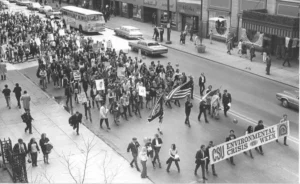
“I arrived at Kent State University as a first-year student in September 1970, on the day campus reopened after the shootings that previous May,” Okantah wrote, describing a campus still marked by unrest and protest.
He recalled being “a naive, wide-eyed, anxious 18-year-old” who was quickly “swept up into BUS,” the Black United Students organization that had already staged protests and demanded what would become Africana Studies, the Center of Pan-African Culture and increased hiring of Black faculty and staff.
“I was groomed by upper classmen who had participated in the 1968 ‘walk-out,’” he wrote, adding that he was “mesmerized and in absolute awe of the militant group spirit they exuded.”
By the late 1960s, members of Black United Students were pushing to expand Negro History Week into a full month on campus, building on earlier community-based monthlong efforts and Woodson’s original framework.
When two students approached university leaders to propose extending the programming throughout February, Okantah wrote they were acting as part of a broader national movement and guided by the same philosophy as Woodson.
“Those who have no record of what their forebears have accomplished lose the inspiration which comes from the teaching of biography and history,” he wrote.
Kent State’s decision in February 1970 is said to mark the first time an institution formally designated the entire month of February as a celebration of Black history, helping solidify a model that would later be adopted nationwide.
Black History Month nationally, federally recognized
In 1976, the federal government formally designated February as Black History Month under President Gerald Ford, cementing a tradition that had already taken shape years earlier at Kent State and in communities across the country.
Reflecting on the legacy of that moment, Okantah wrote that the lesson remains clear: “We must tell our own story.”